
 French
 German
 English
 Spanish
 Hindi
 Italian
 Japanese
 Korean
 Norwegian
 Chinese
Psyllium: Benefits, Dosage and Risks You Should Know
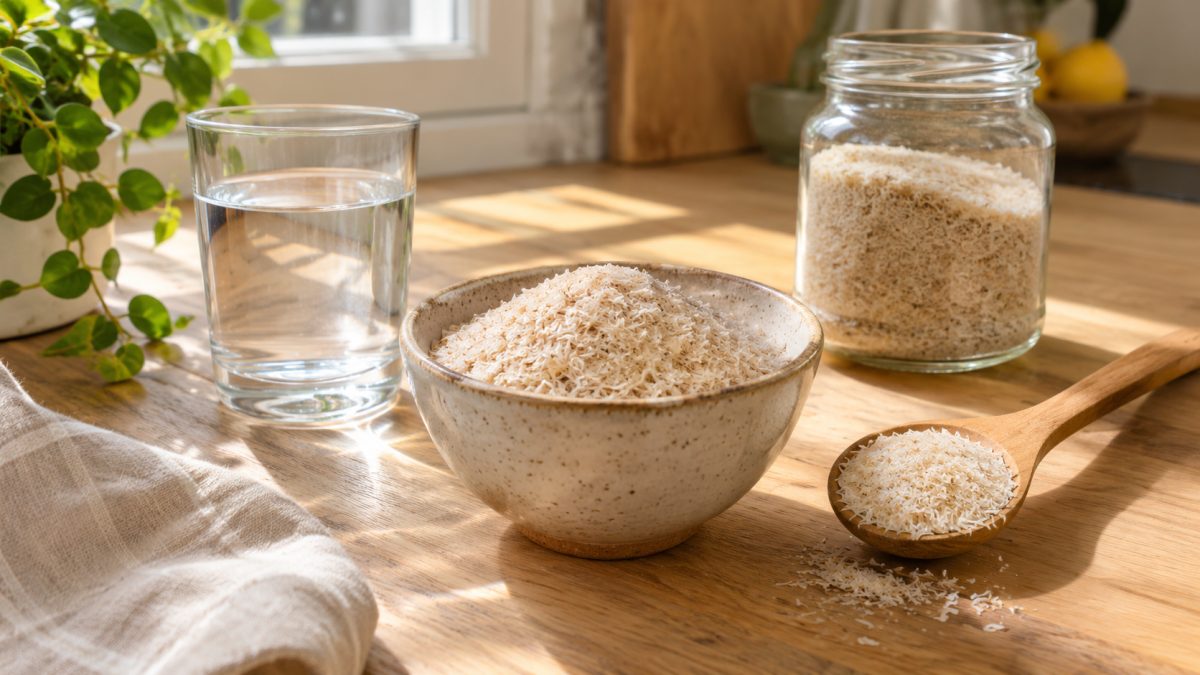
Psyllium is a plant-based fiber used to regulate bowel movements, with potential effects on cholesterol and satiety also discussed. Its benefits for constipation are supported by scientific research, but the available information does not establish a universal daily dose or an ideal time to take it. Its use should primarily account for hydration, contraindications, and medications taken at the same time.
Blond psyllium, also called ispaghula, has become a popular dietary supplement. Yet the evidence behind promises of a flat stomach, controlled cholesterol, or perfect digestion varies considerably. To decide whether it belongs in your routine, it is better to distinguish documented effects from marketing claims and understand the mistakes that can turn a simple fiber into a serious digestive problem.
How does psyllium actually work in the gut?
Psyllium comes from the plant Plantago ovata. It mainly contains soluble fibers called mucilages, along with insoluble fibers, particularly cellulose. Its distinctive feature is its ability to retain water and form a gel-like substance that expands when it comes into contact with liquids.
This property explains how it works as a bulk-forming laxative. Unlike a substance that directly stimulates the intestinal wall, it changes the properties of digestive contents without irritating the lining. This is also how Doctissimo describes psyllium in its herbal medicine overview.
There is an interesting paradox: the same fiber can be used for both constipation and diarrhea. In the first case, its behavior in water helps change stool consistency. In the second, its ability to retain fluids helps make stools firmer.
However, this physical action is also the main reason to follow precautions. A substance that swells inside the digestive tract should not be taken without considering the amount of available fluid and the condition of the digestive tract.
What daily dose of psyllium is actually effective?
This is probably the most important question for someone considering buying it. Commercial products readily emphasize the benefits of psyllium, but a general claim of effectiveness is not enough to determine how many grams to take each day.
The scientific information available in the sources reviewed does not support a reliable numerical comparison of doses used for bowel regularity, cholesterol, and satiety. Giving a precise amount and claiming it is validated for all these goals would therefore be misleading.
Why does the effective dose depend on your goal?
Improving stool consistency, changing a blood marker, and feeling fuller are not interchangeable outcomes. Ideally, each should be assessed using its own clinical trials, administered amounts, and measures of success.
A 2025 scoping review on dietary management of functional constipation, discussed by Ma Vitamine, ranks fiber supplementation, including psyllium, among the best-supported dietary approaches. This strengthens the case for this category of interventions without establishing one dose suitable for everyone.
Another systematic review of dietary interventions for chronic constipation highlights the heterogeneity of the trials. In other words, results observed in some participants cannot automatically be generalized to everyone with constipation.
Should you take it in the morning, afternoon, or evening?
No standardized time clearly emerges from the available references. It would therefore be an overstatement to describe morning or nighttime use as scientifically superior.
The key practical consideration is choosing a time when you can follow usage precautions, especially adequate hydration and appropriate spacing from medications. To determine an amount and schedule suited to your circumstances, seek advice from a healthcare professional rather than copying a social media routine.
Does psyllium really lower cholesterol?
The potential cardiovascular benefits of psyllium are not simply an advertising invention. In 1998, the US Food and Drug Administration recognized that certain heart-health claims could be made for psyllium.
However, this recognition needs careful interpretation. Authorization of a health claim does not mean that a supplement is a stand-alone treatment for high cholesterol or that all products on the market are equally effective.
In particular, the scientific information directly usable here lacks numerical findings that would establish the average size of the cholesterol reduction and link it to a specific daily amount.
The distinction is essential: a recognized effect is not necessarily a dramatic one. Before buying a supplement in the hope of changing blood test results, do not confuse potential benefits, effectiveness demonstrated under certain conditions, and a guaranteed result for every consumer.
Does psyllium help with weight loss or appetite control?
Psyllium is also promoted as a fiber that increases satiety. Médoucine lists this property among its potential benefits, alongside possible effects on blood sugar and prebiotic activity.
However, three ideas must be distinguished: feeling hungry less quickly, possibly eating differently, and actually losing weight. These are not equivalent outcomes.
The available information does not allow us to quantify weight loss attributable to psyllium or define a dose that would guarantee this effect. Presenting this supplement as a proven weight-loss product would therefore go beyond what can responsibly be claimed.
My main caution is simple: when a product is marketed for digestion, blood sugar, cholesterol, and body shape all at once, each promise should be examined separately. More advertised benefits do not, by themselves, mean more evidence.
Which medications can interact with psyllium?
Taking psyllium alongside medications is an important precaution. Médoucine advises against consuming this fiber close to the time of taking medication because of possible interactions.
However, the references used here do not provide a sufficiently documented list of the specific drugs concerned or a universally validated interval between doses.
It would therefore be unwise to invent a list of treatments or claim that a particular interval always eliminates the risk.
The safest approach is to show a pharmacist or doctor the ingredients of the product you are considering and a complete list of your regular medications. This check is particularly relevant for people taking several prescriptions every day.
Key point: the fact that psyllium comes from a plant does not guarantee an absence of interactions. A dietary supplement deserves as much care when added to a medication routine as any other regularly used product.
What are the real dangers of incorrect use?
The risks of psyllium are directly linked to how it works. Since it absorbs water and expands, the conditions in which it is swallowed matter just as much as the goal of improving bowel regularity.
Too little water: a potentially serious mistake
Inadequate hydration is one of the mistakes highlighted by Médoucine. The problem is not limited to disappointing results: if psyllium swells under unfavorable conditions, it can cause a blockage in the digestive tract.
The risk is particularly concerning when the digestive tract is already narrowed. The description natural fiber should therefore never be taken as a guarantee of safety.
Starting with too much: why it is not a good strategy
Another identified mistake is starting immediately with an excessive amount. Suddenly increasing intake to speed up results is not a sensible approach.
Digestive reactions vary between individuals, depending in part on their sensitivity and gut microbiome. Bloating or discomfort after taking psyllium should not automatically be interpreted as proof that it is working.
Who should avoid psyllium?
Contraindications listed by Dietetical include intestinal obstruction, swallowing difficulties, and certain types of acute abdominal pain.
These situations require particular care because swelling fiber can worsen an existing mechanical problem. Unexplained acute abdominal pain should not be self-treated with psyllium without medical advice.
How can you use psyllium without common mistakes?
Rather than offering a universal recipe in grams, here is a practical checklist to follow before use. It helps distinguish genuinely important precautions from arbitrary habits often presented as essential.
- Check the product: identify the exact form purchased, particularly powder or capsules, and read its instructions for use.
- Check contraindications: do not start if you have a known intestinal obstruction, difficulty swallowing, or acute abdominal pain without medical assessment.
- Allow for enough water: follow the hydration instructions supplied with the product, as the fibers swell when exposed to liquids.
- Avoid excessive starting amounts: do not begin with a large quantity in the hope of achieving faster results.
- Check medication schedules: ask a pharmacist how to time your doses if you take medicines.
- Monitor tolerance: pay attention to individual digestive reactions instead of trying to reach a supposedly ideal amount at all costs.
This approach does not replace medical dosing advice. It simply emphasizes that correct use depends on several factors, not just the number of spoonfuls added to a glass.
The right approach is not to seek the highest dose, but to choose a way of using psyllium that suits your digestive health, hydration, and medications.
Psyllium therefore has genuine value, particularly in dietary approaches to bowel regularity. But claims about cholesterol and satiety should be assessed without extrapolating beyond the available results. Its apparent simplicity does not remove the need for precautions or a critical view of marketing promises.
Frequently asked questions
How much psyllium should you take each day?
The scientific references used here do not establish a universal daily dose in grams. The appropriate amount depends on factors including your goal, the product form, and individual tolerance. It is best to follow the product instructions and seek advice from a healthcare professional.
Can you take psyllium at the same time as medications?
Taking psyllium close to medication doses is discouraged because of possible interactions. However, the available information does not identify every affected medication or establish an interval that applies in all situations. A pharmacist can help you plan dosing times.
Can psyllium cause an intestinal obstruction?
Yes. There is a risk of blockage, particularly when fluid intake is inadequate or the digestive tract is narrowed. Psyllium is contraindicated in intestinal obstruction and requires precautions in people with swallowing problems or acute abdominal pain.
Does psyllium really help you lose weight and lower cholesterol?
Psyllium has long-standing recognition for certain heart-health claims and is promoted as helping with satiety. However, the scientific information available here does not quantify weight loss or the average reduction in cholesterol. It should not be regarded as a miracle solution.
Sources
- Psyllium: benefits, reviews, dosage, risks, and uses ... (mesbienfaits.com)
- Psyllium: effects, uses, and precautions – Doctissimo (doctissimo.fr)
- Psyllium: its benefits and mistakes to avoid (medoucine.com)
- Psyllium: contraindications, risks, and precautions – Dietetical (dietetical.fr)
- Psyllium: benefits, risks, and dosage (complete guide) (mavitamine.fr)