 English
  French
  German
  Spanish
  Hindi
Hindi  Italian
  Japanese
  Korean
  Norwegian
  Chinese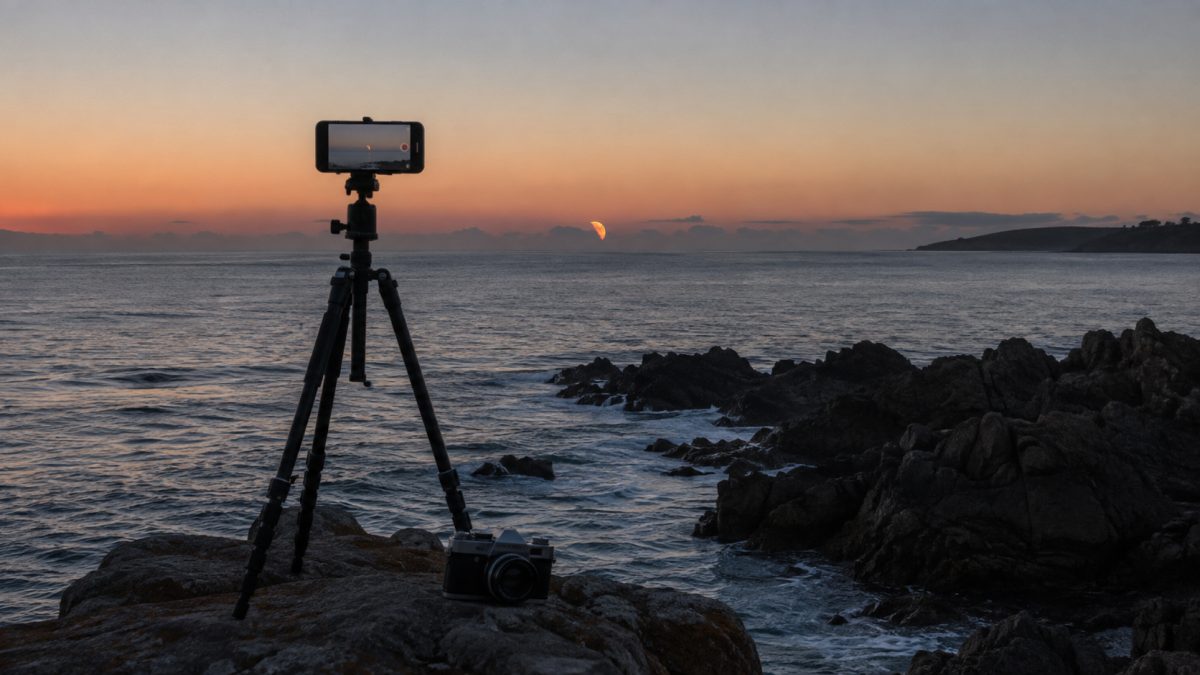
Lunar eclipse August 28, 2026: times and photo guide for France
The lunar eclipse of August 28, 2026 will be clearly visible from part of mainland France, but one important point needs correcting: it is not a total eclipse. It is a very deep partial lunar eclipse, with maximum eclipse around 6:12 to 6:14 a.m. Paris time. Depending on the source, between 93% and 96% of the lunar disk will then be covered.
To make the most of the lunar eclipse of August 28, 2026, knowing the time will not be enough: the Moon will already be very low on the western horizon, almost at moonset. In other words, a few minutes of difference between Brest and Strasbourg may matter more than a long list of theoretical times. A perfectly unobstructed western horizon will be decisive.
Timeline for the night of August 27 to 28
The full event, including the penumbral phase, runs from 3:23 a.m. to 9:01 a.m.. The partial phase begins at 4:33 a.m. and lasts a total of 3 h 18 min 7 s. Its magnitude is 0.9299. In mainland France, however, the theoretical end of the eclipse matters less than the local moonset time: part of the event will take place after our satellite has already dropped below the horizon.
From 3:23 to 4:33 a.m.: the penumbra begins
The first phase begins at 3:23 a.m. This is the astronomical start of the eclipse, but the truly useful time for an observer who wants to see a clear change in the lunar disk comes at 4:33 a.m., when the partial phase begins.
From 4:33 a.m. to about 6:12 a.m.: the most interesting part builds
From 4:33 a.m., the Moon enters the partial phase. Sources place the maximum between 6:10 and 6:14 a.m., with a practical consensus around 6:12 a.m.. You should therefore be in position before then, especially in eastern France where the margin after maximum will be short.
After 6:12 a.m.: the west keeps the advantage
In Strasbourg, the Moon sets at around 6:46 a.m.. In Brest, it remains visible until about 7:37 a.m.. This difference illustrates the geographical inequality of this eclipse. At moonset, the residual occultation can range from around 20% in the east to nearly 79% in the west.
The most useful advice: do not choose your viewing point for the darkest sky first; choose it for a low, completely unobstructed western horizon.
What time should you aim for in each region?
The available data do not honestly allow a minute-by-minute schedule for every major French city. They do, however, provide three solid reference points: maximum eclipse around 6:12 a.m., moonset in Brest at 7:37 a.m. and in Strasbourg at 6:46 a.m. That is enough to build a regional observing plan without inventing false local timings.
- Brittany: this is the best-placed area. Brest is the most favorable reference provided, with the Moon still present until about 7:37 a.m.
- Pays de la Loire: also favored, in the same broad western sector where the Moon sets later.
- Nouvelle-Aquitaine and the southwest: favorable geometry, with more useful time after maximum than in the east.
- Eastern France: the eclipse remains observable, but the window closes quickly after maximum. Strasbourg keeps the Moon above the horizon only until about 6:46 a.m.
Belgium and Switzerland will experience conditions close to those in eastern France. For Paris, the sources place maximum in the same 6:10 to 6:14 a.m. window, without giving a sufficiently precise moonset time here to build a finer schedule.
How does this eclipse compare with the previous ones?
Comparison with the previous three eclipses must remain cautious because not all data are available at the same level of detail. One thing is certain: the eclipse of March 3, 2026 was total but not visible from mainland France. The eclipse of March 14, 2025 was total and visible in France, with totality from 6:56 to 8:02 a.m., or 66 minutes. September 7, 2025 also appears in the available chronology, but without comparable duration or weather data.
| Date | Type / visibility | Documented duration | Documented weather |
|---|---|---|---|
| March 14, 2025 | Total, visible in France | Totality from 6:56 to 8:02 a.m. | No comparable data available |
| September 7, 2025 | Date listed | No comparable duration available | No comparable data available |
| March 3, 2026 | Total, not visible from mainland France | No comparable duration available here | Not applicable to mainland observation |
| August 28, 2026 | Partial, visible in France | 3 h 18 min 7 s in the partial phase; about 5 h 36 min including penumbra | No quantified regional forecast available here |
The distinctive feature of August 28, 2026 is therefore less its raw duration than its visibility cut short by moonset. On paper, the complete event lasts around 5 h 36 min. In France, moonset will reduce the observable duration.
Smartphone or film: which time slots should you choose?
Film photography has regained a real place among young adults. In 2025, 35% of the world’s 42 million active film-camera users were aged 18 to 30. A 2024 Ilford Photo survey also indicated that more than 30% of respondents shooting film were aged 25 to 34. Online searches around the practice rose by 41%, and PetaPixel even described 2024 as its best year in decades.
For this eclipse, the choice of equipment mainly changes how you approach the moment. The available sources do not provide reliable numerical settings for ISO, shutter speed or film stock; it is better to say so than to invent a universal recipe. You can, however, choose your time slots according to the kind of image you want.
| Time slot | Smartphone | Film |
|---|---|---|
| Before 4:33 a.m. | Mainly useful for preparing the framing and testing the horizon | A good time to frame without unnecessarily using several exposures |
| 4:33 to 6:00 a.m. | Comfortable window for trying multiple shots | An interesting window for selecting a few spaced-out exposures |
| Around 6:12 a.m. | Priority window for aiming at maximum eclipse | Priority window if you want to devote one frame to maximum eclipse |
| After 6:12 a.m. | Very interesting in the west, but increasingly short toward the east | Best reserved for regions where the Moon remains above the horizon long enough |
A smartphone encourages immediate experimentation: you can take many shots and check the framing. Film, by contrast, imposes a stricter selection of moments. That constraint can become a creative advantage: each shutter release corresponds to a deliberately chosen stage.
What about the weather on August 28?
With only the verified data available here, it is too early to say which regions will lose the show to clouds. No reliable quantified regional forecast for August 28 is available in the information consulted. The astronomical advantage of Brittany, Pays de la Loire or Nouvelle-Aquitaine should therefore not be turned into a promise of clear skies.
The right strategy is to separate two questions: where will the Moon remain visible longest? On that point, the west clearly wins. Where will the sky be clear? That answer will need to be checked with a weather forecast close enough to the event.
The simple plan to remember
- Prepare your location before 4:33 a.m..
- Choose an unobstructed western horizon first.
- Aim for the period around 6:12 a.m. for maximum eclipse.
- In the east, do not wait: the Moon sets in Strasbourg around 6:46 a.m..
- In the west, the margin is much better: Brest keeps the Moon until about 7:37 a.m..
- No special eye protection is needed to observe this lunar eclipse.
This eclipse is therefore not the grand “total” spectacle that some headlines might suggest, but it remains exceptional for its depth: around 93% to 96% of the lunar disk will be covered at maximum. The best memory will probably not belong to the person with the most expensive equipment, but to the person who chose the right horizon, the right moment and prepared the framing before the Moon disappeared.