
Loading...
By continuing to browse this site, you agree to the use of cookies that ensure its proper functioning.
enEnglish
frFrench
esSpanish
zhChinese
jaJapanese
koKorean
hiHindi
deGerman
noNorwegian
Recherche article
Me connecter
Fleche top bulle Fleche top bulle
DE EN ES FR HI JA KO NO ZH
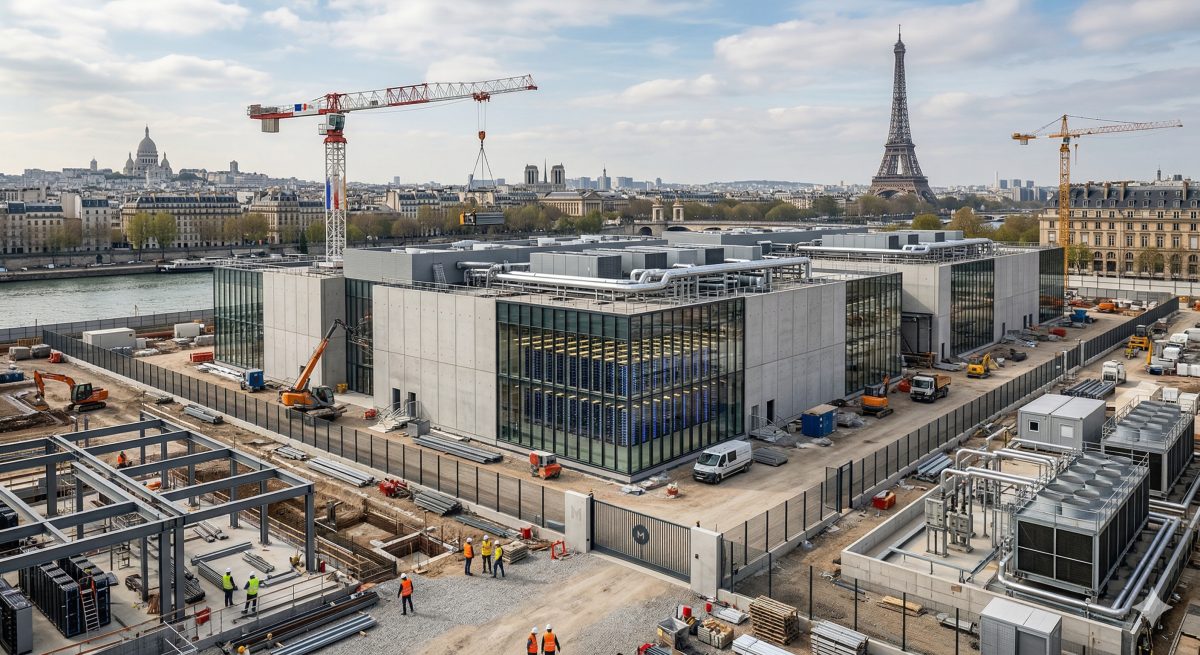
Rows of servers illuminated in blue inside a modern data center symbolizing the computing power needed for artificial intelligence

Mistral AI Raises $830M for a Sovereign Data Center in Paris

Publié le 07 Avril 2026

The French startup Mistral AI has just made a major move in the global race for artificial intelligence. On March 30, 2026, the company announced it had raised $830 million in debt from a consortium of seven banks to finance the construction of its first proprietary data center, located in Bruyères-le-Châtel, south of Paris. A powerful signal for European digital sovereignty.

An unprecedented bank financing for a European AI startup

Unlike classic venture capital fundraising, Mistral opted for debt financing, a first for the startup founded in 2023 by former researchers from Meta and Google DeepMind. The banking consortium brings together major financial heavyweights: BNP Paribas, Crédit Agricole CIB, HSBC, La Banque Postale, MUFG, Natixis CIB, and the public investment bank Bpifrance.

This financial structure reflects Mistral's growing maturity. The company has already raised nearly $2.9 billion since its founding, according to the Dealroom platform. But these figures remain modest compared to the tens of billions captured by American giants like OpenAI or Anthropic, making the company's ability to diversify its financing sources all the more strategic.

13,800 Nvidia GB300 chips: a colossal computing power

The Bruyères-le-Châtel data center will be equipped with 13,800 Nvidia GB300 graphics processors, the latest generation of chips designed for AI training and inference. This infrastructure will represent a total capacity of 44 megawatts, a considerable volume that will allow Mistral to:

  • Train its own language models without depending on third-party cloud infrastructure like AWS or Azure
  • Offer inference services to its enterprise clients with data sovereignty guarantees
  • Accelerate the development of its next model generations, in a market where computing power has become the key battleground

The facility is scheduled to go live in the second quarter of 2026, making it one of the fastest AI infrastructure projects ever deployed in Europe.

Digital sovereignty: a strategic challenge for Europe

Beyond technical performance, this project carries a major geopolitical dimension. Today, almost all computing power used for AI is hosted in the United States, primarily in the data centers of Google, Microsoft, and Amazon. This dependency raises crucial questions about data protection, national security, and industrial competitiveness.

By building its own data center on French soil, Mistral offers a credible alternative to European companies and administrations that want to use AI without their data transiting through American servers subject to the Cloud Act. This is a powerful argument in a context where the European Commission is actively pushing for greater technological autonomy for the continent.

A European ambition that goes beyond France

The Paris data center is just a first step. Mistral announced in February 2026 a $1.4 billion investment in Sweden to build additional AI infrastructure there. The stated objective is ambitious: achieve 200 megawatts of computing capacity distributed across Europe by end of 2027.

This multi-site deployment strategy responds to several logics. First, the geographical diversification of risks. Then, proximity to European clients to reduce inference service latency. Finally, access to abundant clean energy – a criterion that has become central to data center location decisions, with Sweden offering largely decarbonized electricity thanks to hydroelectric and nuclear power.

The energy challenge: AI's Achilles heel

With 44 megawatts just for the Bruyères-le-Châtel site, the question of energy consumption is unavoidable. Globally, data centers dedicated to AI are expected to represent more than 4% of global electricity consumption by 2028, according to the International Energy Agency. In Europe, where electricity costs are significantly higher than in the United States, this economic equation is particularly challenging.

Mistral will therefore have to balance computing performance and energy efficiency – a balance that the Nvidia GB300 chips promise to improve thanks to a more economical architecture than previous generations. But the real challenge remains political: Europe must massively invest in its power grids and production capacity to avoid seeing its AI ambitions hampered by a simple lack of power.

Mistral vs. the giants: David against Goliath?

Despite this impressive fundraising, perspective must be kept. OpenAI raised more than $13 billion from Microsoft alone, and the GAFAM collectively invest more than $200 billion per year in AI. Mistral therefore plays in a different weight category.

But the French startup has specific strengths. Its open and semi-open models have won a large developer community. Its positioning on sovereignty responds to a real demand from European companies. And its ability to attract top talent, in an increasingly dynamic Parisian ecosystem, allows it to maintain a sustained innovation pace despite fewer resources.

Mistral's bet is clear: you don't need to be the biggest to be the best. By focusing on efficiency, sovereignty, and proximity to the European market, the startup hopes to carve out its place in a sector where size isn't everything, but where infrastructure has become the cornerstone of credibility.

What to remember

Mistral AI's announcement marks a turning point for the European AI ecosystem. With $830 million mobilized for a sovereign data center, France is positioning itself as a serious player in the global race for artificial intelligence. The question remains whether this momentum will be enough to bridge the technological and financial gap that still separates Europe from the United States. One thing is certain: the AI battle is no longer fought solely in research laboratories, but also in server rooms and bank boardrooms.

Tags
Mistral AI
Paris data center
AI funding
digital sovereignty
Nvidia GB300
artificial intelligence France
Envoyer à un ami
Signaler cet article
A propos de l'auteur
Rows of servers illuminated in blue inside a modern data center symbolizing the computing power needed for artificial intelligence

Mistral AI Raises $830M for a Sovereign Data Center in Paris

Publié le 07 Avril 2026

The French startup Mistral AI has just made a major move in the global race for artificial intelligence. On March 30, 2026, the company announced it had raised $830 million in debt from a consortium of seven banks to finance the construction of its first proprietary data center, located in Bruyères-le-Châtel, south of Paris. A powerful signal for European digital sovereignty.

An unprecedented bank financing for a European AI startup

Unlike classic venture capital fundraising, Mistral opted for debt financing, a first for the startup founded in 2023 by former researchers from Meta and Google DeepMind. The banking consortium brings together major financial heavyweights: BNP Paribas, Crédit Agricole CIB, HSBC, La Banque Postale, MUFG, Natixis CIB, and the public investment bank Bpifrance.

This financial structure reflects Mistral's growing maturity. The company has already raised nearly $2.9 billion since its founding, according to the Dealroom platform. But these figures remain modest compared to the tens of billions captured by American giants like OpenAI or Anthropic, making the company's ability to diversify its financing sources all the more strategic.

13,800 Nvidia GB300 chips: a colossal computing power

The Bruyères-le-Châtel data center will be equipped with 13,800 Nvidia GB300 graphics processors, the latest generation of chips designed for AI training and inference. This infrastructure will represent a total capacity of 44 megawatts, a considerable volume that will allow Mistral to:

  • Train its own language models without depending on third-party cloud infrastructure like AWS or Azure
  • Offer inference services to its enterprise clients with data sovereignty guarantees
  • Accelerate the development of its next model generations, in a market where computing power has become the key battleground

The facility is scheduled to go live in the second quarter of 2026, making it one of the fastest AI infrastructure projects ever deployed in Europe.

Digital sovereignty: a strategic challenge for Europe

Beyond technical performance, this project carries a major geopolitical dimension. Today, almost all computing power used for AI is hosted in the United States, primarily in the data centers of Google, Microsoft, and Amazon. This dependency raises crucial questions about data protection, national security, and industrial competitiveness.

By building its own data center on French soil, Mistral offers a credible alternative to European companies and administrations that want to use AI without their data transiting through American servers subject to the Cloud Act. This is a powerful argument in a context where the European Commission is actively pushing for greater technological autonomy for the continent.

A European ambition that goes beyond France

The Paris data center is just a first step. Mistral announced in February 2026 a $1.4 billion investment in Sweden to build additional AI infrastructure there. The stated objective is ambitious: achieve 200 megawatts of computing capacity distributed across Europe by end of 2027.

This multi-site deployment strategy responds to several logics. First, the geographical diversification of risks. Then, proximity to European clients to reduce inference service latency. Finally, access to abundant clean energy – a criterion that has become central to data center location decisions, with Sweden offering largely decarbonized electricity thanks to hydroelectric and nuclear power.

The energy challenge: AI's Achilles heel

With 44 megawatts just for the Bruyères-le-Châtel site, the question of energy consumption is unavoidable. Globally, data centers dedicated to AI are expected to represent more than 4% of global electricity consumption by 2028, according to the International Energy Agency. In Europe, where electricity costs are significantly higher than in the United States, this economic equation is particularly challenging.

Mistral will therefore have to balance computing performance and energy efficiency – a balance that the Nvidia GB300 chips promise to improve thanks to a more economical architecture than previous generations. But the real challenge remains political: Europe must massively invest in its power grids and production capacity to avoid seeing its AI ambitions hampered by a simple lack of power.

Mistral vs. the giants: David against Goliath?

Despite this impressive fundraising, perspective must be kept. OpenAI raised more than $13 billion from Microsoft alone, and the GAFAM collectively invest more than $200 billion per year in AI. Mistral therefore plays in a different weight category.

But the French startup has specific strengths. Its open and semi-open models have won a large developer community. Its positioning on sovereignty responds to a real demand from European companies. And its ability to attract top talent, in an increasingly dynamic Parisian ecosystem, allows it to maintain a sustained innovation pace despite fewer resources.

Mistral's bet is clear: you don't need to be the biggest to be the best. By focusing on efficiency, sovereignty, and proximity to the European market, the startup hopes to carve out its place in a sector where size isn't everything, but where infrastructure has become the cornerstone of credibility.

What to remember

Mistral AI's announcement marks a turning point for the European AI ecosystem. With $830 million mobilized for a sovereign data center, France is positioning itself as a serious player in the global race for artificial intelligence. The question remains whether this momentum will be enough to bridge the technological and financial gap that still separates Europe from the United States. One thing is certain: the AI battle is no longer fought solely in research laboratories, but also in server rooms and bank boardrooms.

Tags
Mistral AI
Paris data center
AI funding
digital sovereignty
Nvidia GB300
artificial intelligence France
Envoyer à un ami
Signaler cet article
A propos de l'auteur
Rows of servers illuminated in blue inside a modern data center symbolizing the computing power needed for artificial intelligence

Mistral AI Raises $830M for a Sovereign Data Center in Paris

Publié le 07 Avril 2026

The French startup Mistral AI has just made a major move in the global race for artificial intelligence. On March 30, 2026, the company announced it had raised $830 million in debt from a consortium of seven banks to finance the construction of its first proprietary data center, located in Bruyères-le-Châtel, south of Paris. A powerful signal for European digital sovereignty.

An unprecedented bank financing for a European AI startup

Unlike classic venture capital fundraising, Mistral opted for debt financing, a first for the startup founded in 2023 by former researchers from Meta and Google DeepMind. The banking consortium brings together major financial heavyweights: BNP Paribas, Crédit Agricole CIB, HSBC, La Banque Postale, MUFG, Natixis CIB, and the public investment bank Bpifrance.

This financial structure reflects Mistral's growing maturity. The company has already raised nearly $2.9 billion since its founding, according to the Dealroom platform. But these figures remain modest compared to the tens of billions captured by American giants like OpenAI or Anthropic, making the company's ability to diversify its financing sources all the more strategic.

13,800 Nvidia GB300 chips: a colossal computing power

The Bruyères-le-Châtel data center will be equipped with 13,800 Nvidia GB300 graphics processors, the latest generation of chips designed for AI training and inference. This infrastructure will represent a total capacity of 44 megawatts, a considerable volume that will allow Mistral to:

  • Train its own language models without depending on third-party cloud infrastructure like AWS or Azure
  • Offer inference services to its enterprise clients with data sovereignty guarantees
  • Accelerate the development of its next model generations, in a market where computing power has become the key battleground

The facility is scheduled to go live in the second quarter of 2026, making it one of the fastest AI infrastructure projects ever deployed in Europe.

Digital sovereignty: a strategic challenge for Europe

Beyond technical performance, this project carries a major geopolitical dimension. Today, almost all computing power used for AI is hosted in the United States, primarily in the data centers of Google, Microsoft, and Amazon. This dependency raises crucial questions about data protection, national security, and industrial competitiveness.

By building its own data center on French soil, Mistral offers a credible alternative to European companies and administrations that want to use AI without their data transiting through American servers subject to the Cloud Act. This is a powerful argument in a context where the European Commission is actively pushing for greater technological autonomy for the continent.

A European ambition that goes beyond France

The Paris data center is just a first step. Mistral announced in February 2026 a $1.4 billion investment in Sweden to build additional AI infrastructure there. The stated objective is ambitious: achieve 200 megawatts of computing capacity distributed across Europe by end of 2027.

This multi-site deployment strategy responds to several logics. First, the geographical diversification of risks. Then, proximity to European clients to reduce inference service latency. Finally, access to abundant clean energy – a criterion that has become central to data center location decisions, with Sweden offering largely decarbonized electricity thanks to hydroelectric and nuclear power.

The energy challenge: AI's Achilles heel

With 44 megawatts just for the Bruyères-le-Châtel site, the question of energy consumption is unavoidable. Globally, data centers dedicated to AI are expected to represent more than 4% of global electricity consumption by 2028, according to the International Energy Agency. In Europe, where electricity costs are significantly higher than in the United States, this economic equation is particularly challenging.

Mistral will therefore have to balance computing performance and energy efficiency – a balance that the Nvidia GB300 chips promise to improve thanks to a more economical architecture than previous generations. But the real challenge remains political: Europe must massively invest in its power grids and production capacity to avoid seeing its AI ambitions hampered by a simple lack of power.

Mistral vs. the giants: David against Goliath?

Despite this impressive fundraising, perspective must be kept. OpenAI raised more than $13 billion from Microsoft alone, and the GAFAM collectively invest more than $200 billion per year in AI. Mistral therefore plays in a different weight category.

But the French startup has specific strengths. Its open and semi-open models have won a large developer community. Its positioning on sovereignty responds to a real demand from European companies. And its ability to attract top talent, in an increasingly dynamic Parisian ecosystem, allows it to maintain a sustained innovation pace despite fewer resources.

Mistral's bet is clear: you don't need to be the biggest to be the best. By focusing on efficiency, sovereignty, and proximity to the European market, the startup hopes to carve out its place in a sector where size isn't everything, but where infrastructure has become the cornerstone of credibility.

What to remember

Mistral AI's announcement marks a turning point for the European AI ecosystem. With $830 million mobilized for a sovereign data center, France is positioning itself as a serious player in the global race for artificial intelligence. The question remains whether this momentum will be enough to bridge the technological and financial gap that still separates Europe from the United States. One thing is certain: the AI battle is no longer fought solely in research laboratories, but also in server rooms and bank boardrooms.

Tags
Mistral AI
Paris data center
AI funding
digital sovereignty
Nvidia GB300
artificial intelligence France
Envoyer à un ami
Signaler cet article
A propos de l'auteur
07 April 2026 14:26:08

Mistral AI筹资8.3亿美元在巴黎建造主权数据中心

法国初创公司 Mistral AI 刚刚在全球人工智能竞赛中打出了一张大牌。2026年3月30日,该公司宣布从七家银行组成的财团筹集了 8.3亿美元债务融资,用于在巴黎以南的 Bruyères-le-Châtel...
Read more
07 April 2026 14:26:19

Mistral AI henter 830 mill. dollar til suverent datasenter i Paris

Den franske oppstartsbedriften Mistral AI har nettopp slått et stort slag i den globale konkurransen om kunstig intelligens. Den 30. mars 2026 kunngjorde selskapet at det hadde skaffet seg 830 millioner dollar i gjeld fra et konsortium av syv banker for å finansiere byggingen av sitt første egne...
Read more