 English
  French
  German
  Spanish
  Hindi
Hindi  Italian
  Japanese
  Korean
  Norwegian
  Chinese
Orionids 2026: when and how to see the peak in France
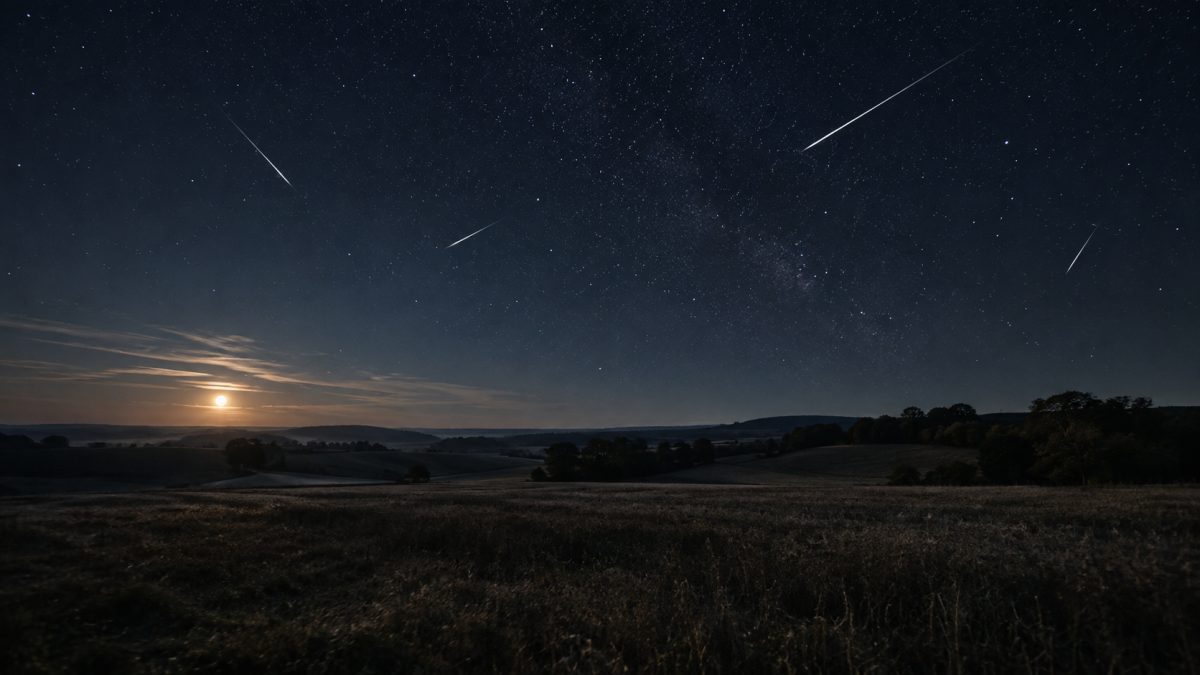
The 2026 Orionids will peak on the night of October 21 to 22, with a precise time announced at 8:27 p.m. CEST on October 21. On paper, the theoretical maximum is about 20 meteors per hour. In practice, this figure does not correspond to what one person will actually see: the Moon will be gibbous and about 76 to 79% illuminated, washing out some of the fainter meteors.
To observe the 2026 Orionids in France, the right approach is therefore not to go outside at exactly 8:27 p.m. expecting to count twenty shooting stars in an hour. The shower becomes especially interesting after midnight when looking east, toward Orion. In Paris, the Moon is forecast to set at 2:30 a.m. that night: this is a concrete reference point for understanding why the second half of the night may be more favorable for detecting faint meteors, even though no number of meteors is guaranteed.
What time should you observe the 2026 Orionids peak?
Two pieces of information need to be distinguished. First, the astronomical maximum is given for October 21, 2026 at 8:27 p.m. CEST. Second, observation recommendations suggest looking after midnight, facing east, where the radiant lies in the constellation Orion.
These two indications do not contradict each other. The calculated maximum describes the moment when the shower's activity is strongest. But actual visibility also depends on the position of the radiant and moonlight. For an observer in France, I would therefore keep two practical windows in mind: the evening of October 21 so as not to miss the period around the peak, and especially the hours after midnight. In Paris, moonset at 2:30 a.m. provides a third useful marker: after that time, its brightness no longer directly affects the sky.
However, caution is needed with this Paris time. The lunar times given here are for Paris; they should not be copied unchanged for every region of France. The important idea is to check the local moonset time and, if possible, favor the part of the night when the Moon brightens the sky the least.
How many meteors can you really see?
The number most often quoted for the Orionids is 20 meteors per hour. This is a ZHR, or zenithal hourly rate, calculated for ideal conditions: a perfect sky, the radiant at the zenith and a limiting magnitude of 6.5. It is not a personal counter.
A practical rule sometimes cited for meteor showers is to divide the ZHR by two or three to get closer to real-world conditions. It cannot guarantee a result, especially in 2026 because the Moon will still be strongly illuminated. To illustrate the gap between theory and reality, the Perseids are a useful example: with a ZHR of around 100, the IMO instead reports 30 to 50 meteors per hour from rural sites.
For the Orionids, it would therefore be misleading to announce a precise number of visible meteors per hour in Paris, Lyon, Marseille, Bordeaux or elsewhere. No verified figure allows the ZHR to be cleanly converted here into a city-by-city result. What can be said is that the theoretical ceiling is 20 per hour, and that the combination of a 76–79% illuminated Moon, light pollution, possible clouds and the radiant's altitude will reduce the number actually seen.
City, suburbs or countryside: what really changes
The most useful regional difference is not an arbitrary ranking of regions, but the quality of the sky at the exact observing site. There is no reliable rate such as “8/h in Île-de-France” or “14/h in the Landes.” Presenting such figures would suggest a level of precision that is not supported.
- In a large urban area: light pollution adds to the strong moonlight at the peak. You should therefore expect to lose the faintest meteors.
- In the suburbs: moving away from direct lighting improves the chances of seeing dimmer trails, but the actual rate still cannot be guaranteed.
- In a dark rural area: conditions are closer to those sought for observing a meteor shower, without turning a ZHR of 20 into twenty meteors actually visible.
In other words, the administrative region matters less than the observing site itself. For the 2026 edition, the factor common to all of France remains the gibbous Moon, bright enough for several sources to describe the conditions as average.
How do the Orionids compare with the other showers of 2026?
The Orionids are not the year's most spectacular shower in terms of quantity. Much of their appeal lies in their origin: they come from debris left by Halley's Comet, whose particles enter the atmosphere at more than 66 km/s. Halley itself will not return to perihelion until July 28, 2061.
To place the Orionids in the 2026 calendar, here are the announced theoretical maxima for several major showers:
- Quadrantids, January 3: about 120/h.
- Lyrids, April 22: about 18/h.
- Eta Aquariids, May 5: about 50/h.
- Perseids, August 12: about 100/h.
- Draconids, October 8: about 10/h.
- Orionids, October 21–22: about 20/h.
- Leonids, November 17: about 15/h.
- Geminids, December 14: about 150/h.
The comparison is fairly clear: in theoretical rate, the Orionids exceed the Draconids, the Leonids and slightly the Lyrids, but remain far behind the Perseids, the Quadrantids and especially the Geminids. The Geminids are also forecast to be the most intense shower of 2026, with a maximum occurring under an almost moonless sky, placing them in much more favorable circumstances than October's Orionids.
This is exactly why the raw figure of 20/h needs to be put in perspective. A less intense shower observed under a dark, moonless sky can be more impressive than a theoretically more active shower under a bright sky. In October 2026, the Orionids combine a modest rate with an intrusive Moon: the show may be enjoyable, but this is not the year to expect an avalanche of meteors.
The most useful guide for the night of October 21 to 22
- Keep October 21 at 8:27 p.m. CEST as the announced maximum time, without treating it as a magic moment.
- Prefer observing after midnight, looking east toward the Orion area.
- In Paris, keep the 2:30 a.m. moonset in mind as a reference point for the second half of the night; elsewhere, check the local time.
- Move as far away as possible from direct lights, because the already bright Moon itself reduces sky contrast.
- Do not interpret the ZHR of 20/h as twenty guaranteed meteors. Real conditions can greatly reduce that total.
The best way to approach the 2026 Orionids is to treat the figures as points of comparison, not as a promise of yield.
In my view, that is what makes this night interesting despite only average conditions: it offers a chance to observe a shower linked to Halley without requiring exceptional skies. If the main goal is to see as many shooting stars as possible in 2026, the figures favor the major showers such as the Perseids, the Quadrantids and especially the Geminids. If the goal is to enjoy an October night with a precise time reference and a strong astronomical story, the Orionids remain well worth watching.