 English
  French
  German
  Spanish
  Hindi
Hindi  Italian
  Japanese
  Korean
  Norwegian
  Chinese
Pope Leo XIV's visit to France: who really pays?
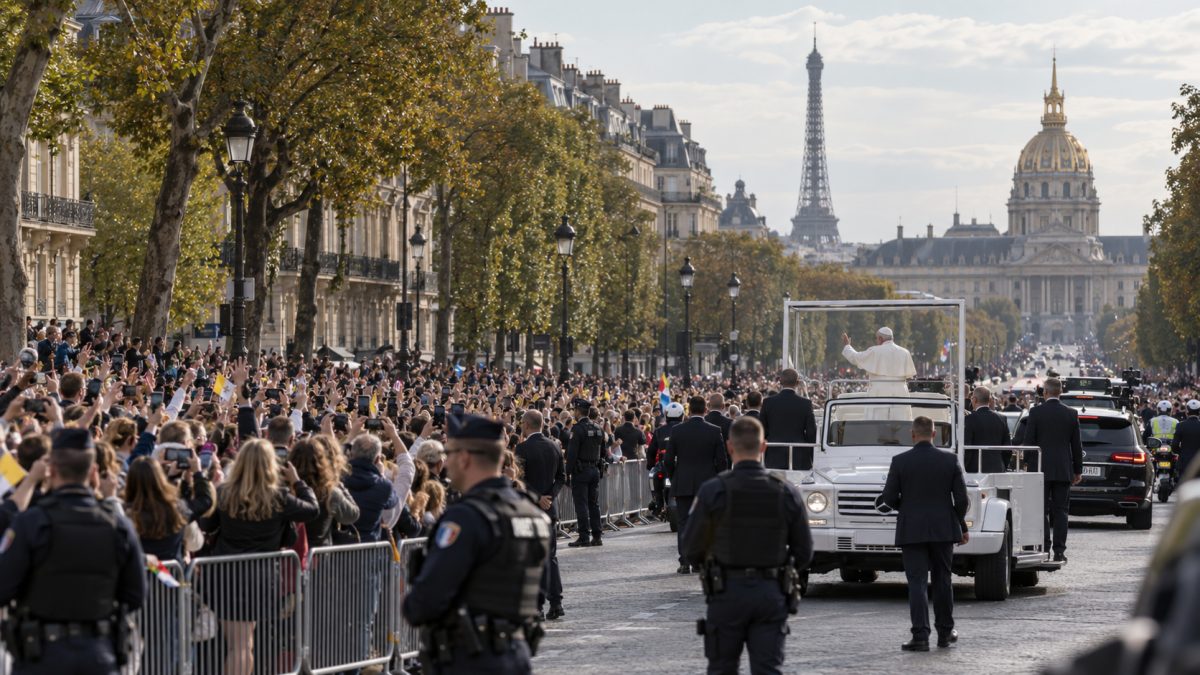
The Pope Leo XIV's visit to France, from September 25 to 28, 2026, can easily be seen as a religious and media event. But it can also be viewed as an extraordinary logistical operation: four days, several cities, huge crowds, transport, temporary facilities and a security operation mobilizing thousands of people. The figure that immediately draws attention is €27 million for the organization funded by the Church.
To understand the real impact of Pope Leo XIV's visit to France, however, a shortcut must be avoided: those €27 million do not necessarily represent the full cost to the public. Worship-related and logistical expenses are borne by the Church, while the state covers public security. Yet no precise overall figure is available for that security. The event's full economic cost therefore cannot be summed up by a single number.
€27 million: what does this budget actually cover?
The trip is financed by the French Bishops' Conference and by donations. The appeal launched for the event had already raised €9 million. Expenses related to worship and reception are the Church's responsibility: altars, ceremonies, staging, seating, logistics and private security in particular.
Some items give a very concrete idea of the scale of the organization. A single giant screen for the public costs €50,000, and several dozen are being installed. Added to this is a geographically dispersed schedule: Leo XIV is due to fly four times and travel 3,857 kilometers in seven hours of flight. Media coverage itself is on another scale, with 2,500 accredited journalists.
The key point is therefore the separation of the budgets. The announced €27 million corresponds to Church funding for the visit. For its part, the state fully funds the security provided by public forces. Properly adding the two would require knowing the cost of this public mobilization, a figure that has not been precisely quantified.
Security: a definite public cost, but impossible to total
The announced security operation mobilizes 23,000 police officers, gendarmes, military personnel and firefighters. The figures released notably mention 17,500 personnel in Paris, 3,000 in Lourdes and 4,000 in Metz. They show the scale of the effort, but do not allow this mobilization to be honestly converted into a bill.
Among other things, the exact duration of assignments, reinforcements, overtime and associated equipment would need to be known. These data are not published as a detailed cost by city. Claiming that the visit “costs France €27 million” would therefore be misleading: that amount corresponds to the budget financed by the Church, while public security spending exists separately with no precise total available.
In Paris, the logistical impact also goes beyond the mere presence of law enforcement. Metro stations close during the popemobile route. In other words, the event also creates real traffic and urban-organization constraints, even when they are not converted into euros.
Paris, Saint-Denis, Lourdes and Metz: what economic benefits?
This is where the figures become much less solid. An official statement refers to significant economic benefits and an opportunity to showcase France. However, no precise amount of additional revenue for Paris, Lourdes, Metz or Saint-Denis has been established. It is therefore not possible to seriously announce a net gain for the host cities.
Attendance levels nevertheless provide a measure of the potential activity surrounding the event. In Paris, 1.5 million people are expected in the streets for the popemobile procession and 600,000 for Mass at Place de la Concorde. The Stade de France is expected to host 80,000 people and Notre-Dame vespers 7,000 participants.
These figures should not simply be added together to produce a total of unique visitors: the same person may attend several events. This is all the more important because another estimate mentions 700,000 participants for the visit as a whole. The two sets of figures clearly do not measure attendance in the same way.
For the territories concerned, the reasonable economic conclusion is therefore more modest: large concentrations of people generate local activity, but without data on overnight stays, food services, transport or visitor spending, a territorial return on investment cannot be calculated. That is precisely the limitation to keep in mind when the phrase “economic benefits” is used.
A budget incomparable with recent previous visits
Historical comparison, however, makes the change in scale very clear. In 2008, Benedict XVI's visit to Paris and Lourdes, also lasting four days, had cost €3.5 million for the Church. The €27 million budget announced for 2026 is therefore about 7.7 times higher.
Pope Francis's visit to Marseille in 2023 represented approximately €2.3 million to €2.5 million according to available estimates, for 200,000 faithful. The visit to Corsica in 2024 was valued at €2.7 million by the Diocese of Ajaccio. Here again, the 2026 edition falls into a different budget category.
This comparison does not mean that every additional euro corresponds to more visitors. The formats, cities visited and logistical needs differ. It mainly shows that multiplying sites and equipment quickly drives up the bill. The price of several dozen giant screens at €50,000 each illustrates the mechanism well: making a gathering visible and accessible to an immense crowd is expensive even before public security is considered.
The right indicator is not a hypothetical single “profit”
The temptation would be to ask a simple question: how much does France spend and how much does it get back? The available data do not allow that subtraction. The Church budget is known, but the full public security cost is not; expected crowds are documented, but their local spending is not.
- €27 million : estimated budget financed by the Church and donations;
- €9 million : donations already collected;
- 23,000 personnel : announced scale of the public security operation;
- no consolidated amount : total cost of that security;
- no precise figure : net economic benefits for the host cities.
The most useful conclusion is therefore less spectacular than a grand total: the visit is exceptionally costly for its religious organizer, very demanding for state services and potentially beneficial to local activity, but its territorial economic benefit has not yet been demonstrated by figures. In cost-benefit terms, knowing what has not been measured is just as important as knowing the millions already announced.