 English
  French
  German
  Spanish
  Hindi
Hindi  Italian
  Japanese
  Korean
  Norwegian
  Chinese
Wildfires in France in 2026: when can you return home?
The wildfires in France in 2026 have mainly been reported through evacuations, hectares burned and the work of emergency services. Yet the crisis does not end when the flames recede. Returning home opens a second phase: is it safe to breathe, use the water, clean up yourself and report the damage in time?
After the wildfires in France in 2026, there is no universal waiting period that makes it possible to say a home is safe twenty-four hours, three days or a week after the fire has passed. Returning depends on a prefectural decision taken after technical advice from the SDIS fire and rescue service and the Gendarmerie. This authorization means the area may be re-entered, but it does not guarantee that every home is once again healthy, clean and immediately habitable.
Returning home is not simply the end of the evacuation
The Orsec emergency plan distinguishes between preparedness, emergency response and post-incident management. The transition from the emergency to the aftermath nevertheless creates a break. After firefighters and security forces, other parties take over: environmental services, air-monitoring bodies, cleaning companies and insurers. They do not intervene with the same speed or according to a single timetable.
This is where the blind spot lies. Collective authorization to return first answers a public-safety question: are the roads accessible, is the fire sufficiently contained, and have the most dangerous areas been excluded? It does not replace a home-by-home inspection. A weakened tree, a flare-up, ash deposited in a yard or smoke that entered the home may remain even though the neighborhood has officially reopened.
In Biscarrosse, around 3,000 residents were thus allowed to return on July 25, 2026. In Gironde, several municipalities were gradually reopened after safety conditions had been assessed. These examples show why the situation must be considered locally: the correct date is the one announced by the prefecture for the area concerned.
The most important rule: do not confuse “return authorized in the municipality” with “home completely safe.” The first decision is collective; the second requires concrete checks in your own home.
Air, water and soil: invisible damage that must not be underestimated
Indoor air may remain polluted after the smoke has disappeared
Wildfire smoke carries fine PM2.5 particles, carbon monoxide, nitrogen oxides, volatile organic compounds and polycyclic aromatic hydrocarbons, among other pollutants. Some substances decrease quickly as the air is renewed. Others settle on walls, floors, furniture or fabrics and may then be released gradually over several days or even longer.
The absence of a strong smell is therefore not enough to conclude that the air has returned to normal. Smoke can penetrate deep into the respiratory system, impair lung defenses, increase oxidative stress and worsen bronchial hyperreactivity in people with asthma. Older people and those with respiratory or heart disease are strongly advised not to take part in cleaning. When they cannot avoid it, continuous use of an FFP2 mask is recommended.
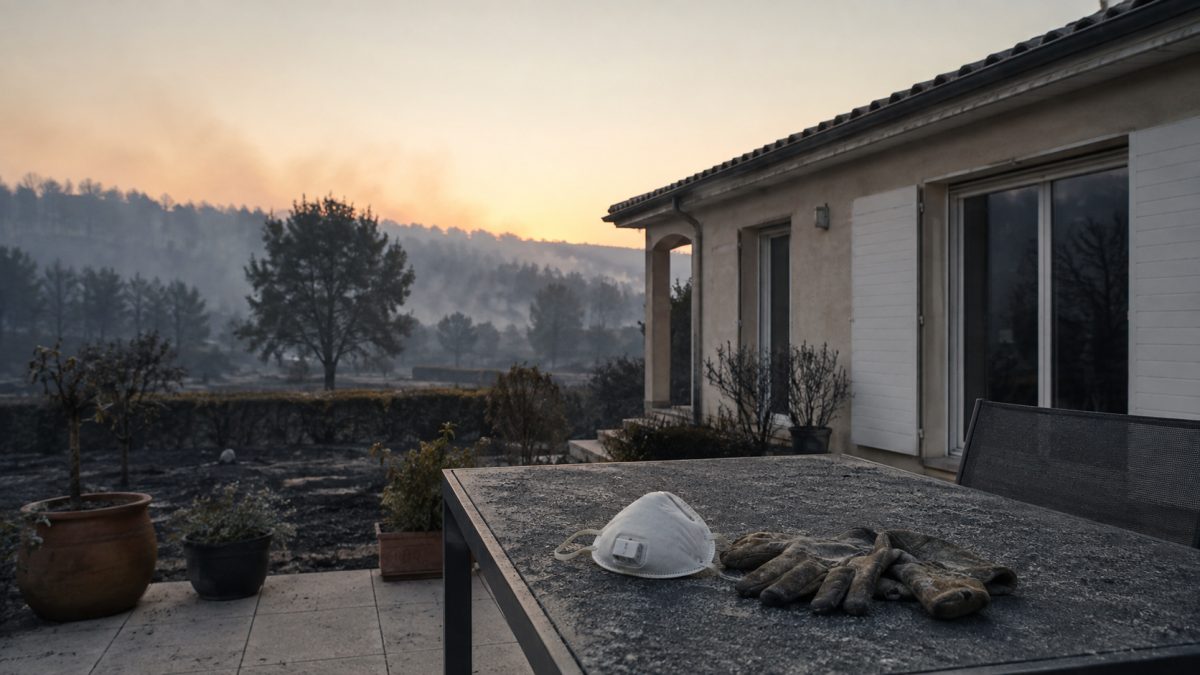
Cleaning itself can stir dust and residues back into the air. The Nouvelle-Aquitaine Regional Health Agency therefore recommends gloves and an FFP2 mask because pollutants may enter through the skin and respiratory tract. Care must be taken not to resuspend these residues during cleaning.
Water and soil may also have been exposed
Ash and toxic substances released by fires can degrade water quality. Smoke plumes can also affect air, water and soil over several hundred kilometers. No general contamination duration is available for soil and water, and the applicable thresholds depend on checks carried out locally.
Before resuming normal use, it is therefore prudent to check instructions from the town hall, prefecture or Regional Health Agency. For an exposed home, the useful question is: have checks or restrictions been announced in this area? If the information is unclear, it is better to ask for confirmation.
What to do during the first few days
- Wait for official authorization. The return is decided by the prefecture after advice from the SDIS and the Gendarmerie. Informal information or the presence of neighbors does not replace that decision.
- Inspect before cleaning. Identify soot-covered areas, ash deposits, smoke marks and weakened outdoor elements. This initial inspection also helps document the condition of the property.
- Protect the most vulnerable people. Older people, people with asthma or those with heart conditions should not take part in cleaning when it can be avoided.
- Use gloves and an FFP2 mask. This protection is intended for residues that may enter through the skin or respiratory tract.
- Check local instructions on air and water. Risks vary according to the area’s exposure and the checks carried out after the fire.
- Keep evidence. Photograph visible damage and note abnormalities before moving or cleaning belongings to make discussions with the insurer easier.
This method may feel slow when all you want is to get back into your home. Yet a few hours spent inspecting, protecting and documenting can prevent unnecessary exposure to dust, the loss of useful evidence or the premature disposal of belongings that should have been examined.
Insurance: do not wait until everything has been cleaned
A wildfire falls under the standard fire coverage in home insurance. Contrary to a common misconception, it does not depend on the natural-disaster compensation scheme. The usual deadline for reporting the claim is five working days after the loss.
For victims in Gironde, Landes and Var, insurers announced on July 27, 2026, an exceptional extension of the deadline to August 31, 2026. This additional time should not be interpreted as a reason to wait. The sooner the claim is reported, the sooner the insurer can specify the required supporting documents, arrange an assessment or consider an advance payment.
The claim should distinguish obvious damage from problems that are still uncertain. A blackened facade, destroyed furniture or a burned outbuilding can be identified immediately. A persistent smell, deposits in ventilation ducts, a room saturated with smoke or doubts about habitability may require further assessment. It is better to mention them from the outset rather than limit the claim to the most spectacular damage.
Other forms of support may supplement insurance: municipal or departmental emergency funds, agricultural aid, rehousing solutions and advance payments from insurers. Amounts and conditions are not uniform and must be checked with the relevant organizations.
The following weeks: keep monitoring instead of moving on too quickly
Physically returning does not always mean a return to normal. Some pollutants may remain on surfaces or be released gradually. Insurance procedures take time, checks may occur after the neighborhood has reopened, and cleaning may reveal damage that was not visible on the first day.
The psychological after-effects must also be taken seriously. A delayed reaction after an evacuation, fear of another flare-up or difficulty sleeping is not abnormal. Support can be sought from the medico-psychological emergency unit, a general practitioner or associations.
France has 18 million hectares of forest, and 310,000 hectares have burned over twenty years. In 2026, 117,000 hectares had already been reported as affected by fire. These figures show the scale of the risk, but say little about what a family experiences once it returns. In my view, the true indicator that the crisis is over is not the number of roads reopened: it is the moment when residents finally have a safe home, reliable information and a properly initiated compensation claim.
Returning home must therefore be treated as a full stage in its own right. Waiting for prefectural authorization, checking the immediate surroundings, protecting vulnerable people, documenting damage and promptly reporting the loss provide a simple course of action. It does not remove uncertainty, but it prevents the aftermath of the fire from adding health or administrative risks to damage already suffered.