 Hindi
Hindi  French
  German
  English
  Spanish
  Italian
  Japanese
  Korean
  Norwegian
  Chinese
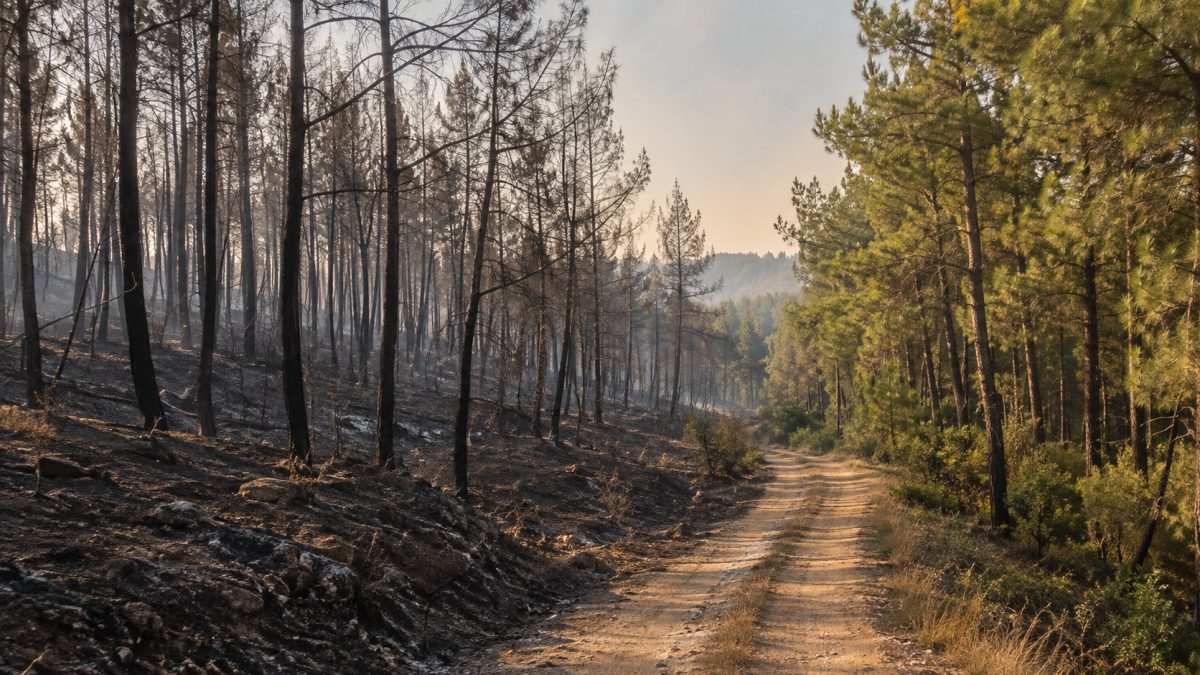
Forest insurance: the real cost of protecting one hectare
Forest insurance remains the exception in France: according to the CGAAER, only 7.5% of private forest was insured against fire and/or storms in 2023. In other words, 92.5% was not. That figure is all the more striking because private forests account for 75% of France’s forest area and belong to 3.5 million owners.
But talking about forest insurance without converting policies into euros per hectare does not help anyone decide. The real question is simple: how much do you pay each year, how much can you recover after a loss, and how much is ultimately left for the owner to bear? That is the calculation we will set out here, carefully separating available figures from simulation assumptions.
How much does forest insurance really cost?
There is no single national average rate here that would allow us to say that insuring a French forest costs exactly X euros per hectare. However, one concrete example is documented: a premium of €9/ha falls to €2.16/ha after applying the 76% tax credit, when the owner is eligible within the applicable limits.
The tax mechanism matters. The tax credit provided for under Article 200 quindecies of the French General Tax Code represents 76% of eligible contributions, capped at €15 per insured hectare, with an expenditure ceiling of €6,250 for a single person and €12,500 for a couple.
- 20 hectares at €9/ha: €180 gross premium, or €43.20 after the tax credit.
- 50 hectares: €450 gross, or €108 net.
- 100 hectares: €900 gross, or €216 net.
These calculations do not mean that all policies cost €9/ha. They simply provide a numerical benchmark based on a rate that has actually been published. The price then depends on the policy, the risk, and the level of cover.
What does that price cover?
Sylvassur advertises cover levels of €1,000, €3,000, €5,000 or €7,000/ha. Compensation applies when the damaged area exceeds a threshold defined according to the size class: 1, 3, 5 or 7 hectares. Sylvassur also states that its prices are on average 40% lower than traditional offers.
At XLB Assurances, the Contrafeu policy provides for a flat excess of €305 per claim, with no minimum intervention threshold required for compensation. The Contraforêt policy adds storms, hail, frost, rime and snow; for storms, cover is triggered from 20% damage, or 30% for certain species, over an area of at least 0.33 hectare.
What to check before the price: a low premium only makes sense if the cover level, excess and trigger threshold match the size of the property and the kind of loss you actually want to absorb.
92.5% uninsured: is it really about price?
The 92.5% figure is simply the complement of the 7.5% coverage rate. It should not be turned into a survey: the available publications do not provide a quantified breakdown of the reasons why each owner remains uninsured.
What can be observed is that the tax-adjusted cost can become very low in the €9/ha example even though coverage remains limited. Yet insured areas and the number of policies have been rising by around 7% a year since 2011. Another estimate mentions about 1 million insured hectares out of 12 million, or close to 10%, compared with less than 5% ten years earlier. The statistical scopes are not explained in exactly the same way, so it is better to retain a range indicating low coverage than to force the two figures into equivalence.
Another factor changes the calculation: since January 2017, there have been no public aid programs for re-establishing forest stands after storms. The idea that a public scheme will automatically step in after a major loss is therefore risky. And in France, a forest fire does not fall under the statutory natural-disaster regime: there is no CatNat decree and no statutory €380 excess applicable on that basis.
Out-of-pocket cost: a concrete example after a wildfire
The fires of summer 2026 showed the potential scale of the risk: the Saumos fire covered 42,000 hectares and led to 220,000 evacuations. Between January 1 and July 22, 2026, EFFIS recorded 42,810 hectares burned in France. Even so, no available figure makes it possible to isolate the actual average loss per hectare suffered by a private owner in those fires.
We can nevertheless build a decision grid without inventing that value. Take a 100-hectare property and assume a fire destroys 10 hectares. To represent the capital at risk, we will use only the cover levels actually offered by Sylvassur, without claiming that they correspond to the exact economic value of the timber.
- At €1,000/ha: 10 hectares represent €10,000 of reference capital.
- At €3,000/ha: €30,000.
- At €5,000/ha: €50,000.
- At €7,000/ha: €70,000.
For an uninsured owner, the financial out-of-pocket amount corresponding to the loss used in their own calculation is, by definition, total: there is no forest-insurance payout to absorb it. If the actual economic loss on the 10 hectares were €30,000, the owner would therefore bear €30,000. This amount is a calculation scenario, not an official estimate of the fires in Gironde or the Landes.
For an insured owner, the policy rules must then be applied. Purely arithmetic example: if a claim is recognized for compensation of €30,000 before the excess under a policy with a flat €305 excess, the payout after the excess would be €29,695. With a policy based on an area threshold, the first step is to check whether the loss exceeds the specified threshold.
A useful break-even point, but one that should not be overinterpreted
Take the benchmark again of 100 hectares insured at €9/ha, or €216 a year after the tax credit. A hypothetical loss of €30,000 represents almost 139 years of that net premium. The comparison is deliberately simple: it does not measure the actuarial profitability of a policy and does not link the €9/ha rate to a specific €3,000/ha cover level. It merely shows why a recurring annual expense should be compared with a potentially very large one-off loss.
What cheaper alternatives are there to traditional insurance?
The main quantified tool available is not a collective replacement fund but the CIFA, the forestry investment and insurance account. It is reserved for owners who have already taken out insurance covering storms or fire. It therefore does not replace the cover; rather, it helps build additional financial capacity.
Permitted deposits reach €2,500 per insured hectare, then €5,000/ha from the fifth year onward. The scheme also benefits from a three-quarter exemption from gift and inheritance transfer duties. For an owner who wants to self-finance part of the restoration work, this is a reserve mechanism backed by insurance, not free pooling of risk.
As for pooled funds or foreign models often mentioned in the debate, there is no sufficiently documented quantitative comparison here to claim that one European country is X times cheaper or compensates Y times better. It is better to leave that box empty than to invent an appealing but false comparison.
The decision grid in four lines
- 1. Calculate the net premium: gross contribution minus the applicable tax credit.
- 2. Calculate the capital at risk: hectares likely to be lost multiplied by a reference value suited to the stand or the contemplated cover level.
- 3. Read the triggers: excess in euros, minimum threshold in hectares, percentage of damage and risks actually covered.
- 4. Measure the funding gap: estimated loss minus contractual compensation, then check what share can be absorbed by personal reserves or a CIFA.
The surprising point, ultimately, is not that forests are difficult to insure. It is that the debate often stops at the 7.5% figure, even though the decision becomes much clearer as soon as three numbers are put on the table: annual net cost, amount of cover and maximum out-of-pocket cost. For a private owner, that arithmetic is what shows whether the savings from remaining uninsured are really worth the risk being taken.