
 Japanese
  French
  German
  English
  Spanish
  Hindi
Hindi  Italian
  Korean
  Norwegian
  Chinese
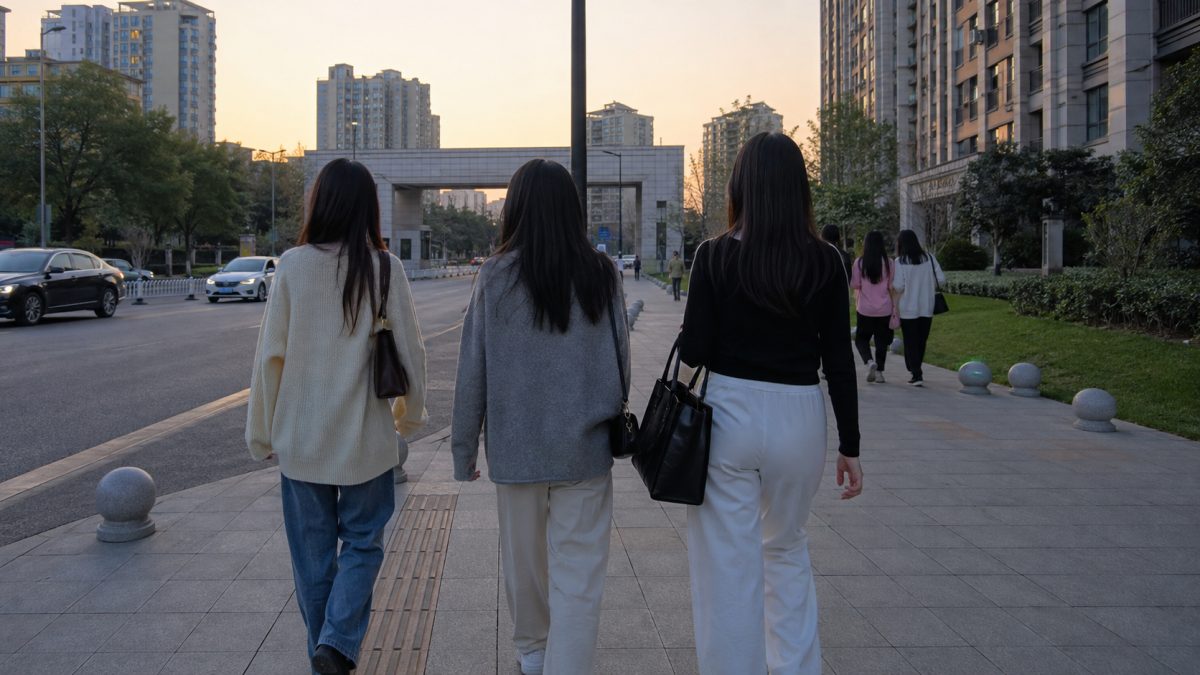
In China, Falling Births Also Tell a Success Story
Falling births are almost always presented as a thermometer for crisis: fewer children would mean a society losing confidence, an economy that is too expensive, and a future that looks too bleak. In China, that interpretation obviously exists. But it hides a far more interesting paradox: part of the decline in births also looks like the logical outcome of forty years of successful modernization.
The Chinese state wanted a more educated, more mobile and more highly skilled population. It largely got what it sought. Yet the women who benefited from this transformation do not automatically return to the family model of their mothers or grandmothers. They have more education, more career options and more power to decide when they marry, how many children they want, or even whether they want any at all.
The problem is no longer only what the state allows
The one-child policy obviously left a deep mark on Chinese demographics. But by itself it does not explain what is happening today. Since 2011, and then in 2014, 2016 and 2021, restrictions were progressively relaxed. The expected rebound never came.
The study by Fang, Liu and Yang, based on the 2017 China Fertility Survey, helps explain why. It covers 249,946 women aged 15 to 60 across 2,737 counties in all 31 provinces. When the universal two-child policy took effect in 2016, its measured impact remained small: about 0.025 additional child per eligible woman, or roughly 744,000 additional births per year, 4.1% of the annual total.
Most importantly, the effect came from women who already wanted two children or more. Those who wanted only one did not change their behavior simply because the law now allowed them to have two. In the survey, 32% of women said they wanted just one child, 55% two, 1.4% none, 9% three and 2.5% four or more.
That is the central point: the main obstacle is no longer prohibition. It is desired fertility itself. And even if every woman had exactly the number of children she wanted, births would continue to decline because both the number of women of childbearing age and the average number of children desired are falling at the same time.
The generation of only daughters changed the rules of the game
There is a historical irony here. In many urban families shaped by the one-child policy, an only daughter received an exceptional concentration of family resources: education, extracurricular activities, professional ambitions. She grew up with the idea that she could aim for a broader life than the one traditionally reserved for women.
Today, women make up more than half of university students in China and have entered elite professions in unprecedented numbers. That progress does not disappear when marriage age arrives. On the contrary, it changes the calculation.
Housing costs reinforce that autonomy in decision-making. The study of the two-child policy shows that additional births were far less common in areas where real estate was expensive, especially among women who did not own urban housing. Economics therefore matters, but it acts on women who now have more expectations and more alternatives.
The decline in marriage further amplifies the phenomenon because marriage and childbirth remain strongly linked in China. In the first quarter, 1.697 million marriages were registered, down 6.2% year on year and around half the 2017 level. In 2025, the country recorded 7.92 million births and its population fell by 3.39 million people, the fourth consecutive year of decline.
South Korea and Japan: the same wall in another form
South Korea and Japan show why pronatalist policies can fail even when governments spend enormous sums. In these societies, housing and education are expensive, working days are long, and domestic labor remains unevenly shared. A child is not merely an expense: it can represent entry into a way of life seen as too burdensome.
In South Korea, the fertility rate was 0.72 child per woman in 2023, after an 8% decline in a single year. Yet the government had already spent about 379.8 trillion won, nearly $286 billion, on support policies over almost two decades. Bonuses, subsidized housing, hospital costs, fertility treatment support for married couples: the incentives were not enough to reverse the trend durably.
One figure also captures the weight of the family model: in 2022, only 2% of South Korean births occurred outside marriage. A young producer interviewed by the BBC explained that she wanted neither marriage nor children until she found a partner genuinely willing to share housework and childcare.
This is where the parallel with China becomes powerful. A society modernizes women’s education, careers and aspirations faster than it always modernizes the practical organization of couples and families. The outcome is not necessarily a rejection of children. It may be a rejection of the conditions attached to parenthood.
The real conflict pits two incompatible successes against each other
The conventional story sets birth rates against modernity, as if the former were collapsing because the latter had gone wrong. The same facts can be read differently. A society succeeds in giving women greater autonomy, then discovers that this autonomy produces choices that are less predictable for the state.
That helps explain why financial aid alone struggles to make much difference. It treats a child as a cost to offset, even though the decision also involves time, career, housing, personal freedom and the division of domestic labor. A check is not enough to make an unequal family model fair.
Japan and South Korea are not documented using exactly the same framework as China, but the facts converge on a comparable tension: a better-educated, more autonomous younger generation encounters a model of couplehood that remains demanding, expensive and sometimes deeply asymmetric.
For Southern Europe, more caution is needed. The sociological parallel is tempting, but the available data do not establish with the same strength the link between women’s education, autonomy and falling fertility in Italy, Spain or Greece. That would go beyond what the figures can support.
A demographic crisis, yes. But also a political success that has become inconvenient
China now wants to build a society more supportive of births between 2026 and 2030 and to integrate young people’s needs more deeply into urban planning, employment, housing, health and public services. This shift is revealing: the problem can no longer be treated simply as a matter of quotas or permission.
Chinese modernization produced women who are more educated, more ambitious and more able to reject a family trajectory that does not suit them. That was, in part, one of development’s objectives. Falling births are also one of its consequences.
The paradox can therefore be summed up in one sentence: Asian governments are now trying to correct demographically an individual autonomy they themselves helped make possible. Falling births can become an economic crisis without necessarily proving a social failure. On the contrary, they may signal that a society succeeded in widening its citizens’ choices faster than it managed to reinvent family institutions around those new choices.