 English
  French
  Spanish
  Chinese
  Japanese
  Korean
  Hindi
Hindi  German
  Norwegian
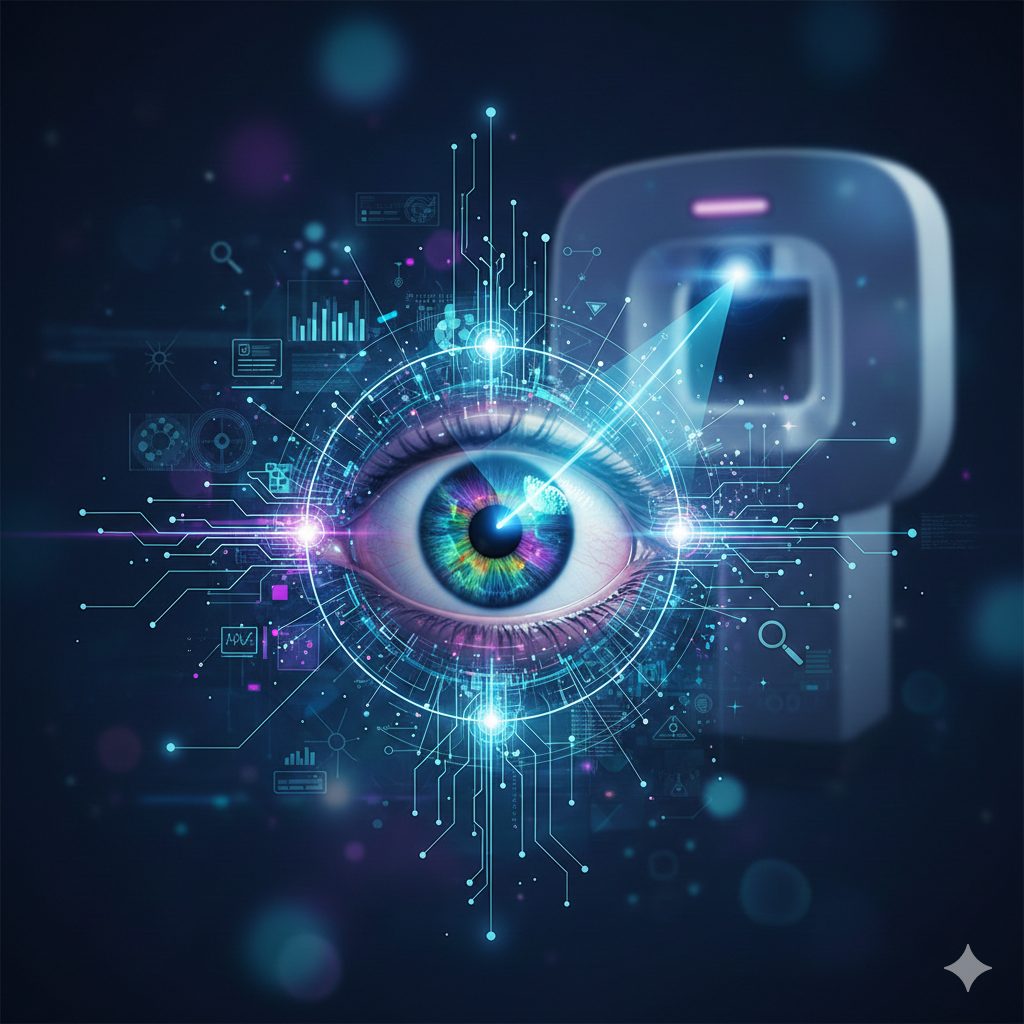
Artificial Intelligence Revolutionizes Ophthalmology: Toward Mass Eye Disease Screening
The healthcare field is undergoing a revolution, and **Artificial Intelligence (AI)** has just taken a decisive step in the field of ophthalmology. Researchers recently published the results of a clinical study validating an AI system capable of **detecting early and with remarkable precision** several serious eye diseases, including diabetic retinopathy and glaucoma. This technology promises to transform the way screenings are conducted.
Why is this advancement so significant? The main challenge in eye disease screening is the volume of images to analyze and the need for advanced human expertise. AI allows to **drastically accelerate this process**, providing a reliable tool for general practitioners and remote clinics.
This new deep learning system analyzes fundus images (retinographies) in seconds. It does not merely flag an anomaly; it is capable of **classifying it with a level of detail comparable to, or even superior to, that of the best specialists**. This opens the door to better quality care for millions of people, particularly in regions where access to an ophthalmologist is limited.
However, the integration of AI into medical practice raises important ethical and regulatory questions. Developers emphasize that the tool is designed to be a **decision support aid** and not a substitute for the physician's clinical judgment. The goal is to relieve specialists from routine tasks so they can focus on the most complex cases and patient monitoring. Collaboration between humans and machines is the key.
The future of vision may therefore be intimately linked to these algorithms. The next steps will include broadening clinical trials and obtaining the certifications needed for worldwide use. If this deployment is confirmed, we could witness a **significant reduction in preventable blindness cases** in the years ahead, thanks to ultra-early and targeted detection.



Artificial Intelligence Revolutionizes Ophthalmology: Toward Mass Eye Disease Screening
The healthcare field is undergoing a revolution, and **Artificial Intelligence (AI)** has just taken a decisive step in the field of ophthalmology. Researchers recently published the results of a clinical study validating an AI system capable of **detecting early and with remarkable precision** several serious eye diseases, including diabetic retinopathy and glaucoma. This technology promises to transform the way screenings are conducted.
Why is this advancement so significant? The main challenge in eye disease screening is the volume of images to analyze and the need for advanced human expertise. AI allows to **drastically accelerate this process**, providing a reliable tool for general practitioners and remote clinics.
This new deep learning system analyzes fundus images (retinographies) in seconds. It does not merely flag an anomaly; it is capable of **classifying it with a level of detail comparable to, or even superior to, that of the best specialists**. This opens the door to better quality care for millions of people, particularly in regions where access to an ophthalmologist is limited.
However, the integration of AI into medical practice raises important ethical and regulatory questions. Developers emphasize that the tool is designed to be a **decision support aid** and not a substitute for the physician's clinical judgment. The goal is to relieve specialists from routine tasks so they can focus on the most complex cases and patient monitoring. Collaboration between humans and machines is the key.
The future of vision may therefore be intimately linked to these algorithms. The next steps will include broadening clinical trials and obtaining the certifications needed for worldwide use. If this deployment is confirmed, we could witness a **significant reduction in preventable blindness cases** in the years ahead, thanks to ultra-early and targeted detection.
Artificial Intelligence Revolutionizes Ophthalmology: Toward Mass Eye Disease Screening
The healthcare field is undergoing a revolution, and **Artificial Intelligence (AI)** has just taken a decisive step in the field of ophthalmology. Researchers recently published the results of a clinical study validating an AI system capable of **detecting early and with remarkable precision** several serious eye diseases, including diabetic retinopathy and glaucoma. This technology promises to transform the way screenings are conducted.
Why is this advancement so significant? The main challenge in eye disease screening is the volume of images to analyze and the need for advanced human expertise. AI allows to **drastically accelerate this process**, providing a reliable tool for general practitioners and remote clinics.
This new deep learning system analyzes fundus images (retinographies) in seconds. It does not merely flag an anomaly; it is capable of **classifying it with a level of detail comparable to, or even superior to, that of the best specialists**. This opens the door to better quality care for millions of people, particularly in regions where access to an ophthalmologist is limited.
However, the integration of AI into medical practice raises important ethical and regulatory questions. Developers emphasize that the tool is designed to be a **decision support aid** and not a substitute for the physician's clinical judgment. The goal is to relieve specialists from routine tasks so they can focus on the most complex cases and patient monitoring. Collaboration between humans and machines is the key.
The future of vision may therefore be intimately linked to these algorithms. The next steps will include broadening clinical trials and obtaining the certifications needed for worldwide use. If this deployment is confirmed, we could witness a **significant reduction in preventable blindness cases** in the years ahead, thanks to ultra-early and targeted detection.