 Chinese
  French
  German
  English
  Spanish
  Hindi
Hindi  Italian
  Japanese
  Korean
  Norwegian
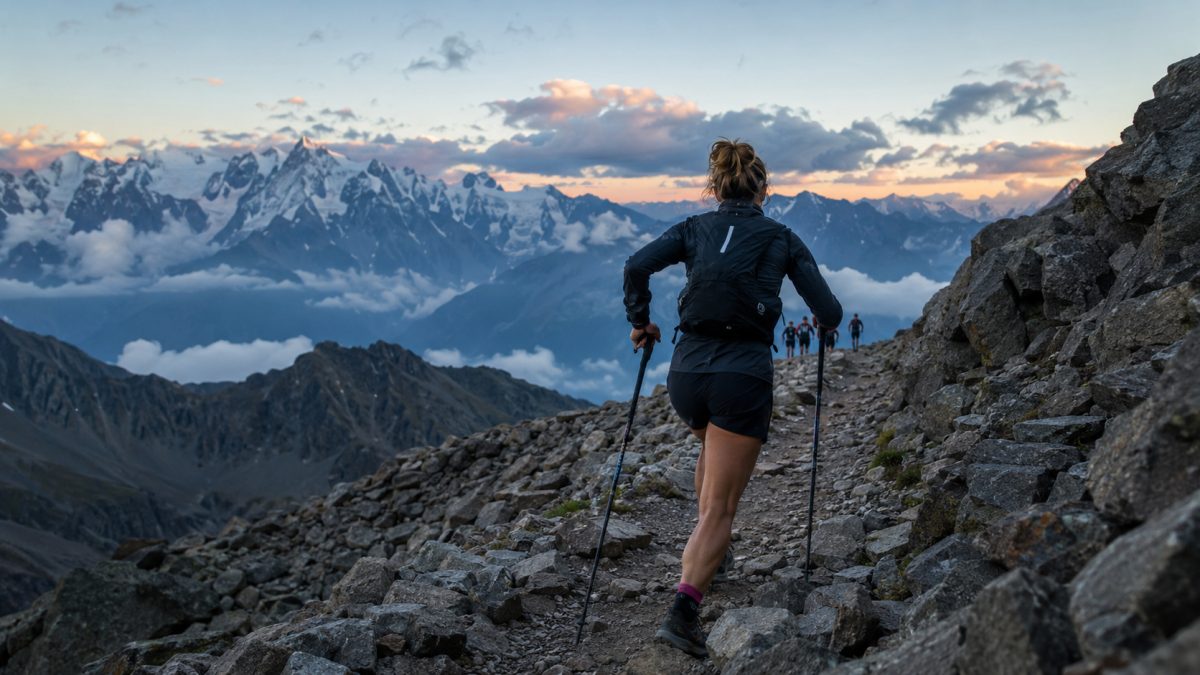
UTMB 2026: why women are closing the gap with men in ultra
UTMB 2026 is once again highlighting a striking ultra-trail paradox: women remain a clear minority at the start of very long distances, while the gap with the best men narrows as the kilometers add up. The phenomenon is no longer just an impression. Over 10 km, women account for 40% of starters and the gap with the best man reaches 19%. Over 100 miles, or around 160 km, they are only 16%, but the gap falls to 4.5%. Beyond 200 km, fewer than 10% of participants are women and the gap is down to 3%.
Just days before UTMB 2026, scheduled from August 24 to 30 with the flagship race starting on August 28, these figures change the way the question should be framed. The issue is not only why there are fewer women in ultra-trail. We also need to understand why their representation falls precisely where their relative performance comes closest to men’s, then identify realistic levers for registration, preparation and visibility.
The longer the distance, the narrower the performance gap
The clearest comparison comes down to three distances. At 10 km, the reported performance gap between women and men is 19%. Over 100 miles, it falls to 4.5%. Beyond 200 km, it is only 3%. In other words, between the 10 km and distances above 200 km, the relative gap is divided by more than six.
The ultra-distance paradox is simple: female participation falls as race distance grows, while the performance gap with the best men falls as well.
Rachel Entrekin’s result at the Cocodona 250 shows how far that convergence can go. In May 2026, she won the overall classification of the 402 km race in 56 hours and 9 minutes, becoming the first woman to win the event outright and finishing more than an hour ahead of the first man.
These data come in particular from work built from ITRA rankings and organized in the open TRAILGENDER and ITRA Phase 0 databases. They document the convergence in performance as distance increases. However, they are not enough to attribute the phenomenon to a specific physiological mechanism. Claiming, for example, that a particular metabolic advantage alone explains these results would go beyond the available data.
Another extrapolation should also be avoided: the figures cited do not form a homogeneous ten-year series that would allow an annual rate of women’s progress relative to men to be calculated. What can be measured solidly here is a distance effect: the longer the race, the smaller the relative performance gap.
At UTMB, participation is rising but remains heavily unbalanced
UTMB provides a good laboratory for this paradox. Across all races, women represent 26% of participants in 2026, compared with 21.5% in 2023. On the main 174 km course, their share is given as 15% in 2026, compared with 10% in 2022. The two figures do not cover exactly the same scope, but they tell the same story: female participation is rising without reaching balance over the very longest distance.
The contrast with shorter formats is striking: the female share can rise as high as 45%. This matters for organizers. Accessible formats are not merely entry products; they can act as a gateway to ultra-distance. Moving from a shorter race to a longer one can create a gradual progression rather than an abrupt leap to 170 km or more.
Pressure on registrations makes the situation more complicated still. The 2026 edition attracted 29,000 candidates to the lottery. For UTMB itself, 10,411 applications were recorded for 2,500 bibs. The CCC received 7,239 applications and the OCC 11,369. When supply falls this far below demand, even a small barrier upstream can have a significant effect on the final composition of the field.
Why do women remain a minority?
Several obstacles are mentioned: logistics, cost, preparation and access to the qualification pathway. They must, however, be presented cautiously because the available data do not quantify their respective weight. It would therefore be misleading to claim that any single factor explains the participation gap on its own.
A more clearly identified barrier concerns visibility. Marie Sammons, head of elite athlete management at UTMB Group, points to a lack of female role models on top-level start lines. It is precisely to strengthen that visibility that the organization seeks strict parity in elite corrals.
This logic is consistent with figures such as Courtney Dauwalter, a three-time winner of the Tour du Mont-Blanc: the more visible elite female performances become, the easier it is for women who are still hesitant to imagine a pathway into ultra-running.
A guide for organizers: act without inventing false quotas
The available sources provide neither an official female quota to apply in 2027, nor differentiated qualification times, nor a quantified prize-money gap between men and women. It would therefore be artificial to propose a percentage as the “right” solution. Several concrete actions can, however, be inferred from the existing data.
- Measure each distance separately. An overall rate of 26% can hide a share of only 15% on the main course. Publishing race-by-race figures makes it possible to see where the drop-off occurs.
- Maintain parity in elite corrals. This is a direct visibility lever already being pursued by UTMB.
- Use shorter formats as bridges. Since they can attract up to 45% women, they form the best identified pool for encouraging a gradual move up in distance.
- Audit qualification and lottery rules. Without inventing differentiated times, organizers can check whether existing criteria create different selection effects by sex.
- Publish prize money in a comparable way. In the absence of figures here establishing a gap, the first useful step is to make amounts easily comparable between categories.
A guide for a woman aiming for UTMB
The first strategy is not to interpret the low proportion of women over long distances as an indicator of potential. The figures say almost the opposite: where women are least numerous, their relative performance is closest to men’s.
Next, it is better to build the project in stages. Shorter formats attract more women and provide a coherent gateway to longer distances. For a UTMB goal, the difficulty of obtaining a bib also needs to be integrated very early: 10,411 applications for 2,500 places in 2026 means that successful sporting preparation does not guarantee access to the race.
For qualification times, runners should rely on the official rules applicable to the edition they are targeting rather than generic figures: no precise time allowing a comparison between men and women is established in the data used here. The same caution applies to budget and logistics: they are mentioned as possible barriers, but without sufficiently documented amounts to build a reliable sample budget.
By 2027, the best indicator will be the numbers rather than the rhetoric
Female participation at UTMB is already progressing: 26% women across all races in 2026 compared with 21.5% in 2023, and 15% on the 174 km compared with 10% in 2022. But the real question now is whether that increase will reach the distances where underrepresentation remains greatest.
Perhaps the most interesting point is this: ultra-trail does not only show a gap between men and women, it shows that this gap changes sharply with distance. Going from 19% at 10 km to 3% beyond 200 km forces us to look differently at female participation. The sporting potential is visible. The next task is to make sure the start lines become visible evidence of it too.