

Loading...
By continuing to browse this site, you agree to the use of cookies that ensure its proper functioning.
enEnglish
frFrench
esSpanish
zhChinese
jaJapanese
koKorean
hiHindi
deGerman
noNorwegian
Recherche article
Me connecter
Fleche top bulle Fleche top bulle
DE EN ES FR HI JA KO NO ZH
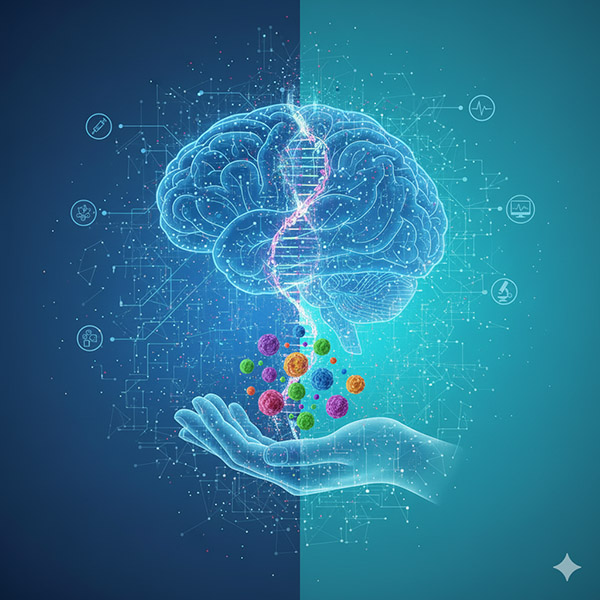
Digital visualization of AI analyzing medical and genomic data for personalized patient treatment

AI at the Patient's Bedside: The New Era of Personalized Medicine

Publié le 24 Avril 2026

Recent scientific news has highlighted a fascinating and crucial subject for our future: the discovery of new approaches in the field of artificial intelligence (AI) and its impact on personalized medicine. Researchers have recently published revolutionary work showing how sophisticated AI models can analyze massive amounts of genomic and clinical data to predict with unprecedented precision a patient's response to specific treatments.

This advance represents a paradigm shift, moving from a "one-size-fits-all" treatment model to an ultra-individualized strategy, making therapies more effective and reducing unnecessary side effects.

One of the most significant studies focuses on oncology. By leveraging *machine learning* to decipher the complex mutations of tumors, AI is able to identify biomarkers previously invisible to the human eye. These biomarkers act as **key indicators** for determining whether a cancer patient will respond positively to immunotherapy or targeted chemotherapy. The potential is immense: improving survival rates by offering the right treatment at the right time.

But the impact of AI does not stop at diagnosis and prognosis. It also accelerates **drug discovery**. By simulating thousands of molecular interactions in just a few minutes, algorithms considerably reduce the time and cost required to identify new therapeutic molecules. Leading pharmaceutical companies are already integrating these tools to optimize their R&D pipelines, promising a new era for medical innovation.

However, this revolution raises crucial ethical and practical questions. Patient **data privacy** is at the heart of concerns. How can we ensure that highly sensitive genomic information remains protected while feeding global AI models? Moreover, it is imperative that AI systems be transparent and explainable so that doctors can understand and trust the recommendations made by the machine.

In conclusion, the integration of artificial intelligence into personalized medicine is no longer a distant promise, but an emerging reality. Although regulatory and ethical challenges remain, the marriage of these two disciplines is poised to redefine healthcare as we know it, offering renewed hope for the treatment of complex diseases.

Tags
Artificial Intelligence
AI
personalized medicine
oncology
biomarkers
genomics
machine learning
health
treatments
data ethics
Envoyer à un ami
Signaler cet article
A propos de l'auteur
Digital visualization of AI analyzing medical and genomic data for personalized patient treatment

AI at the Patient's Bedside: The New Era of Personalized Medicine

Publié le 24 Avril 2026

Recent scientific news has highlighted a fascinating and crucial subject for our future: the discovery of new approaches in the field of artificial intelligence (AI) and its impact on personalized medicine. Researchers have recently published revolutionary work showing how sophisticated AI models can analyze massive amounts of genomic and clinical data to predict with unprecedented precision a patient's response to specific treatments.

This advance represents a paradigm shift, moving from a "one-size-fits-all" treatment model to an ultra-individualized strategy, making therapies more effective and reducing unnecessary side effects.

One of the most significant studies focuses on oncology. By leveraging *machine learning* to decipher the complex mutations of tumors, AI is able to identify biomarkers previously invisible to the human eye. These biomarkers act as **key indicators** for determining whether a cancer patient will respond positively to immunotherapy or targeted chemotherapy. The potential is immense: improving survival rates by offering the right treatment at the right time.

But the impact of AI does not stop at diagnosis and prognosis. It also accelerates **drug discovery**. By simulating thousands of molecular interactions in just a few minutes, algorithms considerably reduce the time and cost required to identify new therapeutic molecules. Leading pharmaceutical companies are already integrating these tools to optimize their R&D pipelines, promising a new era for medical innovation.

However, this revolution raises crucial ethical and practical questions. Patient **data privacy** is at the heart of concerns. How can we ensure that highly sensitive genomic information remains protected while feeding global AI models? Moreover, it is imperative that AI systems be transparent and explainable so that doctors can understand and trust the recommendations made by the machine.

In conclusion, the integration of artificial intelligence into personalized medicine is no longer a distant promise, but an emerging reality. Although regulatory and ethical challenges remain, the marriage of these two disciplines is poised to redefine healthcare as we know it, offering renewed hope for the treatment of complex diseases.

Tags
Artificial Intelligence
AI
personalized medicine
oncology
biomarkers
genomics
machine learning
health
treatments
data ethics
Envoyer à un ami
Signaler cet article
A propos de l'auteur
Digital visualization of AI analyzing medical and genomic data for personalized patient treatment

AI at the Patient's Bedside: The New Era of Personalized Medicine

Publié le 24 Avril 2026

Recent scientific news has highlighted a fascinating and crucial subject for our future: the discovery of new approaches in the field of artificial intelligence (AI) and its impact on personalized medicine. Researchers have recently published revolutionary work showing how sophisticated AI models can analyze massive amounts of genomic and clinical data to predict with unprecedented precision a patient's response to specific treatments.

This advance represents a paradigm shift, moving from a "one-size-fits-all" treatment model to an ultra-individualized strategy, making therapies more effective and reducing unnecessary side effects.

One of the most significant studies focuses on oncology. By leveraging *machine learning* to decipher the complex mutations of tumors, AI is able to identify biomarkers previously invisible to the human eye. These biomarkers act as **key indicators** for determining whether a cancer patient will respond positively to immunotherapy or targeted chemotherapy. The potential is immense: improving survival rates by offering the right treatment at the right time.

But the impact of AI does not stop at diagnosis and prognosis. It also accelerates **drug discovery**. By simulating thousands of molecular interactions in just a few minutes, algorithms considerably reduce the time and cost required to identify new therapeutic molecules. Leading pharmaceutical companies are already integrating these tools to optimize their R&D pipelines, promising a new era for medical innovation.

However, this revolution raises crucial ethical and practical questions. Patient **data privacy** is at the heart of concerns. How can we ensure that highly sensitive genomic information remains protected while feeding global AI models? Moreover, it is imperative that AI systems be transparent and explainable so that doctors can understand and trust the recommendations made by the machine.

In conclusion, the integration of artificial intelligence into personalized medicine is no longer a distant promise, but an emerging reality. Although regulatory and ethical challenges remain, the marriage of these two disciplines is poised to redefine healthcare as we know it, offering renewed hope for the treatment of complex diseases.

Tags
Artificial Intelligence
AI
personalized medicine
oncology
biomarkers
genomics
machine learning
health
treatments
data ethics
Envoyer à un ami
Signaler cet article
A propos de l'auteur
23 April 2026 22:02:56

Open letter to everyday AI: give us clear usage gauges at last

Tribune / Open letter We are asking for one simple thing: clear, consistent, universal gauges that can be understood in a matter of seconds. Using multiple AI assistants in the same week has become commonplace. We switch from ChatGPT / OpenAI to Claude, then to Kimi, sometimes to GitHub...
Read more
24 April 2026 08:18:17

Artificial Intelligence Revolutionizes Ophthalmology: Toward Mass Eye Disease Screening

The healthcare field is undergoing a revolution, and **Artificial Intelligence (AI)** has just taken a decisive step in the field of ophthalmology. Researchers recently published the results of a clinical study validating an AI system capable of **detecting early and with remarkable...
Read more