
 English
  French
  German
  Spanish
  Hindi
Hindi  Italian
  Japanese
  Korean
  Norwegian
  Chinese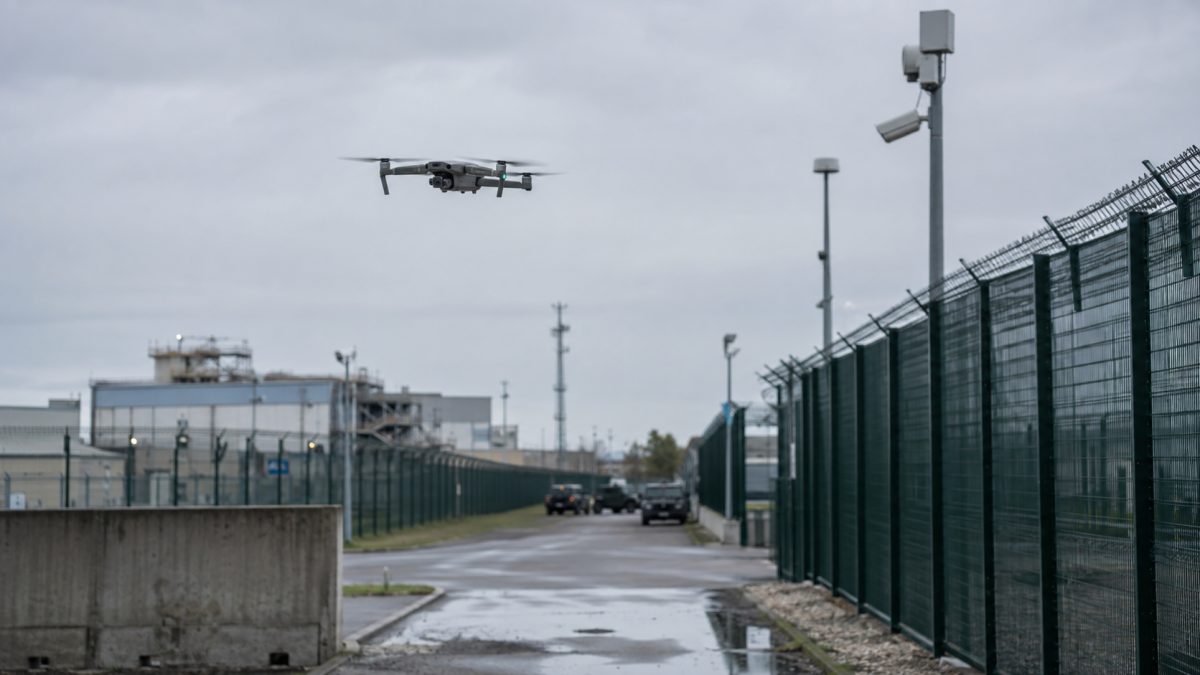
Drones over sensitive sites in France: the cost of response
Drones over sensitive sites in France have become a very concrete security issue: arms factories, military bases, police stations, rail infrastructure and nuclear sites are all concerned. Yet one essential figure is still missing from the public debate: there is no dated, consolidated national total of reports recorded since 2023. We know incidents are increasing, but not exactly how many there have been nationwide.
To understand the threat posed by drones over sensitive sites in France, we therefore need to look at what is actually documented: several recent overflights in Bergerac, Mulhouse, Mourmelon and over Île Longue, the PARADE counter-drone system whose contract is worth €51.05 million excluding VAT, Mica missiles costing more than €600,000 each, Hellfires at around $100,000 and a new guided rocket announced at between €25,000 and €40,000 per shot. The real issue is not only detecting a drone: it is knowing how much it costs to neutralize it and whether the response can be sustained over time.
Real incidents, but still no national tally
Several cases show that the threat is not limited to nuclear power plants. In early November 2025, the Eurenco plant in Bergerac, which specializes in military powders and explosives, was overflown several times. In Mulhouse, a drone entered the perimeter of a police station and a marshalling yard used to transport heavy military equipment. In Mourmelon, suspicious overflights were reported by the military during a period of heightened vigilance.
Île Longue in Finistère, where France’s fleet of nuclear submarines is based, has also been targeted by overflights in recent months. These examples are enough to show the diversity of the sites concerned: arms production, security forces, military logistics and nuclear deterrence.
But we should resist a common temptation: turning a succession of media-reported cases into a national statistic. The available data do not support claims that there have been 50, 100 or 500 reports since 2023. No consolidated total of this kind is provided. The most accurate formulation therefore remains simple: reports are described as rising sharply, without a verifiable national figure.
€51.05 million for PARADE: what that price really means
France has the PARADE system, short for “Protection déployAble modulaiRe Anti-DronEs”, awarded under a contract in 2022. The stated amount is €51.05 million excluding VAT. This figure matters, but it must be interpreted correctly: it corresponds to the framework agreement mentioned for this system, not to an equipment price per site.
In other words, it would be wrong to write that protecting a power plant, an air base or a military factory costs €51.05 million. The actual cost per deployment is not provided. It would depend on what is installed, the number of sensors, jamming or neutralization capabilities and how continuously the system is operated, but none of these per-site costs is quantified here.
To give a sense of scale without distorting it, France’s defense budget excluding pensions reached €43.9 billion in 2023. PARADE’s price is therefore significant in absolute terms, but it must be placed within a much larger military budget. What is still missing to assess the system’s economic efficiency is a detailed cost per protected site and a public accounting of the number of intrusions detected or neutralized.
The cost of each shot is becoming almost as important as performance
The economic difficulty appears above all at the neutralization stage. A Rafale can use a Mica missile costing more than €600,000. A typical hostile drone, however, is estimated to cost around €30,000 to manufacture. Even without complex calculations, the gap is obvious: destroying a relatively inexpensive target with a very expensive munition is not a comfortable solution if attacks become numerous.
France is therefore exploring several levels of response. The French Air and Space Force, together with the DGA, successfully tested firing a Hellfire missile from an MQ-9 Reaper drone against a drone-type aerial target. A Hellfire costs about $100,000. France has 12 Reapers, opening up an intermediate option between fighter aircraft and lighter means.
Rafales equipped with Mica missiles and Tigre helicopters with their 30 mm cannon also remain existing options. But current efforts are also focused on a 68 mm guided rocket intended to turn Rafales and Tigres into drone hunters using a much cheaper munition.
The 68 mm rocket changes the equation
This new rocket is announced at between €25,000 and €40,000 per shot. The tests are described as successful. Its range could reach 5 km, compared with 1 to 2 km for a conventional rocket, and a salvo could neutralize 12 to 24 targets, whereas conventional rockets are said to handle 1 to 3.
This is probably the most interesting point in the French strategy: research is no longer aimed only at shooting down a drone, but at doing so with a munition whose price is closer to that of the target. The need is all the clearer because more than 70 Mica missiles were recently fired to shoot down Iranian drones attacking Emirati allies. A credible counter-drone defense must be able to withstand repeated engagements.
Nuclear sites already have dense regulatory protection
France has 56 operational nuclear reactors spread across 18 sites. Each is covered by a permanent no-drone zone. The law of 24 October 2016 strengthened this protection. Central Paris is also covered by the permanent LF-P 23 zone, established by an order dated 2 April 2025.
Criminal penalties also exist: flying over a prohibited zone such as Paris can result in 6 months’ imprisonment and a €15,000 fine. Violating a takeoff ban can be punished by up to a €45,000 fine and one year in prison.
The problem is that an administrative ban does not physically neutralize an aircraft that ignores the rule. That is precisely why the SGDSN is still working on a framework allowing drones to be destroyed and defining the zones concerned. At this stage, that legal mechanism has not been finalized.
France versus its European neighbors: no serious winner can be named
The question is legitimate: is France behind or ahead of its European neighbors? With the public data available here, no serious quantitative comparison is possible. No comparable amount is given for Germany, Spain, Italy, Belgium or the United Kingdom, and there is no common indicator for comparing the number of equipped sites, detection rates, neutralizations or average deployment cost.
It would therefore be misleading to produce a ranking. What can be said about France is more precise: it already has a dedicated system with PARADE, uses existing military capabilities such as the Rafale and Tigre, has tested the Hellfire from a Reaper and is developing a cheaper guided rocket. At the same time, its legal framework for intervention continues to evolve.
What should be published to truly measure effectiveness
The debate would benefit greatly from moving beyond the simple accumulation of spectacular incidents. Three simple indicators would make it possible to assess counter-drone policy on a concrete basis:
- the annual number of reports at sensitive sites, broken down by site type;
- the number of confirmed detections, jamming actions and actual neutralizations;
- the installation and operating cost of systems per protected site.
Without these data, we know the price of several weapons but still not the full cost of effective protection. This is the current limit of the French debate: the threat is visible, the technical response is progressing, but public measurement of its effectiveness remains incomplete.
The conclusion is less spectacular than a story about “spy drones”, but more useful. The incidents exist, including around major strategic sites. France is committing tens of millions of euros to specialized systems and is seeking to reduce the cost of each interception. However, neither the national number of overflights since 2023, nor the cost per site, nor a quantified European comparison is currently established by the available data. Until those three pieces of information are available, it is impossible to know whether the response is merely impressive or genuinely efficient.