
 English
 French
 German
 Spanish
 Hindi
 Italian
 Japanese
 Korean
 Norwegian
 Chinese
Eco-friendly funerals in France: What can you choose today?
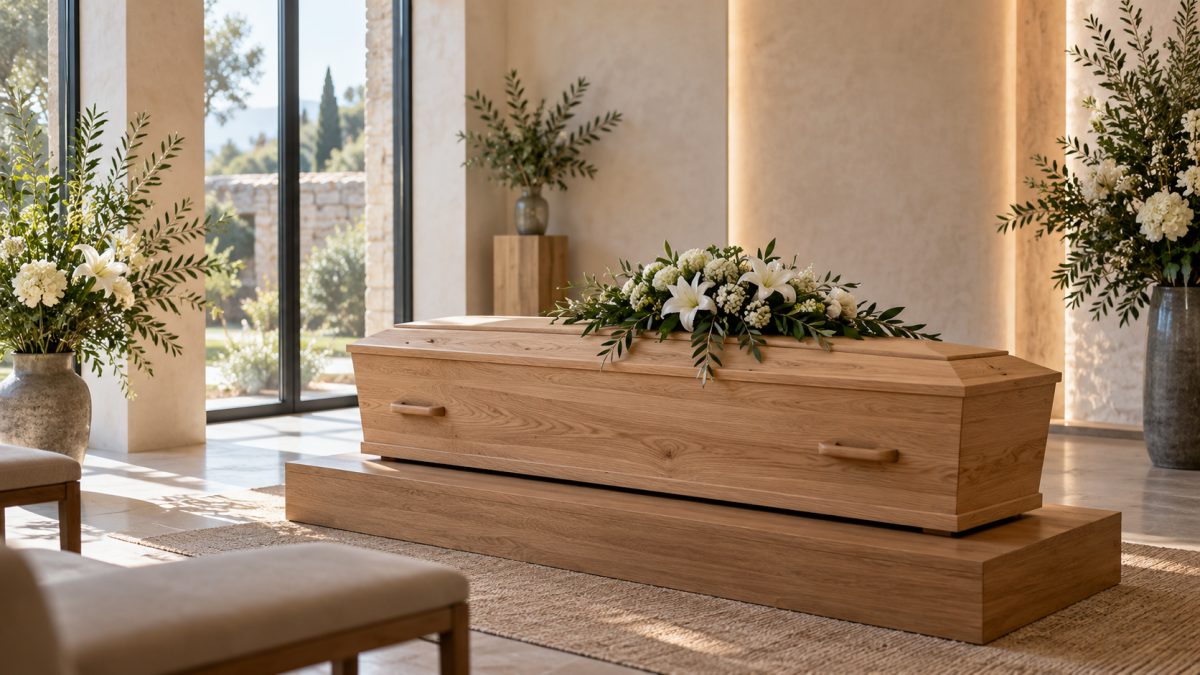
The eco-friendly funerals in France are attracting growing interest, particularly in human composting, a method intended to turn a body into humus. However, this practice is not permitted in France. Families arranging a funeral today must therefore examine legally available services and ask funeral directors for precise information about costs and environmental impacts.
The issue of eco-friendly funerals is not simply a matter of choosing a method marketed as natural. Between promising results from an animal experiment, legal restrictions and the actual cost of a ceremony, it is essential to distinguish what has been demonstrated, what still needs study and what can be decided now.
Is human composting permitted in France?
No, human composting is not an authorised funeral service in France. This method relies on the decomposition of a body in contact with plant matter, with the aim of turning it into humus. It is currently being researched, notably through the F-Compost project.
The Humo Sapiens association advocates making the practice available in France and participates in the experiment reported by the CNRS. However, the existence of a scientific programme does not amount to permission to use the method on human remains.
As Funéraire Actualités points out, any legalisation would require legislative action. Families therefore cannot treat human composting as an option they can book with a funeral provider.
What does the experiment near Les Ulis actually show?
The experiment described by the CNRS provides concrete observations about decomposition in the presence of plant matter. It does not, however, establish that human composting has already been validated technically, economically or environmentally.
An experiment involving sheep carcasses
According to the CNRS, the research team received permission on 26 June 2025 to use land near the Les Ulis cemetery. The experiment involved eight pits containing sheep carcasses weighing approximately 35 kilograms each.
The protocol compared two situations: carcasses buried directly in soil and others covered with shredded plant material. This made it possible to observe the role of plant matter in decomposition.
When the carcasses were exhumed roughly a year after burial, between June 2025 and July 2026, those placed in shredded vegetation had decomposed completely apart from their bones. According to the CNRS report, the corresponding pits also had no distinctive odour when opened.
Why are these findings not enough?
These observations are interesting, but their scope must be carefully defined. They concern animal carcasses under specific experimental conditions, not a funeral service for deceased people.
In particular, they provide neither a price for human composting nor a measured environmental assessment. Nor do they establish, on their own, that the process could be applied directly to human funerals.
Observed decomposition is not an environmental assessment. This distinction is essential: seeing organic matter break down does not automatically tell us about all the resources consumed, emissions generated or operations required.
Which lower-impact funeral options can families choose today?
For a family seeking to reduce the footprint of a funeral, the first step is to ask funeral providers about the options that are actually legal and the services they offer.
Human composting cannot be included among the options currently available. Families can, however, request a detailed comparison of the funeral arrangements a provider is authorised to organise, without assuming that one option is necessarily greener than another.
The public information presented here does not establish a comprehensive, verified list of lower-impact funeral arrangements currently permitted. It would therefore be misleading to present particular services as universally available without checking first.
Ask specific questions
Rather than simply asking for a “green” funeral, it is better to specify the goal: limit services, reduce travel, avoid unnecessary equipment or understand the environmental consequences of the proposed choices.
These are questions to explore, not guaranteed savings or emissions reductions. The funeral provider must confirm whether they are feasible and worthwhile.
A useful request might be:
“I would like to arrange a funeral that uses as few resources as possible. Could you explain the permitted options, distinguish essential services from optional ones, and share any environmental information you have?”
This wording has one advantage: it moves the discussion from general promises to verifiable choices.
Which items on a funeral quote should you compare?
A quote can look straightforward if you only consider the total. But understanding differences between offers requires examining what each includes.
The available documents contain no comparable prices or numerical breakdown of costs. It is therefore impossible to state here how much a simpler funeral would cost or promise any percentage saving.
Families can nevertheless ask providers to explain several elements:
- Essential services: which are required in the particular circumstances, and which are optional?
- Equipment offered: which models are available, what are their characteristics, and how do their prices differ?
- Transport: what journeys and procedures are planned, and what opportunities exist to reduce travel?
- Ceremony arrangements: which services are included, added or removable?
- Additional charges: what expenses might be added to the initial quoted amount?
This is a practical checklist of questions, not an official list of mandatory charges. Answers depend on the circumstances and the services actually offered.
To compare quotes fairly, the most important thing is to request offers covering the same scope. A cheaper quote that excludes certain services should not be compared directly with one that includes them.
How can you compare environmental impacts accurately?
The main difficulty is the lack of directly comparable data in the information examined here. No measured assessment of human composting is available, and emissions figures sometimes quoted for burial and cremation are not supported by a sufficiently documented calculation method to serve as a common benchmark.
It would therefore be unwise to claim that human composting cuts emissions by a specific amount or to rank other options using figures that cannot be verified.
Three checks before accepting an environmental claim
- Identify what is measured: emissions, energy consumption, materials used or another indicator?
- Check the scope: does the comparison cover the same operations and services?
- Ask where the figures come from: is there an identifiable study, an explained methodology and accessible results?
A company may genuinely pursue a resource-conscious approach without having a complete environmental study. In that case, it is simply important to distinguish stated commitments from benefits that have actually been quantified.
One personal observation is worth emphasising: the most reassuring option is not necessarily the one using the greenest language, but the one whose characteristics can be checked. A modest, transparent offer is easier to assess than a service described as natural without further explanation.
How can you decide right now?
For a family facing an immediate decision, waiting for hypothetical approval of human composting offers no practical solution. Scientific research continues, while funeral decisions must comply with existing regulations.
A sensible approach is to request several quotes, seek explanations for each service, and then consider three separate criteria: total cost, whether the funeral arrangement is legally permitted, and the environmental information actually available.
It is also useful to keep written responses to your questions. They make it easier to revisit differences between offers and discuss choices without relying solely on marketing claims.
Finally, the absence of an environmental figure does not mean a service has no impact or that it is necessarily harmful. It simply means the impact cannot be reliably quantified using the information presented.
Human composting therefore raises important questions about the future of funeral practices, but it does not replace a rigorous comparison of available services today.
Frequently asked questions
Is human composting legal in France?
No. Human composting is not authorised as a funeral practice in France. The F-Compost project is investigating the possibility, but any approval would require a change in the law.
What does the human composting experiment near Les Ulis prove?
The experiment reported by the CNRS shows that sheep carcasses placed in shredded plant material had decomposed, apart from the bones, when exhumed. On its own, it does not prove the feasibility of human composting or establish its environmental impact.
How can you request a more eco-friendly funeral?
Ask which services are legally available, which can be adapted and what environmental evidence exists. A detailed quote then allows you to compare offers rather than relying on a marketing label.
Is human composting cheaper than cremation or burial?
There is no documented cost for human composting here that would allow a reliable comparison. Since the practice is not authorised in France, it should not be presented as a commercially available service with a verified price.