
 English
  French
  German
  Spanish
  Hindi
Hindi  Italian
  Japanese
  Korean
  Norwegian
  Chinese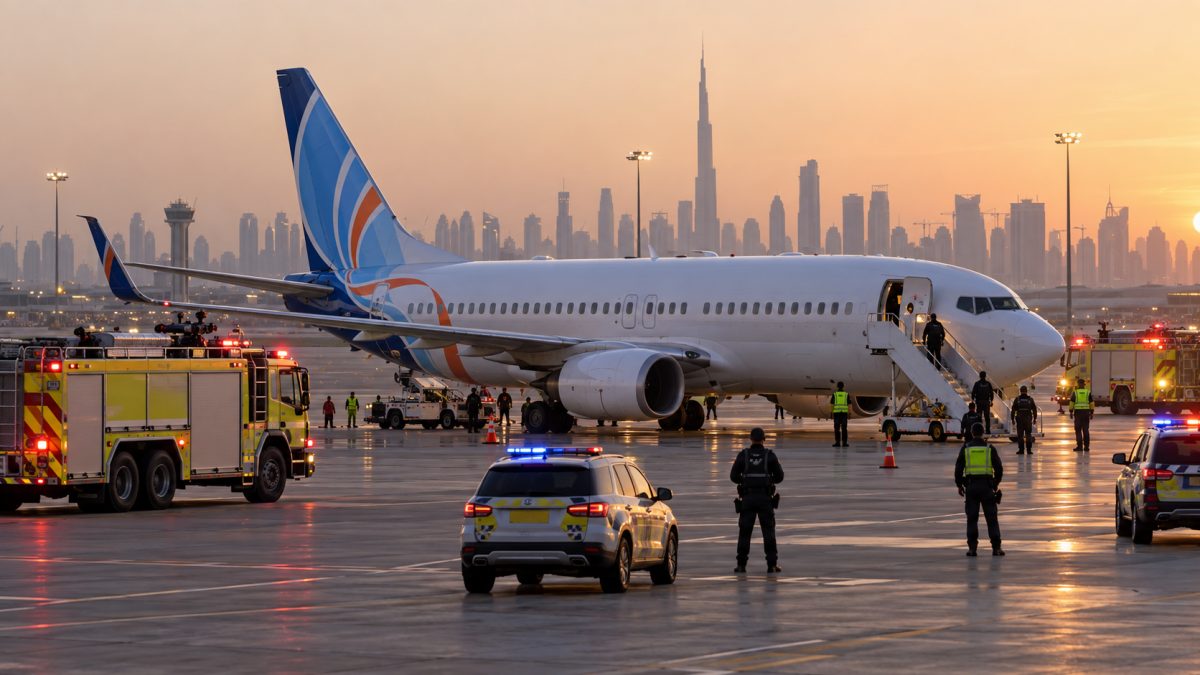
Flydubai Flight FZ1073: What Impact on the Israeli Elections?
Flydubai flight FZ1073, traveling from Dubai to Tel Aviv, was diverted to Tabuk on September 30, 2026, after a violent altercation in the cockpit and a sudden plunge by the aircraft. The episode came 27 days before Israel's October 27 parliamentary election, which is due to renew all 120 seats in the Knesset.
Flydubai flight FZ1073 therefore affects both the safety of regional air links and an election campaign already dominated by security issues. The facts show an immediate political effect on campaign messaging and an operational effect on links between the United Arab Emirates and Israel, but not enough evidence to quantify any shift in votes or stock-market reaction.
What happened minute by minute on flight FZ1073?
The most usable timeline is based on flight data reported by Al Jazeera from Flightradar24. The Boeing 737 MAX 8, registered A6-FKF, took off from Dubai at 03:05 GMT on September 30, 2026, and reached about 34,000 feet.
- 05:21 GMT: according to Al Jazeera and Flightradar24, a sudden descent began. Other accounts describe a loss of about 17,000 feet, while Le Monde reports 14,000 feet in less than 30 seconds.
- 05:28 to 05:31 GMT: the transponder switched to code 7700, the general emergency signal. Differences of a few minutes between reports mean the times should be treated as reference points.
- around 05:33 GMT: according to Al Jazeera, the aircraft was at around 15,000 feet, or 4,572 meters.
- 05:35 to 05:38 GMT: the code changed to 7500, used to signal unlawful interference or hijacking.
- 05:44 GMT: Tabuk air traffic control received a distress call, according to Al Jazeera.
- 06:45 GMT: the aircraft landed in Tabuk. Other reports give slightly different local times.
- 17:40 Saudi time: according to Gulf News, the passengers departed for Tel Aviv on another aircraft.
The 180 occupants cited by the English-language version of Wikipedia — 174 passengers and 6 crew members — survived. The exact injury count varies: the cited sources range from 2 injured to more than 6. The captain was, in any case, seriously injured.
According to several authorities, the first officer attacked the captain and then tried to send the aircraft into a dive. The captain reportedly managed to open the cockpit, allowing passengers to subdue the first officer. Flydubai pilots traveling as professional passengers then took control and flew to Tabuk. The United Arab Emirates described the incident as an attempted “terrorist act,” while Al Jazeera was still noting the lack of independent confirmation of a hijacking.
Can the incident actually change Israel's election timetable?
No available evidence shows any postponement or formal change to the October 27, 2026 election. The date remains set for the renewal of the Knesset's 120 seats, where an absolute majority requires 61 seats.
The visible effect is instead on the political calendar. On September 29, the day before the incident, Benjamin Netanyahu had warned that Israel's enemies might attempt attacks before the vote. Yair Lapid received a security briefing that same evening and called for the threats not to be exploited politically.
After FZ1073, Netanyahu incorporated the event into his campaign communications by releasing images of his meeting with a passenger who had helped subdue the first officer. This comes as his image as a protector is also being challenged following revelations about failures preceding the October 7, 2023 massacre.
The key figure is therefore the interval: 27 days separate the incident from the vote. That is enough time to keep aviation and regional security in the campaign, but not enough to assert a measurable electoral effect. Likud won 32 seats in 2022, but no available data can translate FZ1073 into seats gained or lost.
What concrete impact is there on regional air traffic?
The Israeli Air Force dispatched fighter jets and Israel closed its airspace after the transponder alert. Gulf News also says the episode affected air links between the United Arab Emirates and Israel.
The 180 people on the flight did not continue their journey on the same aircraft: they waited in Tabuk before departing on another plane. Between the landing at 06:45 GMT and the announced departure at 17:40 Saudi time, the onboard emergency turned into an operational disruption lasting several hours.
However, no available data gives the number of canceled flights, the percentage decline in traffic, or a financial cost for Flydubai. It would therefore be misleading to quantify a regional economic loss.
What can really be compared with three similar precedents?
A robust comparison should cover three areas: aviation safety, airline stock-market reactions, and political decisions triggered. Yet the verified facts available provide no figures for three specific previous incidents. Naming three precedents and assigning them a stock-market movement or a quantified political decision would amount to invention.
For FZ1073, the safety dimension is measurable: a drop of 14,000 to 17,000 feet depending on the source, codes 7700 followed by 7500, diversion to Tabuk, and closure of Israeli airspace. The political dimension is documented: Netanyahu's warning the day before, Lapid's briefing, then the incorporation of the incident into the campaign. The stock-market dimension, by contrast, has no verified figures.
This difference is instructive: the political and operational effects are immediately visible, while the financial effect requires precise market data. Without it, talk of a “stock-market shock” would be speculative.
What this episode really changes 27 days before the vote
An aviation event lasting a few minutes can occupy several weeks of the political agenda without formally changing a single election date. At this stage, FZ1073 does not change October 27, 2026; it mainly changes the issue on which political leaders must take a position.
It brings back to the forefront the state's ability to anticipate threats, the protection of international air links, and the credibility of leaders when they speak about security. The opposition, which hopes for a change of government around figures including Gadi Eisenkot and the Yashar party, must respond without allowing the entire campaign to be reduced to security.
Finally, fact and interpretation must be distinguished. The investigations involve Israel, Oman, Saudi Arabia, the United Arab Emirates, and the United States. Until the exact motives are definitively established, the incident can carry political weight as a security event without its origin being regarded as conclusively proven.
Frequently asked questions
What exactly happened during the attempted hijacking of flight FZ1073?
On September 30, 2026, the Dubai–Tel Aviv flight experienced a violent cockpit altercation, a sudden plunge, and the transmission of emergency codes 7700 and then 7500. The injured captain was able to open the cockpit, passengers subdued the first officer, and other Flydubai pilots on board landed the aircraft in Tabuk.
Can flight FZ1073 postpone the Israeli elections?
No available fact indicates a postponement: the parliamentary election remains scheduled for October 27, 2026. The observed impact is mainly on the campaign, as the incident puts security back at the center of debate 27 days before the vote.
What is the measurable impact on air traffic?
Israel closed its airspace after the alert and fighter jets were dispatched. The passengers continued their journey on another aircraft, but no reliable available figure measures the total number of canceled flights or the economic cost.
Can FZ1073 be compared with three precedents in stock-market and political terms?
Not quantitatively with the verified data available: no market figures or comparable series covering three earlier incidents has been established. It is better to state that clearly than to fabricate stock movements or political consequences.