

NASA presents the new 2020 Martian Rover
Information
Video published by CNET
In the next chapter of exploration, NASA wants to send another Rover (currently planned for the summer of 2020).
This new Rover is assembled in a meticulously sterilized room ("NASA's Jet Propulsion Laboratory" in Southern California), and engineers must be decontaminated when entering this room (acetone, brushing, etc.), which itself filters its air intensively (70 times every hour).
This important sterilization procedure will help avoid confusing particles from the design phase with those collected on Mars.
This Rover will be sent to look for traces of bacteriological life, test new technologies, and collect rock samples. These will be the first pieces of the red planet brought back to Earth for further analysis.
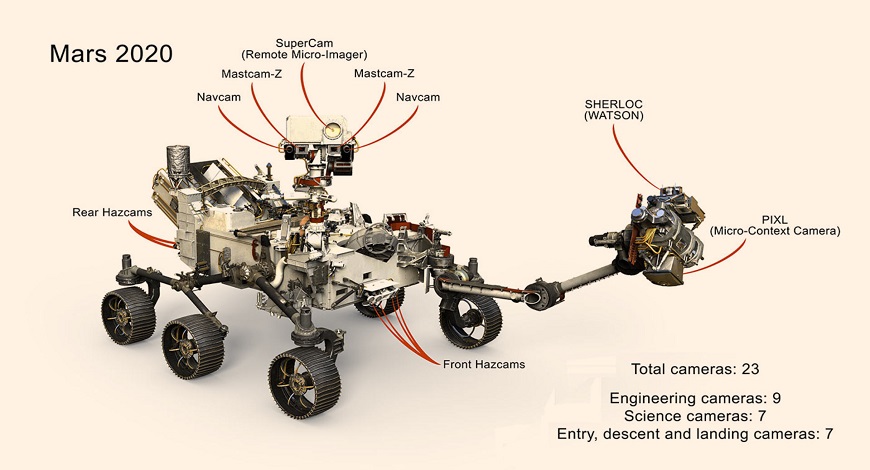
It is equipped with a high-definition camera, a laser on its head to measure elements and distances, a spectrometer to identify the composition of rock, and a drill capable of collecting and storing samples in a sample tube, with a system that will be able to send a group of samples back to Earth. Unlike the previous Rover, its wheels will be stronger and more flexible to avoid the deterioration observed on the old model.
In addition, it has a small system designed to create a scientific experiment to transform the carbon dioxide abundantly present in the atmosphere into oxygen.
It will be accompanied by a small helicopter attached to the Rover, allowing aerial footage to be filmed.
Finally, all this equipment will have to be placed on the surface of Mars, which will not be easy; they are considering using a lander with 4 thrusters that will lower the Rover attached underneath by cables.
A very large and beautiful project that will allow us to better understand the planet Mars.
NASA presents the new 2020 Martian Rover
Information
Video published by CNET
In the next chapter of exploration, NASA wants to send another Rover (currently planned for the summer of 2020).
This new Rover is assembled in a meticulously sterilized room ("NASA's Jet Propulsion Laboratory" in Southern California), and engineers must be decontaminated when entering this room (acetone, brushing, etc.), which itself filters its air intensively (70 times every hour).
This important sterilization procedure will help avoid confusing particles from the design phase with those collected on Mars.

This Rover will be sent to look for traces of bacteriological life, test new technologies, and collect rock samples. These will be the first pieces of the red planet brought back to Earth for further analysis.
It is equipped with a high-definition camera, a laser on its head to measure elements and distances, a spectrometer to identify the composition of rock, and a drill capable of collecting and storing samples in a sample tube, with a system that will be able to send a group of samples back to Earth. Unlike the previous Rover, its wheels will be stronger and more flexible to avoid the deterioration observed on the old model.
In addition, it has a small system designed to create a scientific experiment to transform the carbon dioxide abundantly present in the atmosphere into oxygen.
It will be accompanied by a small helicopter attached to the Rover, allowing aerial footage to be filmed.
Finally, all this equipment will have to be placed on the surface of Mars, which will not be easy; they are considering using a lander with 4 thrusters that will lower the Rover attached underneath by cables.
A very large and beautiful project that will allow us to better understand the planet Mars.
NASA presents the new 2020 Martian Rover
Information
Video published by CNET
In the next chapter of exploration, NASA wants to send another Rover (currently planned for the summer of 2020).
This new Rover is assembled in a meticulously sterilized room ("NASA's Jet Propulsion Laboratory" in Southern California), and engineers must be decontaminated when entering this room (acetone, brushing, etc.), which itself filters its air intensively (70 times every hour).
This important sterilization procedure will help avoid confusing particles from the design phase with those collected on Mars.

This Rover will be sent to look for traces of bacteriological life, test new technologies, and collect rock samples. These will be the first pieces of the red planet brought back to Earth for further analysis.
It is equipped with a high-definition camera, a laser on its head to measure elements and distances, a spectrometer to identify the composition of rock, and a drill capable of collecting and storing samples in a sample tube, with a system that will be able to send a group of samples back to Earth. Unlike the previous Rover, its wheels will be stronger and more flexible to avoid the deterioration observed on the old model.
In addition, it has a small system designed to create a scientific experiment to transform the carbon dioxide abundantly present in the atmosphere into oxygen.
It will be accompanied by a small helicopter attached to the Rover, allowing aerial footage to be filmed.
Finally, all this equipment will have to be placed on the surface of Mars, which will not be easy; they are considering using a lander with 4 thrusters that will lower the Rover attached underneath by cables.
A very large and beautiful project that will allow us to better understand the planet Mars.
English
French
Spanish
Chinese
Japanese
Korean
Hindi
German
Norwegian