
 English
  French
  German
  Spanish
  Hindi
Hindi  Italian
  Japanese
  Korean
  Norwegian
  Chinese
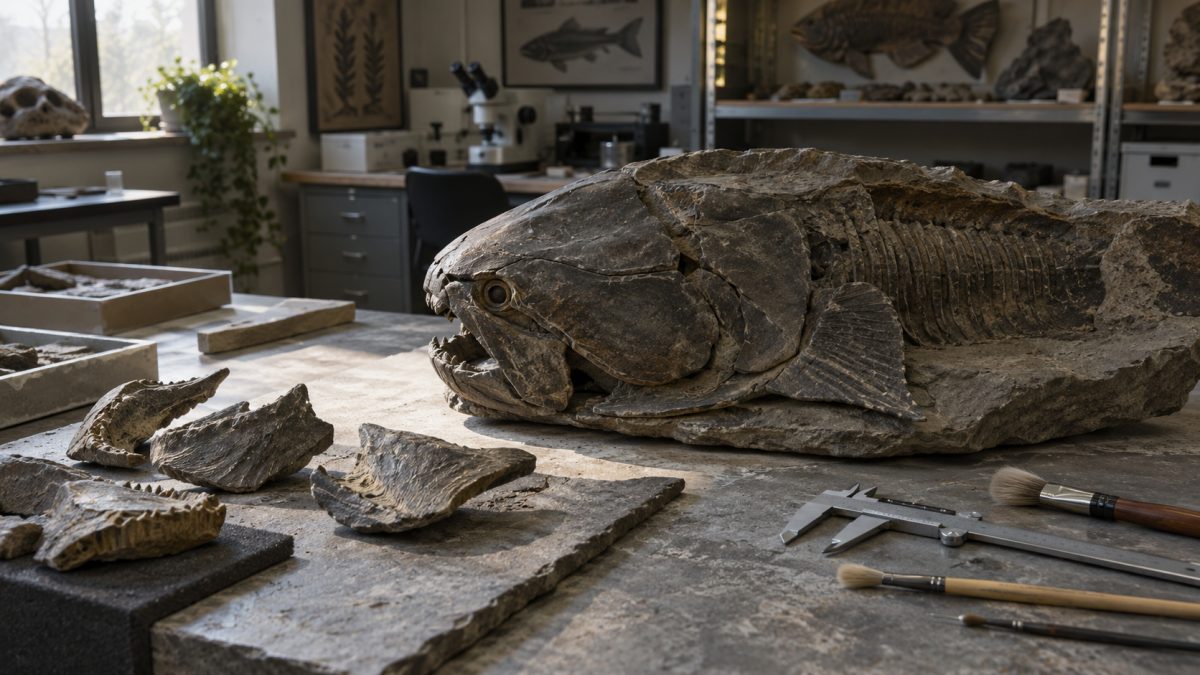
Placoderms: when jaw evolution was still experimenting
We like to tell the story of evolution as if it were a staircase. An innovation appears, improves what came before, and then another one perfects it. In this reassuring version of the story, the jaw would be a kind of decisive invention whose early forms gradually led to the efficient architectures we know today. Placoderms tell a much messier story, and therefore a much more interesting one.
These armored fishes of the Silurian and Devonian, present between roughly 439 and 358.9 million years ago, are among the earliest jawed vertebrates known from the fossil record. Yet their jaws do not look like a sequence of prototypes lined up from rudimentary to perfected. They look more like a workshop in which several solutions were tested in parallel, some very different from one another, before all those lineages disappeared.
A jaw is not a step, it is a space of solutions
The Gogo Formation in Western Australia offers a particularly vivid picture of this diversity. A study published in Scientific Reports compared eight placoderm species about 385 million years old. The fossil jaws were digitized using micro-CT or surface scanning, then turned into 3D models to simulate how they worked and the forces involved in biting.
The key result is not that one form was better than the others. Quite the opposite: animals facing the same general problem — grasping and processing food — could arrive at very different devices.
In Rolfosteus canningensis, the smallest placoderm examined, the dental plates were smooth and flat. At the other extreme, the large Kimberleyichthys bore raised structures mounted on a bony ridge. The researchers liken this latter arrangement to a weapon designed to concentrate force in order to pierce or crush protection, whereas the flatter plate is more reminiscent of a blunt crushing tool with an effective edge.
In neither case, then, are we looking at a “weak” jaw versus an “advanced” jaw. Both size extremes had robust systems, but they did not solve the same problem in the same way. Small placoderms probably fed mainly on small prey that could be crushed between their plates. Larger ones, with greater energy requirements, may have favored prey that had to be broken into pieces before being swallowed.
This already shows what the story of linear progress misses: an innovation does not necessarily produce a single trajectory. Sometimes it opens up a field of possibilities. Natural history does not select one mock-up after another like an engineering office. Several forms can work at the same time because they occupy different niches.
The survivor trap
Another fossil makes the picture even more complicated. Acanthothoracids are generally regarded as very primitive placoderms, but they are often known from incomplete and disarticulated remains. The study of an almost complete upper jaw from the Early Devonian of Mongolia showed that bite-related morphology could remain strongly conserved across several groups despite very different skull geometries. The researchers also suggest that integration of the dermal skeleton may have provided a solid biomechanical foundation for the origin of jaws.
In other words, diversity does not mean total chaos. Some foundations seem stable while other parts diversify dramatically. It is precisely this mixture that makes the story so difficult to turn into an arrow pointing toward a final outcome.
We also know that the two major living lineages of jawed vertebrates, chondrichthyans and osteichthyans, diverged more than 400 million years ago. They therefore do not provide a faithful snapshot of the very first gnathostomes. Looking only at present-day survivors is like observing the exit of a maze and then imagining that the path was always bound to lead there.
Here we need to resist a temptation: saying that “a single jaw solution won.” Fossils document a real diversity of solutions among placoderms, but they do not allow us to identify a simple competition from which one model emerged victorious. Nor do they tell us that one particular morphology eliminated the others because it was intrinsically superior. Placoderm lineages disappeared; that does not automatically turn their jaws into bad inventions.
The teeth themselves blur the scenario
The traditional story becomes even less linear when jaws and teeth are separated. Work reported by the European JAWS Emerge program has challenged the idea that they necessarily appeared together. In this framework, some research suggests an evolutionary decoupling between the two, with early jawed vertebrates lacking teeth.
The case of Loganellia scotica, a primitive jawless vertebrate, is instructive. Structures that looked like teeth were studied and interpreted as internal scales distinct from the teeth of jawed vertebrates. Similar forms can therefore appear independently when they respond to comparable constraints: this is the principle of convergent evolution.
This point matters because it destroys another retrospective illusion. When two elements work together today, we tend to imagine that evolution must have produced them together. Fossils instead force us to consider histories made of assemblies, dissociations and similar solutions that appeared along different paths.
A “failed evolution” is not necessarily bad evolution
Calling something a “failed evolution” is deliberately provocative. Scientifically, an extinct lineage is not a prototype rejected by a jury. The placoderms of Gogo instead show specialized animals capable of processing food with powerful, differentiated jaws. John Long and his colleagues see them as evidence of niche partitioning and ecological specialization in Devonian reefs.
Failure appears only in hindsight, when we look at the tree from its surviving branches. It is a bias of perspective: what still exists can easily seem more logical, more accomplished or more efficient than what disappeared. Yet the fossil record shows at the very least that several viable answers to the same problem once existed.
To my mind, this is where placoderms become more interesting than a simple paleontological curiosity. They teach us not to confuse survival with optimality. A solution can be good in its context without becoming the ancestor of the future world. Another can become dominant without history proving that it was the best of all imaginable solutions.
What fossil jaws can tell technology
The parallel with human innovation must remain a comparison, not an equivalence. A company, a protocol or a technical object does not reproduce like a biological population. But placoderms offer a useful intellectual discipline: when a technology dominates, we should avoid rewriting its past as though that dominance had been obvious from the start.
We can imagine several competing solutions to the same need. Some will suit specific uses, while others will work in different environments. Over time, one trajectory becomes central while others fall out of use. Once that sorting has happened, our perspective easily reconstructs a straight line: the old solution looks archaic, the survivor looks necessary.
Placoderms invite us to reverse that reading. The right question is not only: “Why did this solution win?” It is also: “Which functional solutions disappeared from the story because they left no living descendants?” That shift matters enormously when thinking about innovation. It reminds us that a failure may contain a relevant answer, that an abandoned path was not necessarily absurd, and that a dominant outcome may depend on a particular history rather than on absolute superiority.
There is something salutary in these armored fishes hundreds of millions of years old. They do not show us nature methodically progressing toward the perfect jaw. They show organisms exploring several ways of working with the structures available to them, in different niches, along trajectories that did not know their own future. That may be the best definition of real innovation: not a march toward perfection, but a multiplication of bets, only some of which history preserves.