
 Norwegian
  French
  German
  English
  Spanish
  Hindi
Hindi  Italian
  Japanese
  Korean
  Chinese
Domestic Robots 2026: When AI Comes Home
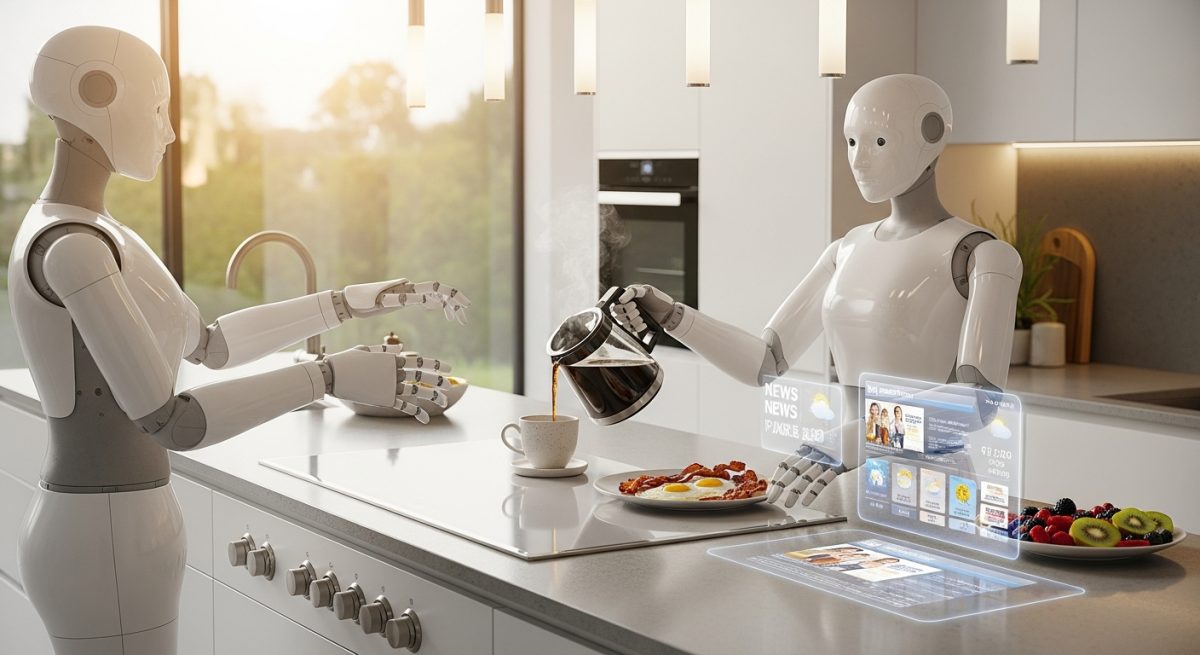
Imagine coming home after a long day of work to find your laundry folded, your dishwasher loaded, and your coffee ready to be served. This scenario, long reserved for science fiction films, is becoming reality in 2026. Articulated-arm domestic robots are entering our homes, and they are far more impressive than the simple autonomous vacuum cleaners we have grown accustomed to.
The new generation of domestic robots
At CES 2026, tech giants unveiled machines capable of performing complex household chores. We are no longer talking about robots that simply vacuum or mow the lawn. The newcomers are equipped with articulated arms, multi-fingered hands, and sufficiently advanced artificial intelligence to understand their environment and interact with it smoothly.
This evolution is part of what experts call "Physical AI", meaning the integration of artificial intelligence into physical bodies capable of acting in the real world. After years of progress in language and image processing, AI is now moving into concrete action.
LG CLOiD: the robotic butler
LG made a strong impression with CLOiD, its autonomous domestic robot. Equipped with two articulated arms each offering seven degrees of freedom, CLOiD can perform movements of remarkable fluidity. Its hands, composed of five independent fingers, allow it to manipulate objects with astonishing precision.
In practice, CLOiD is capable of preparing breakfast by fetching milk from the refrigerator or placing a pastry in the oven. When no one is home, it can start a laundry cycle, then fold and stack the clothes once the cycle is complete. The robot uses computer vision sensors and learning algorithms to recognize objects, navigate the home, and adapt its gestures to the situations it encounters.
Most impressive is its continuous learning capability. CLOiD improves over time by observing the habits of its owners and adjusting its actions accordingly. It learns, for example, the usual location of each object and can tidy things up according to each person's preferences.
SwitchBot Onero H1: the heart of the smart home 2.0
On the SwitchBot side, the Onero H1 positions itself as the central pillar of a smart home ecosystem. With its 22 degrees of freedom distributed across its two arms, this robot simulates movements close to those of the human hand, allowing it to naturally interact with the domestic environment.
SwitchBot highlights concrete, everyday use cases: serving coffee, loading plates into the dishwasher, folding laundry, or putting objects back in their place. The Onero H1 communicates with all existing SwitchBot devices already present in the home, creating a true intelligent domestic network where each device works in synergy.
SwitchBot's approach stands out through its integration into an existing ecosystem. Rather than offering an isolated robot, the brand conceives the H1 as a conductor that coordinates all the connected devices in the home for complete daily automation.
Honor enters the scene
At Mobile World Congress 2026, Honor also unveiled its first humanoid domestic robot. While technical details remain confidential, this announcement confirms that domestic robots are no longer a niche market. Major smartphone and consumer electronics manufacturers now consider this segment as strategic for the years ahead.
This proliferation of players is excellent news for consumers, as competition should accelerate innovation and help drive prices down, making these technologies accessible to more people.
Challenges still to overcome
Despite these spectacular advances, several obstacles remain before domestic robots become as common as smartphones. The first is obviously price. The first available models are in price ranges that are still high, often exceeding several thousand euros.
The question of safety also arises. A robot equipped with articulated arms evolves in an environment shared with humans, children, and pets. Manufacturers must guarantee reliable detection and emergency stop systems to avoid any domestic accidents.
Finally, personal data protection is a major issue. These robots constantly observe, film, and analyze their environment to function. Questions about the storage, processing, and sharing of this data are legitimate and will need to find satisfactory answers before mass adoption.
Towards a transformed daily life
The arrival of articulated-arm domestic robots marks a pivotal moment in our relationship with technology. For the first time, artificial intelligence is not limited to processing information or generating content: it acts physically in our living space.
The coming years will be decisive. If manufacturers can resolve the issues of price, safety, and privacy, we could witness the emergence of a new market as important as that of smartphones. In the meantime, one thing is certain: household chores may have finally found their successor.
In 2026, the question is no longer whether robots will be part of our daily lives, but when they will enter for good.



Domestic Robots 2026: When AI Comes Home
Imagine coming home after a long day of work to find your laundry folded, your dishwasher loaded, and your coffee ready to be served. This scenario, long reserved for science fiction films, is becoming reality in 2026. Articulated-arm domestic robots are entering our homes, and they are far more impressive than the simple autonomous vacuum cleaners we have grown accustomed to.
The new generation of domestic robots
At CES 2026, tech giants unveiled machines capable of performing complex household chores. We are no longer talking about robots that simply vacuum or mow the lawn. The newcomers are equipped with articulated arms, multi-fingered hands, and sufficiently advanced artificial intelligence to understand their environment and interact with it smoothly.
This evolution is part of what experts call "Physical AI", meaning the integration of artificial intelligence into physical bodies capable of acting in the real world. After years of progress in language and image processing, AI is now moving into concrete action.
LG CLOiD: the robotic butler
LG made a strong impression with CLOiD, its autonomous domestic robot. Equipped with two articulated arms each offering seven degrees of freedom, CLOiD can perform movements of remarkable fluidity. Its hands, composed of five independent fingers, allow it to manipulate objects with astonishing precision.
In practice, CLOiD is capable of preparing breakfast by fetching milk from the refrigerator or placing a pastry in the oven. When no one is home, it can start a laundry cycle, then fold and stack the clothes once the cycle is complete. The robot uses computer vision sensors and learning algorithms to recognize objects, navigate the home, and adapt its gestures to the situations it encounters.
Most impressive is its continuous learning capability. CLOiD improves over time by observing the habits of its owners and adjusting its actions accordingly. It learns, for example, the usual location of each object and can tidy things up according to each person's preferences.
SwitchBot Onero H1: the heart of the smart home 2.0
On the SwitchBot side, the Onero H1 positions itself as the central pillar of a smart home ecosystem. With its 22 degrees of freedom distributed across its two arms, this robot simulates movements close to those of the human hand, allowing it to naturally interact with the domestic environment.
SwitchBot highlights concrete, everyday use cases: serving coffee, loading plates into the dishwasher, folding laundry, or putting objects back in their place. The Onero H1 communicates with all existing SwitchBot devices already present in the home, creating a true intelligent domestic network where each device works in synergy.
SwitchBot's approach stands out through its integration into an existing ecosystem. Rather than offering an isolated robot, the brand conceives the H1 as a conductor that coordinates all the connected devices in the home for complete daily automation.
Honor enters the scene
At Mobile World Congress 2026, Honor also unveiled its first humanoid domestic robot. While technical details remain confidential, this announcement confirms that domestic robots are no longer a niche market. Major smartphone and consumer electronics manufacturers now consider this segment as strategic for the years ahead.
This proliferation of players is excellent news for consumers, as competition should accelerate innovation and help drive prices down, making these technologies accessible to more people.
Challenges still to overcome
Despite these spectacular advances, several obstacles remain before domestic robots become as common as smartphones. The first is obviously price. The first available models are in price ranges that are still high, often exceeding several thousand euros.
The question of safety also arises. A robot equipped with articulated arms evolves in an environment shared with humans, children, and pets. Manufacturers must guarantee reliable detection and emergency stop systems to avoid any domestic accidents.
Finally, personal data protection is a major issue. These robots constantly observe, film, and analyze their environment to function. Questions about the storage, processing, and sharing of this data are legitimate and will need to find satisfactory answers before mass adoption.
Towards a transformed daily life
The arrival of articulated-arm domestic robots marks a pivotal moment in our relationship with technology. For the first time, artificial intelligence is not limited to processing information or generating content: it acts physically in our living space.
The coming years will be decisive. If manufacturers can resolve the issues of price, safety, and privacy, we could witness the emergence of a new market as important as that of smartphones. In the meantime, one thing is certain: household chores may have finally found their successor.
In 2026, the question is no longer whether robots will be part of our daily lives, but when they will enter for good.
Domestic Robots 2026: When AI Comes Home
Imagine coming home after a long day of work to find your laundry folded, your dishwasher loaded, and your coffee ready to be served. This scenario, long reserved for science fiction films, is becoming reality in 2026. Articulated-arm domestic robots are entering our homes, and they are far more impressive than the simple autonomous vacuum cleaners we have grown accustomed to.
The new generation of domestic robots
At CES 2026, tech giants unveiled machines capable of performing complex household chores. We are no longer talking about robots that simply vacuum or mow the lawn. The newcomers are equipped with articulated arms, multi-fingered hands, and sufficiently advanced artificial intelligence to understand their environment and interact with it smoothly.
This evolution is part of what experts call "Physical AI", meaning the integration of artificial intelligence into physical bodies capable of acting in the real world. After years of progress in language and image processing, AI is now moving into concrete action.
LG CLOiD: the robotic butler
LG made a strong impression with CLOiD, its autonomous domestic robot. Equipped with two articulated arms each offering seven degrees of freedom, CLOiD can perform movements of remarkable fluidity. Its hands, composed of five independent fingers, allow it to manipulate objects with astonishing precision.
In practice, CLOiD is capable of preparing breakfast by fetching milk from the refrigerator or placing a pastry in the oven. When no one is home, it can start a laundry cycle, then fold and stack the clothes once the cycle is complete. The robot uses computer vision sensors and learning algorithms to recognize objects, navigate the home, and adapt its gestures to the situations it encounters.
Most impressive is its continuous learning capability. CLOiD improves over time by observing the habits of its owners and adjusting its actions accordingly. It learns, for example, the usual location of each object and can tidy things up according to each person's preferences.
SwitchBot Onero H1: the heart of the smart home 2.0
On the SwitchBot side, the Onero H1 positions itself as the central pillar of a smart home ecosystem. With its 22 degrees of freedom distributed across its two arms, this robot simulates movements close to those of the human hand, allowing it to naturally interact with the domestic environment.
SwitchBot highlights concrete, everyday use cases: serving coffee, loading plates into the dishwasher, folding laundry, or putting objects back in their place. The Onero H1 communicates with all existing SwitchBot devices already present in the home, creating a true intelligent domestic network where each device works in synergy.
SwitchBot's approach stands out through its integration into an existing ecosystem. Rather than offering an isolated robot, the brand conceives the H1 as a conductor that coordinates all the connected devices in the home for complete daily automation.
Honor enters the scene
At Mobile World Congress 2026, Honor also unveiled its first humanoid domestic robot. While technical details remain confidential, this announcement confirms that domestic robots are no longer a niche market. Major smartphone and consumer electronics manufacturers now consider this segment as strategic for the years ahead.
This proliferation of players is excellent news for consumers, as competition should accelerate innovation and help drive prices down, making these technologies accessible to more people.
Challenges still to overcome
Despite these spectacular advances, several obstacles remain before domestic robots become as common as smartphones. The first is obviously price. The first available models are in price ranges that are still high, often exceeding several thousand euros.
The question of safety also arises. A robot equipped with articulated arms evolves in an environment shared with humans, children, and pets. Manufacturers must guarantee reliable detection and emergency stop systems to avoid any domestic accidents.
Finally, personal data protection is a major issue. These robots constantly observe, film, and analyze their environment to function. Questions about the storage, processing, and sharing of this data are legitimate and will need to find satisfactory answers before mass adoption.
Towards a transformed daily life
The arrival of articulated-arm domestic robots marks a pivotal moment in our relationship with technology. For the first time, artificial intelligence is not limited to processing information or generating content: it acts physically in our living space.
The coming years will be decisive. If manufacturers can resolve the issues of price, safety, and privacy, we could witness the emergence of a new market as important as that of smartphones. In the meantime, one thing is certain: household chores may have finally found their successor.
In 2026, the question is no longer whether robots will be part of our daily lives, but when they will enter for good.