
 English
 French
 German
 Spanish
 Hindi
 Italian
 Japanese
 Korean
 Norwegian
 Chinese
66 billion trees: the trap of fast-growing forests
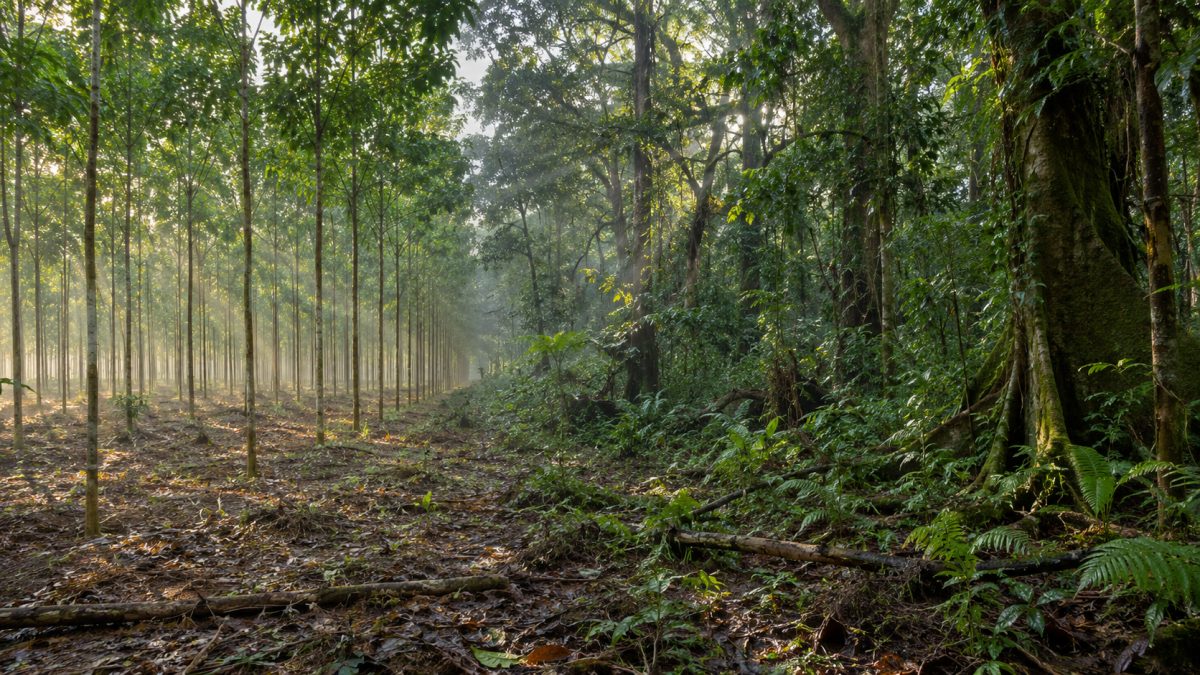
China has planted 66 billion trees since 1978 to combat desertification and capture carbon. A study in Geophysical Research Letters finds that planted forests grow 66% faster than natural forests, but rapid growth does not guarantee equivalent or lasting carbon storage.
This paradox extends far beyond China: what happens to climate strategies that rely on new trees as major natural carbon sinks show signs of slowing?
How did China turn tree planting into a global achievement?
China’s Great Green Wall aims to halt the Gobi and Taklamakan deserts and restore wooded areas that absorb carbon dioxide.
Futura Sciences reports 66 billion trees planted since 1978, with 34 billion more planned by 2050. Forest cover rose from 12% in 1990 to 20% in 2010.
Such a large-scale effort deserves recognition, especially in regions affected by desertification.
Yet the number of trees measures human action, not necessarily ecological success. A plantation can grow quickly without becoming an old-growth forest.
The study reports 66% faster growth in Chinese plantations than in the natural forests examined. That impressive result leaves a crucial climate question unanswered.
How much carbon will this ecosystem actually retain, and for how long?
Why do faster-growing forests not necessarily store more carbon?
We tend to picture forest carbon in trunks, branches and leaves: as trees grow, they accumulate biomass and carbon.
This reasoning is valid but incomplete.
A Swedish study in Science found that the plantations examined can store up to 83% less carbon than the natural or primary forests used for comparison.
Much of the difference lies underground: in the Swedish primary forests studied, soils held 64% of total carbon, trees 30%, and deadwood 6%.
Looking only at trunk growth means ignoring the largest part of the reservoir.
An ancient forest’s carbon is more than its trees
Old forest soils contain accumulated organic matter and complex interactions among plants, deadwood and soil that cannot be quickly recreated by planting seedlings.
Swedish research shows that logging an old forest can remove carbon storage capacity that replanting does not readily restore.
However, these findings concern Swedish boreal forests replanted after industrial logging. They do not prove that Chinese plantations in desertifying areas have the same 83% deficit.
The settings differ, but the lesson holds: tree growth rate and a forest’s total carbon stock are not interchangeable measures.
Are major natural carbon sinks also approaching their limits?
The concern grows when we consider oceans and land ecosystems, not just planted trees.
According to an analysis in The Conversation, oceans have absorbed 35% of fossil-fuel CO2 emissions since 1990, and forests and other vegetation another 13%.
Both have slowed atmospheric carbon accumulation substantially, but their future contribution is not guaranteed.
Oceans still absorb carbon, but growth in uptake may slow
The analysis finds that the ocean carbon sink has expanded, although that expansion could slow in coming decades.
This does not mean oceans have stopped absorbing CO2; the question is whether their capacity will continue increasing.
A sink can keep functioning without becoming more effective each year.
Land ecosystems may offer less protection
The Conversation also reports no clear expansion trend in the land carbon sink over recent decades, contrary to expectations.
Forests remain vital: Meteored cites global sequestration exceeding seven billion tonnes of CO2 annually, making them the second major natural sink after oceans.
Yet climate change can turn some forests from net carbon sinks into net sources.
The risk is not a sudden universal collapse, but stagnation or deterioration of carbon uptake in some ecosystems.
Nor is there evidence that China’s Great Green Wall has already reached saturation.
Why does this challenge carbon offsetting?
Imagine a company clearing an old forest and promising to plant trees elsewhere to offset the emissions. On paper, the exchange can look balanced.
But new trees cannot instantly replace carbon accumulated over decades or centuries, nor guarantee the same future stability.
China’s experience shows that vigorous growth can coexist with major ecological differences; the Swedish findings illustrate how much those differences can matter.
In my view, offsets sometimes confuse a future promise with an existing carbon stock. Planting is measurable immediately; long-term equivalence is not.
An old forest is carbon capital already accumulated; a plantation is ecological capital still being built. Both matter, but they are not immediately equivalent.
If natural sinks grow more slowly than expected, relying on future offsets to balance current emissions becomes even riskier.
What should France and Europe learn from China?
The lesson is not to stop planting trees, but to stop treating every plantation as equivalent.
A meta-analysis presented by Planted Forests finds that young mixed planted forests store, on average, 70% more aboveground carbon than monocultures of the same species.
This concerns aboveground carbon in young stands, not total storage across generations, but it shows that how trees are planted matters.
Forest policies should follow several principles:
- Protect existing forests: avoid losing old carbon stocks that plantations cannot quickly replace.
- Favor diverse stands: value mixed forests rather than focusing only on rapid growth.
- Measure soil carbon: include more than visible tree biomass.
- Track results over time: distinguish planting from durable carbon retention.
- Treat offsets cautiously: do not equate new plantations with mature forests.
These are directions suggested by available research, not proof of the effectiveness of any specific French or European program.
We should pay less attention to tree-planting totals and more to forests and soils that remain intact.
China has demonstrated enormous planting capacity, while carbon research shows that growth alone is not enough.
Planting more helps, but protecting existing carbon stores and cutting emissions at source is a stronger strategy.
Frequently asked questions
Why can planted forests store less carbon than natural forests?
Carbon is not only in trees. The Swedish Science study found that soils held 64% of carbon in the primary forests examined, while some plantations stored up to 83% less overall. These results cannot automatically be generalized worldwide.
Are oceans and forests becoming saturated?
The Conversation suggests slower growth in ocean uptake and no recent expansion trend on land. Both still absorb CO2; claiming universal saturation would be premature.
Can planting trees really offset CO2 emissions?
Plantations can capture carbon, but fast growth cannot guarantee the same durable storage as an old forest. Soil, permanence and ecosystem differences matter.
What can France and Europe apply from China’s experience?
Protect existing forests, diversify plantations and measure soil carbon as well as vegetation, without directly transferring Chinese results to different ecosystems.
Sources
- 66 billion trees planted in China: how these forests differ from natural ones (futura-sciences.com)
- Carbon storage: is replanting less effective than expected? (tameteo.com)
- Planted forests store much less carbon than natural forests (lesmotsontunsens.com)
- Oceans and forests have absorbed roughly half our carbon emissions (theconversation.com)
- Young mixed planted forests store more carbon than monocultures (plantedforests.org)
- Deforestation in China — Wikipedia (fr.wikipedia.org)