
 English
  French
  German
  Spanish
  Hindi
Hindi  Italian
  Japanese
  Korean
  Norwegian
  Chinese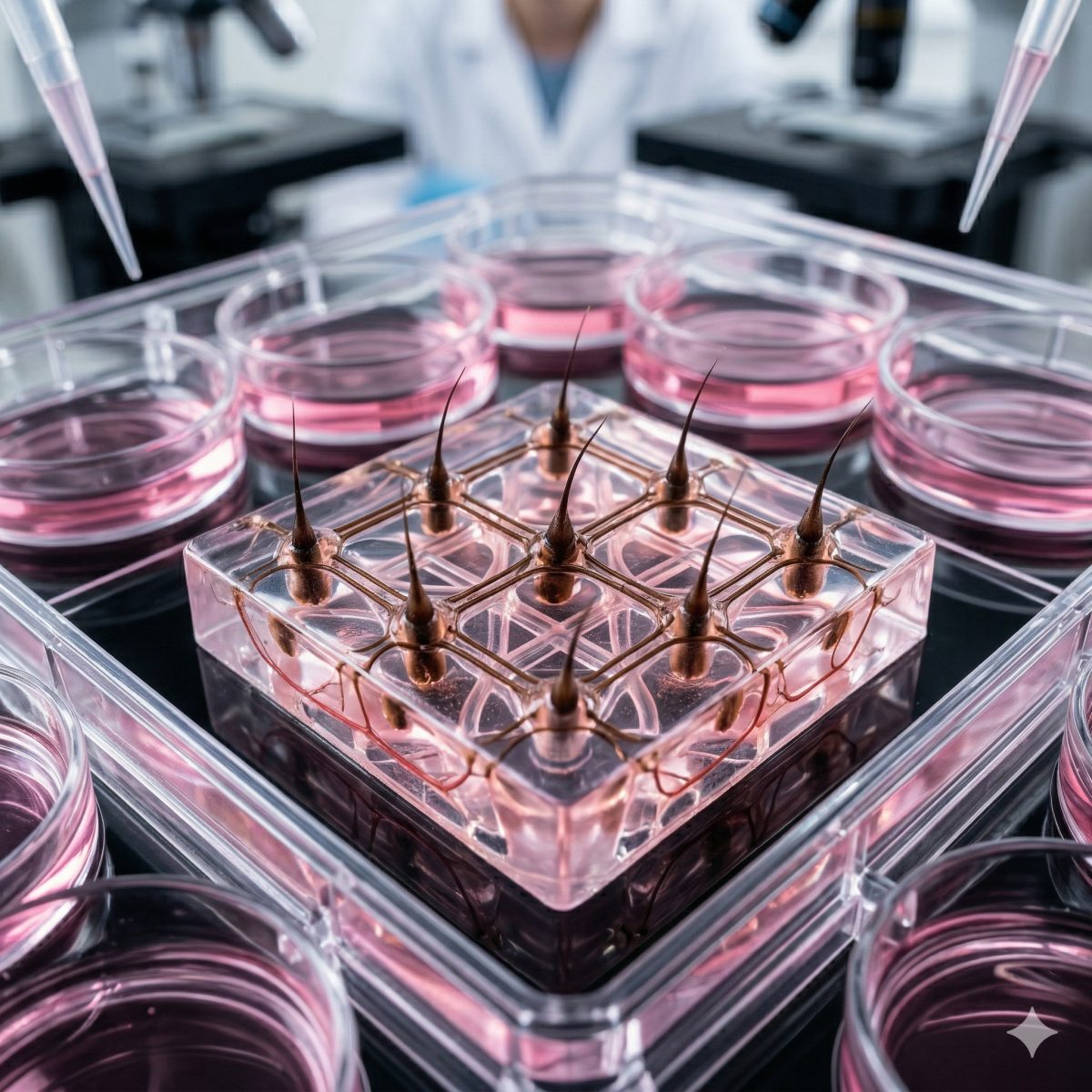
Baldness: functional hair follicles grown in the lab
What if baldness could soon become a distant memory? A team of Japanese researchers has just crossed a historic milestone by cultivating, for the first time, fully functional hair follicles in a laboratory. This breakthrough, published in March 2026 in the journal Biochemical and Biophysical Research Communications, could radically transform how hair loss is treated.
A world first in hair follicle research
For decades, science has tried to reproduce in the laboratory the complex mechanism of hair growth. Previous attempts, based on only two cell types, resulted in incomplete structures, unable to function as real follicles. This time, a team supported by the company OrganTech, whose CEO Yoshio Shimo supervised the work, identified the missing piece of the puzzle.
The key to this success lies in the addition of a third cell type to the culture process. Until now, scientists combined epithelial stem cells (which form the hair shaft) and dermal papilla cells (which send growth signals). The result? Follicle drafts that never managed to complete their life cycle.
The decisive role of mesenchymal cells
The major innovation of this study lies in the introduction of accessory mesenchymal cells, taken from hairy skin. These cells play a scaffolding role: they position themselves around the follicular bulge and the dermal sheath, providing indispensable structural support. Introduced very early in the in vitro assembly process, they allow the follicle to anchor properly and trigger its downward growth into the dermis, just as it would naturally in the skin.
The team used the so-called organ germ method, a technique that involves creating a bio-engineered seed structured in cellular layers. The stem cells are enveloped by papillary cells and support cells, reproducing the embryonic architecture of a forming follicle.
68 days of conclusive observation in mice
To validate their approach, the researchers transplanted these in vitro cultured follicles onto laboratory mice. The results exceeded expectations: over 68 days of observation, the bio-engineered follicles perfectly integrated with the nervous and muscular systems of the rodents. The hair followed its natural complete cycle of growth, shedding, and regrowth, demonstrating that these structures were truly functional.
As Yoshio Shimo pointed out, this work « defines a fundamental cellular configuration for the functional regeneration » of hair follicles. Beyond mere regrowth, it is the follicle's ability to naturally cycle that constitutes the real breakthrough.
Applications that go beyond baldness
While the treatment of androgenetic alopecia — the most common form of baldness — is the most obvious application, the implications of this discovery go much further. These laboratory-cultivated follicles could serve as a test platform to evaluate new anti-hair loss treatments without resorting to animal testing. They also open perspectives in regenerative medicine, particularly for skin reconstruction after burns or surgical procedures.
The technique could also contribute to better understanding certain dermatological diseases and to developing in vitro organ models for other areas of medicine. The hair follicle, a miniature but incredibly complex structure, is indeed considered a reference model for studying organ regeneration.
A hope, but not yet an immediate solution
It is important to temper the enthusiasm: these results were obtained in mice, and transposition to humans remains a major challenge. Human follicles are more complex, and clinical trials will require rigorous protocols before any therapeutic application. The researchers themselves acknowledge that it would be premature to directly extrapolate these results to a treatment for human baldness.
Nevertheless, this study marks a turning point. For the first time, science has a fully functional hair follicle model, capable of developing, cycling, and regenerating outside the body. This is a solid foundation on which the next steps of research can build.
Key takeaway: Japanese researchers have succeeded in cultivating fully functional hair follicles in the laboratory, thanks to the addition of a third cell type (mesenchymal cells). Tested on mice for 68 days, these follicles demonstrated a complete natural growth cycle. While human trials are still distant, this breakthrough opens major perspectives for hair research and regenerative medicine.