

Loading...
🍪

En poursuivant votre navigation sur ce site, vous acceptez l'utilisation de Cookies qui garantissent son bon fonctionnement.

enEnglish
frFrench
esSpanish
zhChinese
jaJapanese
koKorean
hiHindi
deGerman
noNorwegian
Recherche article
Me connecter
Fleche top bulle Fleche top bulle
DE EN ES FR HI JA KO NO ZH
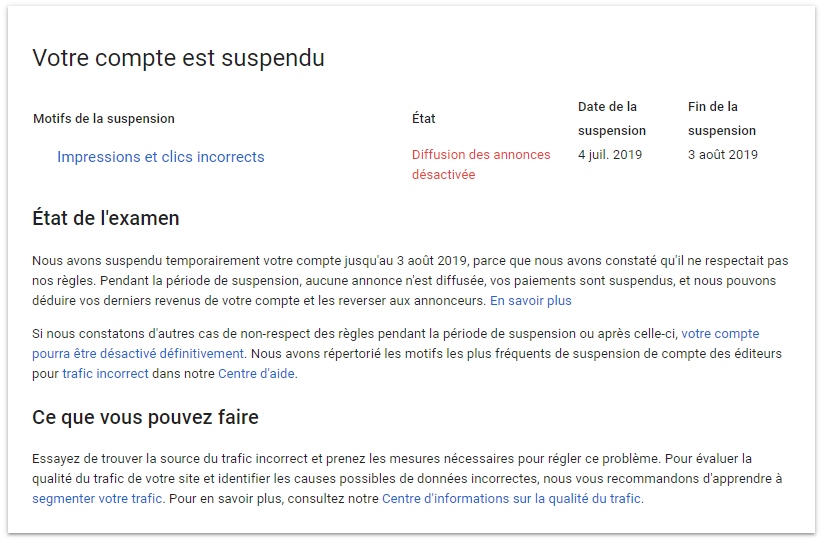
Suspended account

Clicking the ads displayed on your blog is a bad idea

Publié le 29 Avril 2026

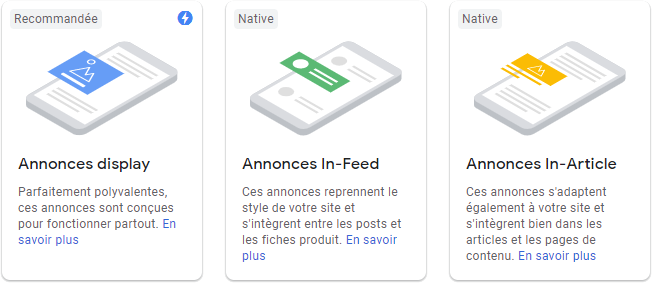
If you have a blog or another type of website for which you have obtained approval for a partnership with Google AdSense, then your site will be able to display ads. Ad placement may or may not be controlled, depending on what you have checked in your Google AdSense interface.
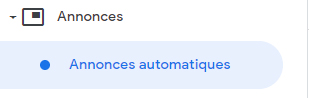
I will take this opportunity to warn you about “automatic ads”: once they are enabled, they are difficult to disable, sometimes even impossible, because there is no “delete” button. Google will then place ads wherever it wants on your pages, which sometimes produces some very ugly results....


In short, once your site finally displays Google ads, depending on the type of ad, you will earn a few cents when an ad is shown, or more if someone clicks the ad to open the original advertising site in a new browser window.


If you have taken the time to read all of Google’s rules about what you can and cannot do, then you have probably come across the warning that your account may be removed if you click on your own ad.
Yes, Google knows the IP address of every person who clicks on an ad, and it knows your IP address when you go to your Google interface.
If the IP address of an AdSense account clicks on an ad from your own website, there is no appeal: without warning, overnight, Google stops all ad delivery on your site for a certain period.

For example, Vosposts, which built an entire system around ads to fairly redistribute money among the different authors, was punished for clicking in the areas reserved for ads.
Indeed, during development, testing required clicking on an ad to check that the system counted that click for an author on their article, in order to test the euro distribution system.
Unfortunately, forgetting this rule proved fatal... Immediate suspension for a month or more (today, Sunday, August 4, 2019, ads are still not being displayed again on the site), and deduction of all your earnings from the last two months.



That said, this is the rule, clearly stated by Google, and it is your fault if you did not follow it. 

In short, do not click on your own ad! Not even to test something, not even if the ad interests you! Above all, do not do it!

Tags
advertising
AdSense
google
rule
punishment
policy
development
Envoyer à un ami
Signaler cet article
A propos de l'auteur
Suspended account

Clicking the ads displayed on your blog is a bad idea

Publié le 29 Avril 2026

If you have a blog or another type of website for which you have obtained approval for a partnership with Google AdSense, then your site will be able to display ads. Ad placement may or may not be controlled, depending on what you have checked in your Google AdSense interface.

I will take this opportunity to warn you about “automatic ads”: once they are enabled, they are difficult to disable, sometimes even impossible, because there is no “delete” button. Google will then place ads wherever it wants on your pages, which sometimes produces some very ugly results....


In short, once your site finally displays Google ads, depending on the type of ad, you will earn a few cents when an ad is shown, or more if someone clicks the ad to open the original advertising site in a new browser window.


If you have taken the time to read all of Google’s rules about what you can and cannot do, then you have probably come across the warning that your account may be removed if you click on your own ad.
Yes, Google knows the IP address of every person who clicks on an ad, and it knows your IP address when you go to your Google interface.
If the IP address of an AdSense account clicks on an ad from your own website, there is no appeal: without warning, overnight, Google stops all ad delivery on your site for a certain period.

For example, Vosposts, which built an entire system around ads to fairly redistribute money among the different authors, was punished for clicking in the areas reserved for ads.
Indeed, during development, testing required clicking on an ad to check that the system counted that click for an author on their article, in order to test the euro distribution system.
Unfortunately, forgetting this rule proved fatal... Immediate suspension for a month or more (today, Sunday, August 4, 2019, ads are still not being displayed again on the site), and deduction of all your earnings from the last two months.


That said, this is the rule, clearly stated by Google, and it is your fault if you did not follow it. 

In short, do not click on your own ad! Not even to test something, not even if the ad interests you! Above all, do not do it!

Tags
advertising
AdSense
google
rule
punishment
policy
development
Envoyer à un ami
Signaler cet article
A propos de l'auteur
Suspended account

Clicking the ads displayed on your blog is a bad idea

Publié le 29 Avril 2026

If you have a blog or another type of website for which you have obtained approval for a partnership with Google AdSense, then your site will be able to display ads. Ad placement may or may not be controlled, depending on what you have checked in your Google AdSense interface.

I will take this opportunity to warn you about “automatic ads”: once they are enabled, they are difficult to disable, sometimes even impossible, because there is no “delete” button. Google will then place ads wherever it wants on your pages, which sometimes produces some very ugly results....


In short, once your site finally displays Google ads, depending on the type of ad, you will earn a few cents when an ad is shown, or more if someone clicks the ad to open the original advertising site in a new browser window.


If you have taken the time to read all of Google’s rules about what you can and cannot do, then you have probably come across the warning that your account may be removed if you click on your own ad.
Yes, Google knows the IP address of every person who clicks on an ad, and it knows your IP address when you go to your Google interface.
If the IP address of an AdSense account clicks on an ad from your own website, there is no appeal: without warning, overnight, Google stops all ad delivery on your site for a certain period.

For example, Vosposts, which built an entire system around ads to fairly redistribute money among the different authors, was punished for clicking in the areas reserved for ads.
Indeed, during development, testing required clicking on an ad to check that the system counted that click for an author on their article, in order to test the euro distribution system.
Unfortunately, forgetting this rule proved fatal... Immediate suspension for a month or more (today, Sunday, August 4, 2019, ads are still not being displayed again on the site), and deduction of all your earnings from the last two months.


That said, this is the rule, clearly stated by Google, and it is your fault if you did not follow it. 

In short, do not click on your own ad! Not even to test something, not even if the ad interests you! Above all, do not do it!

Tags
advertising
AdSense
google
rule
punishment
policy
development
Envoyer à un ami
Signaler cet article
A propos de l'auteur
28 April 2026 13:34:57

Compassionate Parenting: Beyond Punishment and Reward, Alternative Approaches for Optimal Child Development

Education based on the binary model of punishment and reward has long been considered the norm in many cultures. However, more and more voices are being raised to question this traditional model and explore new educational approaches that promote optimal child development. In this article, we will...
Read more
24 April 2026 22:53:11

Understanding dofollow, nofollow and sponsored links

Understanding dofollow, nofollow and sponsored links Hello everyone! Today, we are going to talk about a topic that puzzled me quite a bit at first: the famous dofollow, nofollow and sponsored links. If, like me before, you were not quite sure what these are and why they matter, this article is for...
Read more