
 English
  French
  German
  Spanish
  Hindi
Hindi  Italian
  Japanese
  Korean
  Norwegian
  Chinese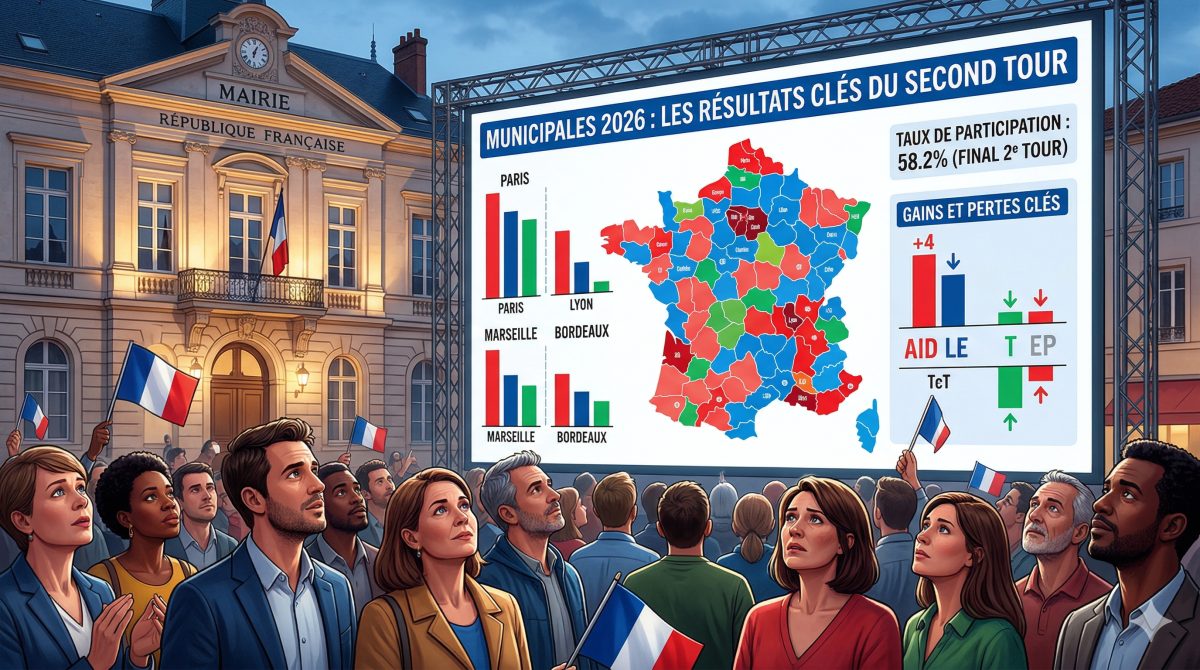
French Municipal Elections 2026: Key Results of the Second Round
The second round of the 2026 French municipal elections, held on Sunday 22 March, brought its share of surprises and confirmed several deep-seated trends in the French political landscape. With turnout higher than in 2020, voters decided in more than 5,000 municipalities, redrawing the country's local political map. Here are the major lessons of this decisive vote, one year before the 2027 presidential election.
Paris, Marseille, Lyon: The Left Consolidates Its Strongholds
In the capital, the socialist Emmanuel Grégoire, supported by a PS-EELV alliance, clearly defeated LR-Horizons candidate Rachida Dati and LFI candidate Sophia Chikirou. Paris thus remains in socialist hands since 2001, a quarter-century of uninterrupted dominance over the City of Light. This result confirms the enduring grip of the left in France's major metropolises.
In Marseille, incumbent mayor Benoît Payan (PS) won despite the surge of the Rassemblement national, whose candidate Franck Allisio had reached 35% in the first round. The formation of a republican front in the second round was enough to keep the Phocaean city on the left. In Lyon, Green mayor Grégory Doucet prevailed with 50.7% of the vote, confirming the Green foothold in France's third city, even if the victory proved tighter than expected.
In Nantes, Johanna Rolland (PS) was comfortably re-elected thanks to a PS-LFI merger that reached around 55% of votes, while in Montpellier, Michaël Delafosse (PS) triumphed without needing alliances, explicitly refusing any party arrangements.
Nice Shifts: The Historic Breakthrough of the Ciotti-RN Alliance
The evening's most notable result is undoubtedly the victory of Éric Ciotti in Nice, leading a UDR-RN alliance. France's fifth city, historically anchored to the centre-right under Christian Estrosi, thus tips for the first time toward the far right. It is the largest city won by the Lepenist camp, a powerful symbol illustrating the recomposition underway on the right of the political spectrum.
However, the RN failed to conquer the major metropolises it had hoped for. In Toulon, RN candidate Laure Lavalette was defeated by Josée Massi (independent right) with a score of 47% against 53%, thanks to the formation of a republican coalition. In Nîmes and Marseille, the republican barrier, though weakened, held. Marine Le Pen's party nevertheless won several medium-sized towns such as Menton, Carcassonne, Montargis, and Liévin, expanding its territorial network.
The Traditional Right Fights Back
One of the notable lessons of this vote is the strong return of the traditional right in several intermediate cities. Republicans and independent right-wing candidates made resounding conquests in Clermont-Ferrand, Besançon, and Brest, cities until then held by the left or Greens. These results show that a moderate right-wing political offer, distinct from the RN, retains a significant electoral reservoir, particularly in medium-sized towns and provincial agglomerations.
In Toulouse, Jean-Luc Moudenc (centre-right) managed the feat of resisting a PS-LFI merger that nonetheless represented around 53% in the first round, proof that local dynamics and candidates' personalities continue to weigh heavily in municipal votes.
La France Insoumise Takes Root in Roubaix
Another notable development: the election of David Guiraud (LFI) in Roubaix, which becomes the largest municipality led by La France Insoumise. This result illustrates LFI's strategy of mobilizing working-class neighbourhoods and lower-income voters, an electorate traditionally won by the Socialist Party. This municipal foothold gives Jean-Luc Mélenchon a weighty argument in the perspective of 2027.
The 2020 Green Wave in Clear Retreat
The Greens, who had surprised in 2020 by conquering several major cities, are registering a noticeable setback. Bordeaux, Besançon, and Poitiers, strongholds won during the famous "green wave," have changed hands. The municipal track record of EELV-elected officials, sometimes contested locally, was not enough to convince voters to renew their trust. Only Lyon stands as an exception, where Grégory Doucet managed to hold his seat narrowly.
Macronism Struggling Locally
Emmanuel Macron's Renaissance party, despite some isolated successes such as the victory of Antoine Armand in Annecy, struggles to establish itself durably in the municipal landscape. The presidential movement, designed as an electoral machine for national votes, continues to lack local relays and notables capable of federating around a municipal project. This structural deficit of territorial rootedness is a handicap one year before the presidential election.
What These Municipal Elections Foreshadow for 2027
These municipal elections paint a fragmented political landscape where no single force clearly dominates. The socialist left retains its historic metropolises, the RN advances in peripheral territories and medium-sized towns, the traditional right resists better than expected, and Macronism stagnates. This fragmentation evokes the "death of the majority principle" mentioned by several analysts: no bloc is able to rally a stable majority on its own.
In this context, former Prime Minister Édouard Philippe, comfortably re-elected in Le Havre, appears as one of the few leaders capable of transcending divides. His posture as a pragmatic centrist and personal popularity make him a serious contender for the Élysée, in a landscape where the demand for calm and competence seems to take precedence over party affiliations.
The 2026 municipal elections are certainly not a dress rehearsal for the presidential race, but they offer a precious snapshot of the balance of power in France. One year from the supreme vote, all camps now have reasons to hope — and grounds for concern.