

Loading...
By continuing to browse this site, you agree to the use of cookies that ensure its proper functioning.
enEnglish
frFrench
esSpanish
zhChinese
jaJapanese
koKorean
hiHindi
deGerman
noNorwegian
Recherche article
Me connecter
Fleche top bulle Fleche top bulle
DE EN ES FR HI JA KO NO ZH
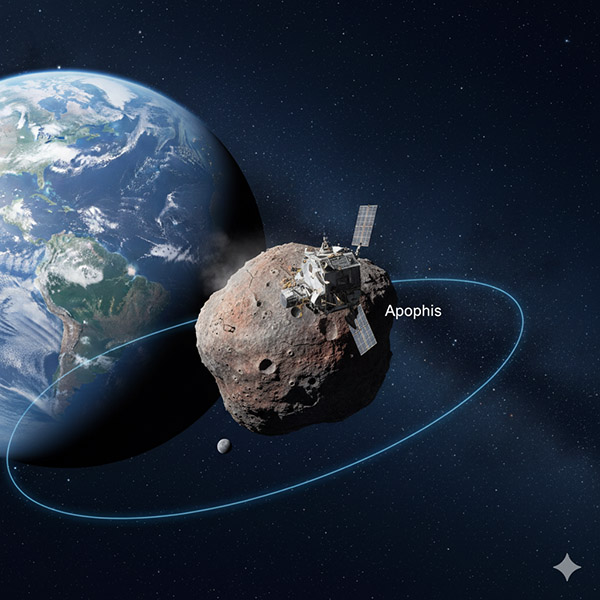
OSIRIS-APEX spacecraft approaching asteroid Apophis for a close flyby in 2029

NASA Prepares OSIRIS-APEX for the Historic Flyby of Asteroid Apophis in 2029

Publié le 24 Avril 2026

The race for space exploration never slows down, and one of NASA's next targets is particularly intriguing: the near-Earth asteroid (99942) Apophis. Initially identified as a potential threat to Earth during its 2029 flyby, more recent calculations have ruled out any collision risk. However, this exceptional close approach offers an extraordinary opportunity for scientific research. The American space agency is intensifying preparations to send a probe on a mission — not to intercept it, but to study it up close.

The Cosmic Rendezvous: Apophis, an asteroid approximately 340 meters in diameter, will make its closest pass by our planet on April 13, 2029. It will pass just 31,000 kilometers from Earth — closer than some of our geostationary satellites! It is this rare and spectacular phenomenon that drives the mission.

This proximity would enable the OSIRIS-APEX mission (which is actually an extension of the OSIRIS-REx mission, famous for returning samples from Bennu). The spacecraft, after delivering its precious samples, is being recalibrated to head toward Apophis. The main objective is to understand how Earth's gravitational force will affect the asteroid during its flyby. The interaction is expected to alter its rotation, orbit, and potentially its surface, creating "landslides" or cracks that will be observed in real time.

Studying Apophis is not merely a matter of observation; it is crucial for planetary defense. Understanding the physical properties and composition of near-Earth asteroids is vital. The data collected will allow scientists to better model the behavior of these space bodies and refine potential deflection strategies if a threatening asteroid were ever detected. This is a unique opportunity to study an asteroid while it is, in a sense, "in motion" — disturbed by a massive body.

The OSIRIS-APEX mission is currently undergoing intensive preparation.

In conclusion, even though Apophis no longer poses an imminent threat to Earth, it has become a space laboratory of the highest order. The 2029 flyby will be the astronomical event of a decade, and NASA is making sure we do not miss it. Studying this close cosmic companion will provide crucial information not only about the origin of the solar system, but also about our capacity to protect ourselves from future impacts. It is not a farewell, but a very scientific "hello" to this much-discussed asteroid.

Tags
NASA
Apophis
OSIRIS-APEX
Asteroid
Near-Earth
2029
Space
Space Exploration
Planetary Defense
OSIRIS-REx
Science
Envoyer à un ami
Signaler cet article
A propos de l'auteur
OSIRIS-APEX spacecraft approaching asteroid Apophis for a close flyby in 2029

NASA Prepares OSIRIS-APEX for the Historic Flyby of Asteroid Apophis in 2029

Publié le 24 Avril 2026

The race for space exploration never slows down, and one of NASA's next targets is particularly intriguing: the near-Earth asteroid (99942) Apophis. Initially identified as a potential threat to Earth during its 2029 flyby, more recent calculations have ruled out any collision risk. However, this exceptional close approach offers an extraordinary opportunity for scientific research. The American space agency is intensifying preparations to send a probe on a mission — not to intercept it, but to study it up close.

The Cosmic Rendezvous: Apophis, an asteroid approximately 340 meters in diameter, will make its closest pass by our planet on April 13, 2029. It will pass just 31,000 kilometers from Earth — closer than some of our geostationary satellites! It is this rare and spectacular phenomenon that drives the mission.

This proximity would enable the OSIRIS-APEX mission (which is actually an extension of the OSIRIS-REx mission, famous for returning samples from Bennu). The spacecraft, after delivering its precious samples, is being recalibrated to head toward Apophis. The main objective is to understand how Earth's gravitational force will affect the asteroid during its flyby. The interaction is expected to alter its rotation, orbit, and potentially its surface, creating "landslides" or cracks that will be observed in real time.

Studying Apophis is not merely a matter of observation; it is crucial for planetary defense. Understanding the physical properties and composition of near-Earth asteroids is vital. The data collected will allow scientists to better model the behavior of these space bodies and refine potential deflection strategies if a threatening asteroid were ever detected. This is a unique opportunity to study an asteroid while it is, in a sense, "in motion" — disturbed by a massive body.

The OSIRIS-APEX mission is currently undergoing intensive preparation.

In conclusion, even though Apophis no longer poses an imminent threat to Earth, it has become a space laboratory of the highest order. The 2029 flyby will be the astronomical event of a decade, and NASA is making sure we do not miss it. Studying this close cosmic companion will provide crucial information not only about the origin of the solar system, but also about our capacity to protect ourselves from future impacts. It is not a farewell, but a very scientific "hello" to this much-discussed asteroid.

Tags
NASA
Apophis
OSIRIS-APEX
Asteroid
Near-Earth
2029
Space
Space Exploration
Planetary Defense
OSIRIS-REx
Science
Envoyer à un ami
Signaler cet article
A propos de l'auteur
OSIRIS-APEX spacecraft approaching asteroid Apophis for a close flyby in 2029

NASA Prepares OSIRIS-APEX for the Historic Flyby of Asteroid Apophis in 2029

Publié le 24 Avril 2026

The race for space exploration never slows down, and one of NASA's next targets is particularly intriguing: the near-Earth asteroid (99942) Apophis. Initially identified as a potential threat to Earth during its 2029 flyby, more recent calculations have ruled out any collision risk. However, this exceptional close approach offers an extraordinary opportunity for scientific research. The American space agency is intensifying preparations to send a probe on a mission — not to intercept it, but to study it up close.

The Cosmic Rendezvous: Apophis, an asteroid approximately 340 meters in diameter, will make its closest pass by our planet on April 13, 2029. It will pass just 31,000 kilometers from Earth — closer than some of our geostationary satellites! It is this rare and spectacular phenomenon that drives the mission.

This proximity would enable the OSIRIS-APEX mission (which is actually an extension of the OSIRIS-REx mission, famous for returning samples from Bennu). The spacecraft, after delivering its precious samples, is being recalibrated to head toward Apophis. The main objective is to understand how Earth's gravitational force will affect the asteroid during its flyby. The interaction is expected to alter its rotation, orbit, and potentially its surface, creating "landslides" or cracks that will be observed in real time.

Studying Apophis is not merely a matter of observation; it is crucial for planetary defense. Understanding the physical properties and composition of near-Earth asteroids is vital. The data collected will allow scientists to better model the behavior of these space bodies and refine potential deflection strategies if a threatening asteroid were ever detected. This is a unique opportunity to study an asteroid while it is, in a sense, "in motion" — disturbed by a massive body.

The OSIRIS-APEX mission is currently undergoing intensive preparation.

In conclusion, even though Apophis no longer poses an imminent threat to Earth, it has become a space laboratory of the highest order. The 2029 flyby will be the astronomical event of a decade, and NASA is making sure we do not miss it. Studying this close cosmic companion will provide crucial information not only about the origin of the solar system, but also about our capacity to protect ourselves from future impacts. It is not a farewell, but a very scientific "hello" to this much-discussed asteroid.

Tags
NASA
Apophis
OSIRIS-APEX
Asteroid
Near-Earth
2029
Space
Space Exploration
Planetary Defense
OSIRIS-REx
Science
Envoyer à un ami
Signaler cet article
A propos de l'auteur
24 April 2026 13:41:57

Sentinel-6B: Europe's New Guardian of Sea Level Rise

The European **Copernicus** programme takes a major new step with the successful launch of its latest ocean and climate observation satellite, **Sentinel-6B**. This eagerly anticipated launch by the scientific community ensures the continuity of crucial measurements for monitoring sea levels and...
Read more
23 April 2026 13:41:54

Artemis II: Humanity Returns to the Moon in April 2026

On March 20, 2026, NASA's SLS rocket left the Vehicle Assembly Building at Kennedy Space Center to reach Launch Pad 39B. Standing 98 meters tall, it carries the Orion spacecraft and the hopes of an entire generation. Artemis II, scheduled for April 1, 2026, will mark the return of astronauts...
Read more