
 English
  French
  German
  Spanish
  Hindi
Hindi  Italian
  Japanese
  Korean
  Norwegian
  Chinese
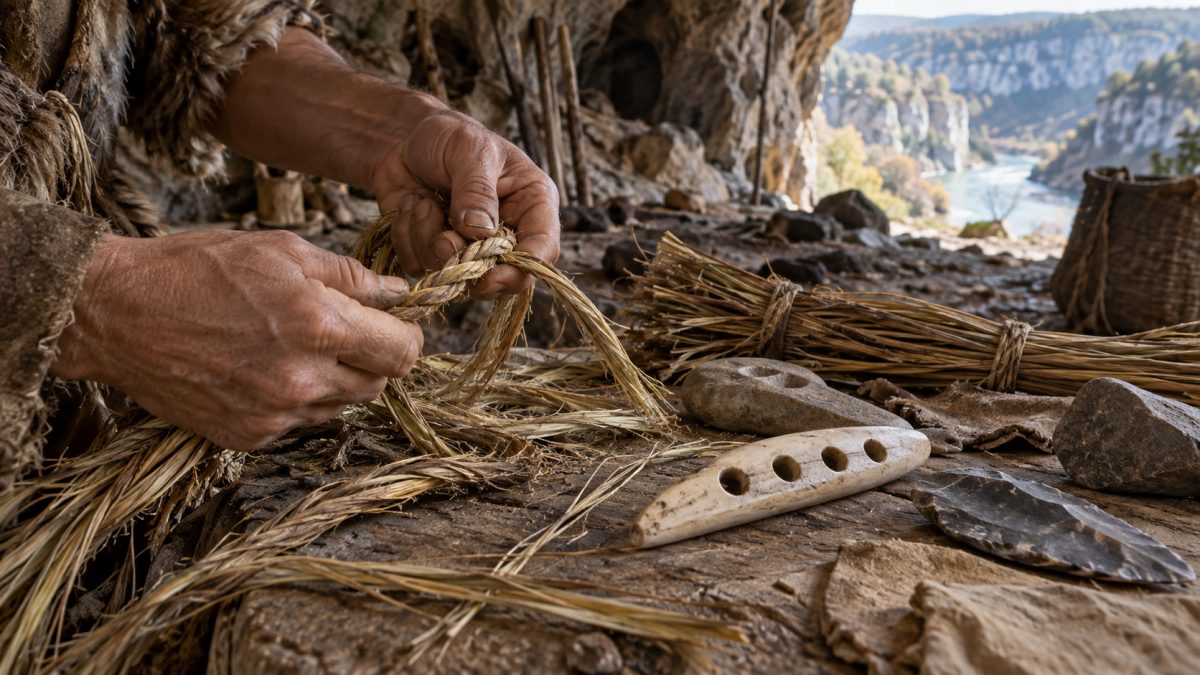
Rope, the prehistoric invention that time erased
When we think of prehistory, we picture handaxes, points, scrapers, and sometimes objects made of bone or ivory. That makes sense: they are what remains. But this material evidence creates a historical illusion. We end up confusing what survived with what mattered most.
Yet a large part of prehistoric technical life probably relied on far more fragile materials: plant fibers, sinews, hides, bark, thread, rope, baskets, nets and textiles. Objects that are used, wear out, rot, burn or disappear. Bruce Hardy, a paleoanthropologist at Kenyon College, even estimates that more than 90% of the technical activity in a prehistoric day may escape the archaeological record. This figure does not precisely measure everything that is missing, but it sums up the scale of the problem: our image of the past is built from an extraordinarily biased sample.
Stone records time well, but not necessarily life
Stone and bone have an unfair advantage: they survive for millennia. Organic materials, by contrast, require exceptional preservation conditions. Intense cold, as in the case of Ötzi in the Alps, can preserve materials that would normally decay. Egypt's aridity saves others. In temperate Europe, some fragments become mineralized through contact with corroding metals. Waterlogged lake deposits or the salt mines of Hallstatt can also preserve ancient textiles.
Everywhere else, daily life dissolves. A rope used to tighten, tie, carry or make a composite tool can disappear without leaving a trace. The same is true of basketry or textiles. So this is not merely a problem of rare discoveries: it is a filter that favors certain human actions and erases others.
Emma Finestone, a paleoanthropologist at the Cleveland Museum of Natural History, stresses this very bias: archaeology first sees what resisted decay. That may sound obvious, but the intellectual consequence is profound. The more perishable a technology is, the more likely it is to be underrepresented in our display cases, textbooks and, by extension, in our idea of prehistoric inventiveness.
At Hohle Fels, a durable tool reveals a vanished technique
A discovery made in 2015 in Hohle Fels Cave in Germany gives concrete form to this invisible technology. Archaeologists found a perforated rod made of mammoth ivory, about 20 centimeters long and dated to more than 35,000 years ago. The object has four holes. Each contains spiral grooves.
Taken on its own, this kind of object might remain mysterious. But Nicholas Conard and his team at the University of Tübingen tested a hypothesis: what if those grooves were used to guide and twist fibers? They passed cattail fibers through the perforations. The result is particularly telling: in 10 minutes, the experiment produced about 5 meters of thick, strong rope.
The most fascinating thing is not simply that the tool works. It is what it reveals by contrast. No rope made by the inhabitants of Hohle Fels has survived. What remains is the most durable part of the production system: the ivory. In other words, we do not directly see the main technology; we see the accessory that made it possible.
An essential part of prehistory can therefore be inferred not from the vanished objects themselves, but from the tools used to make them.
Rope is not a minor detail
Reducing rope to a household accessory would be a mistake. Fibers could be used in hunting, shelter, transport, clothing and the manufacture of composite tools. Textile archaeology itself is not limited to fabrics: it also includes basketry, rope-making and net-making.
The materials used were diverse. Some came from plants, such as flax or linden and willow bark. Others came from animals: hides, sinews and later wool. This diversity reminds us that we are not dealing with a single invention, but with a whole set of skills: preparing a fiber, twisting it, combining it, tightening it, braiding it and turning it into a useful object.
The consequence is simple: a society capable of making rope masters much more than a material. It masters an operational sequence, repeatable gestures and anticipation of the result. These are precisely the forms of technical intelligence that stone alone displays poorly.
Textiles force people to think before acting
The Neolithic makes this story more visible. Flax continued to be used, while the domestication of sheep for wool contributed to what researchers call the “secondary products revolution.” Specialized tools appeared, including the vertical warp-weighted loom and spindle whorls used for spinning.
But the significance of textiles is not merely economic or material. Fabienne Médard points out that weaving requires a genuine act of abstraction. The whole project has to be anticipated and the material organized before the final object exists. A design mistake cannot simply be fixed by improvising at the end.
This changes the way we look at prehistory. If we focus our attention on the hard objects that survive, we naturally emphasize striking, knapping and cutting. Flexible technologies tell a different story: planning, repetition, tension, knotting, assembly and the geometry of weaving. These are not less sophisticated abilities. They are simply harder to recover.
Our museums also display accidents of preservation
This is where archaeological bias becomes cultural bias. A museum does not simply show the past; it shows what time has agreed to give back. If stone fills the display cases, that is not necessarily because it dominated everyday life, but because it had a better chance of reaching us.
This distinction should accompany every account of prehistory. Otherwise, we risk building an implicit hierarchy between innovations: stone seems central because it is visible; fiber seems secondary because it is missing. Yet material absence is not proof of technical absence.
- A vanished rope may have been essential to a tool of which only the hard part survives.
- A lost textile may represent hours of preparation and a strong capacity for anticipation.
- Decayed basketry may have been crucial for transporting resources.
- A vanished net may have mattered more to subsistence than a spectacular object preserved in a display case.
The Hohle Fels perforated baton is therefore important for a reason broader than its function. It forces us to rethink how we read the evidence. We should no longer ask only, “what did we find?”, but also, “what must have existed around what we found?”
Rewriting prehistory with what is missing
We cannot reconstruct every vanished object with certainty. Archaeological sources do not allow us to quantify precisely how often this bias has led us to underestimate prehistoric intelligence or innovation. We therefore have to remain cautious. But that caution should not become an excuse for continuing to tell a story centered only on durable materials.
Prehistoric technology was probably not a world of stone decorated with a few fragile materials. It was likely a world of assemblies, in which mineral, plant and animal components worked together. What we now call a “tool” was sometimes only part of a complete system of which we have preserved just a fraction.
The lesson goes beyond prehistory. Every material history depends on what survives. We naturally give more importance to what leaves a clear trace. Fibers remind us that a civilization can be technically rich while remaining archaeologically silent about a large share of its activities.
Perhaps, then, we should look at museum display cases differently: not as an inventory of the past, but as an inventory of its survivors. Between two knapped stones there may be a missing rope, net, garment, basket, an entire set of vanished techniques that enabled humans to feed, protect, carry, make and organize more effectively.
Stone kept the memory. Fiber, perhaps, did much of the work.