 English
  French
  German
  Spanish
  Hindi
Hindi  Italian
  Japanese
  Korean
  Norwegian
  Chinese
Total solar eclipse of August 12, 2026: practical guide
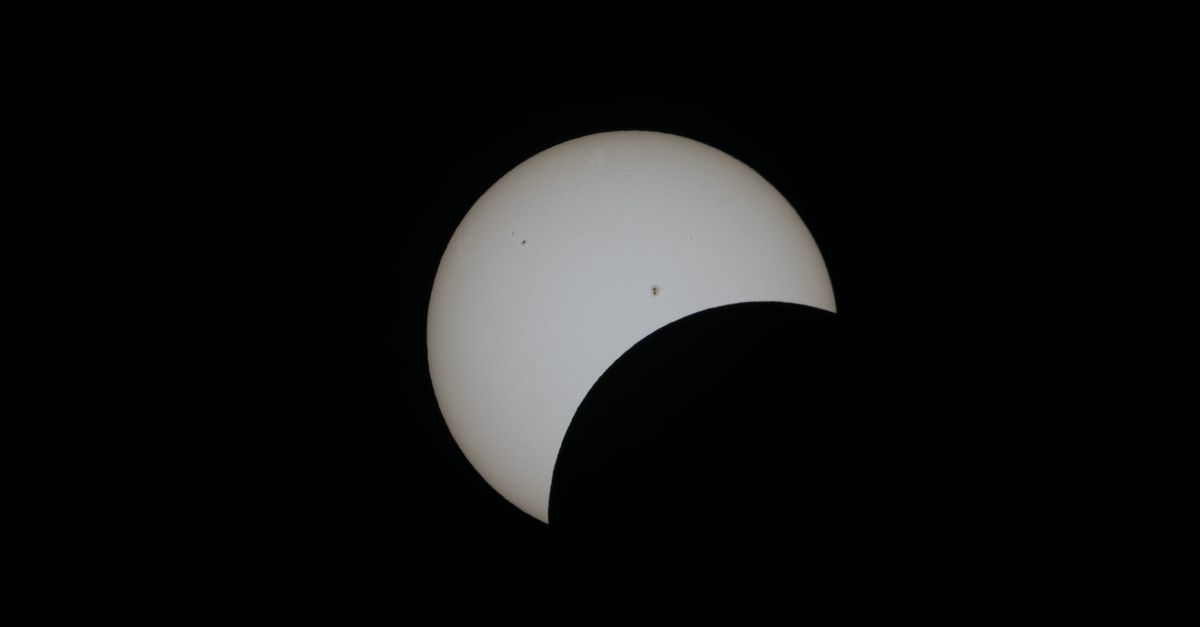
The total solar eclipse of August 12, 2026 will be one of Europe’s major astronomical events of the decade. But from mainland France, the spectacle will not be total: the Sun will remain partially visible, even in the southwest where coverage will approach 99%. The difference is decisive, both when choosing a location and for eye safety.
To enjoy the total solar eclipse of August 12, 2026, you therefore have to choose between two experiences. Staying in France will offer a very deep partial eclipse that is easy to access but must never be viewed without glasses. Traveling to northern Spain, the Balearic Islands or Iceland will provide access to totality, lasting less than two minutes at the main documented land sites.
Times and coverage: what each French city will see
The phenomenon will take place in the evening. All observation sites have one thing in common: the Sun will be low. A location with a genuinely unobstructed view to the west will therefore be more useful than a theoretically ideal spot blocked by buildings, trees, a hill or coastal terrain.
A practical map of coverage rates
- Biarritz: 99.4% of the solar disk covered, with the maximum around 8:26 or 8:27 p.m. This is the highest value among the French cities quantified here.
- Toulouse: 97.8% maximum obscuration. The exact time of maximum is not established in the available data, so inventing one would be misleading.
- Agen: 97.6% at 8:25 p.m.
- Bordeaux: 97.5% at 8:24 p.m.
- Paris: the partial phase begins at 7:22 p.m., reaches a maximum at 8:17 p.m. with 92% of the disk covered, and ends at 9:09 p.m.
This distribution gives the southwest a clear advantage. Between Paris and Biarritz, the announced difference reaches 7.4 percentage points of coverage. Visually, an eclipse above 97% will be spectacular, but it will not create the experience of totality: a bright portion of the Sun will always remain, intense enough to make direct viewing dangerous.
City-by-city figures should not obscure the evening’s main constraint. A few extra percentage points are useless if the Sun disappears behind an obstacle before maximum. When choosing between two nearby sites, the quality of the western horizon should therefore take priority over the theoretical percentage alone.
Where can totality be seen in Europe?
The path of totality will cross the Arctic Ocean, Greenland, Iceland, the North Atlantic, northern Spain and the Balearic Islands before ending in northern Africa. It will be about 250 kilometers wide, while the shadow’s overall path will exceed 8,000 kilometers.
For a departure from France, Spain is the most direct land option. Several cities lie in the 100% zone: Bilbao, Burgos, A Coruña, Gijón, Huesca, Castellón and Ibiza. The duration nevertheless varies from one place to another.
- Oviedo: 1 minute 48 seconds of totality, the longest land duration stated for Spain.
- Burgos: 1 minute 45 seconds.
- León: 1 minute 44 seconds.
- Palma de Mallorca: 1 minute 36 seconds, with a magnitude of 1.015.
- Zaragoza: 1 minute 25 seconds.
The absolute maximum will reach 2 minutes 18.2 seconds at 17:45:54 UTC, but over the North Atlantic. This figure therefore does not correspond to conventional viewing from land. It should not be confused with the 1 minute 48 seconds announced for Oviedo.
Iceland offers another possibility with a special historical dimension: Reykjavik will experience its first total eclipse since 1433. In Spain, it will be the first in more than a century, although the exact date of the previous one is not sufficiently established here to be stated.
The real trap: totality at the horizon
In Spain, the Sun will be only about 3° to 10° above the horizon. This detail completely changes the preparation. It is not enough to reach a city inside the path of totality: you must also find an observation point with an unobstructed view to the west.
The best site will not necessarily be the one closest to the center of the path, but the one where the Sun remains visible until the decisive moment.
An open beach, a headland or a broad plain may seem suitable, provided the actual terrain does not hide the setting Sun. The most sensible approach is to check the site’s orientation before August 12 at a time close to that of the phenomenon. This real-world check is more valuable than choosing solely from a map.
What equipment is essential?
The essential equipment comes down to one item: certified eclipse glasses ISO 12312-2:2015(E). They are required during every partial phase, including when coverage reaches 92%, 97%, 99% or more.
In France, the glasses must never be removed to look at the Sun. Even at 99%, part of the disk remains visible at all times. That fraction is enough to create an eye hazard. Ordinary sunglasses, photographic film or smoked glass are not suitable protection.
The distinction from the path of totality must remain very clear: residents and visitors in mainland France will experience no phase in which the solar disk is fully hidden. They must therefore keep their protection on throughout any direct observation.
2026 versus 1999: what can really be compared
Twenty-seven years separate the eclipse of August 12, 2026, from that of August 11, 1999, the last total eclipse visible from continental Europe. The most concrete comparison concerns the useful path for the French public: in 2026, France will remain outside the path of totality, while travelers will need to target Spain, the Balearic Islands or Iceland to see the Sun completely obscured.
The duration in 2026 is well documented: up to 1 minute 48 seconds on land in Spain and a maximum of 2 minutes 18.2 seconds at sea. However, no verifiable figure is available here to compare precisely the duration, path or attendance in 1999 with those of 2026. Announcing a visitor count or an increase in attendance would therefore be speculative.
Strong practical pressure around Spain’s best western horizons can nevertheless be anticipated without quantifying it. The rarity of the event, the summer season and the Sun’s low altitude make choosing a site more difficult than simply traveling to a city beneath the path of totality.
The instructions in one decision
For straightforward viewing from France, the southwest offers the highest coverage among the documented cities: 99.4% in Biarritz, 97.8% in Toulouse, 97.6% in Agen and 97.5% in Bordeaux. Paris will also be very impressive, with a maximum of 92% at 8:17 p.m.
To experience totality, you will need to cross the border or choose Iceland. Oviedo combines the longest stated Spanish land duration, 1 minute 48 seconds, but every site must be assessed according to its western horizon. In both cases, the most useful preparation rests on three points: know the local time of maximum, check that the setting Sun is unobstructed and have certified glasses.
The highest figure is therefore not always the best guide. From France, no partial coverage can replace totality. In Spain, no perfect position on the map can compensate for a blocked horizon. On August 12, 2026, a successful observation will above all be one that has been prepared precisely.