
Where does the genius behind computer programming come from?
Well, believe it or not, the discovery of computer language is like life on Earth: it did not appear suddenly, but gradually.
First, briefly, what is a computer language?
It allows a human to explain things to a computer in a very precise way. The computer can then read instructions from line 1 on the left to the last line on the right, like a blog article.
When we break down a modern computer language, for example PHP, we discover that it really contains 3 concepts:
- Memorizing a value (A =5 and B = 10)
- Comparing values (If A < B)
- Navigating through the reading of the script
Everything else uses these concepts in combination, even the most advanced features.
So, how did these first basic concepts appear?
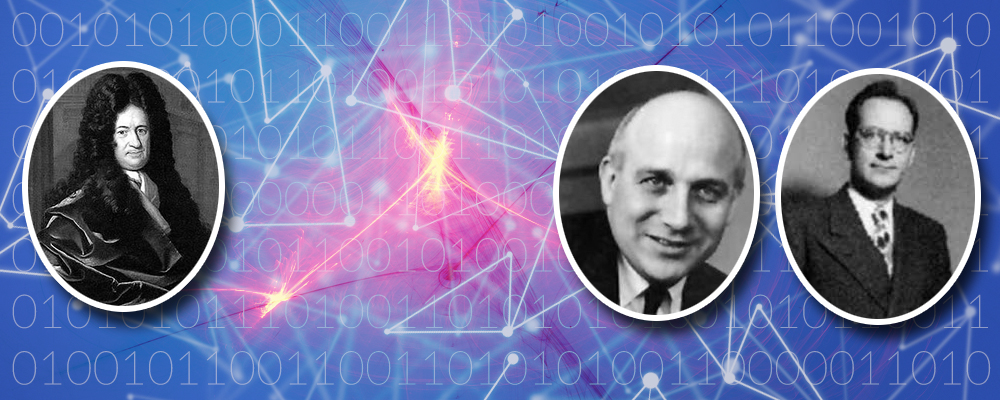
The first concepts were introduced before the computer era; some people used simple mechanical systems (analog). Leibniz was the first to use a binary system to perform arithmetic operations, around the 1700s.
However, the first electronic calculator appeared in 1945 thanks to Presper Eckert and John William Mauchly. This gave us the ability to store, manipulate, compare values, and navigate in a basic way from beginning to end.
The first scripts used to execute advanced commands were probably quite long and tedious. So the concept of functions naturally appeared: smaller scripts that perform the same task with different starting variables.
This new method made it easier to write a computer script. But in the end, when the computer reads the written program and jumps between different functions, it does not do it directly. Before execution, or when saved, the script goes through compilation, which reformulates it differently so it can simply be read from the first character to the last.
So it is an already existing script that allows other, more advanced scripts to be written.
All programming is based on this method: different scripts help develop other scripts more easily, more efficiently, more deeply, and so on.
Coming back to PHP, it has native functions, for example str_replace, which replaces, within a character string, one group of characters with another. Well, this native function is only an already existing script based on the basic concepts. The function scans the character string several times, compares values, and stores new values.
So a few basic elements combined in different ways formalize new concepts, which themselves, combined differently, create others, and so on. This is how we arrive at our current languages, filled with a wide range of possibilities that will become even more numerous in the coming years. All these features are the result of the work of many contributors to the development of computer language.
If you develop your own program, you will start by creating new functions specific to your needs, then your functions will call other functions of yours, combine, and execute within your program so it can achieve its goal.
That is the whole wonder of computing!
Where does the genius behind computer programming come from?
Well, believe it or not, the discovery of computer language is like life on Earth: it did not appear suddenly, but gradually.
First, briefly, what is a computer language?
It allows a human to explain things to a computer in a very precise way. The computer can then read instructions from line 1 on the left to the last line on the right, like a blog article.
When we break down a modern computer language, for example PHP, we discover that it really contains 3 concepts:
- Memorizing a value (A =5 and B = 10)
- Comparing values (If A < B)
- Navigating through the reading of the script
Everything else uses these concepts in combination, even the most advanced features.
So, how did these first basic concepts appear?
The first concepts were introduced before the computer era; some people used simple mechanical systems (analog). Leibniz was the first to use a binary system to perform arithmetic operations, around the 1700s.
However, the first electronic calculator appeared in 1945 thanks to Presper Eckert and John William Mauchly. This gave us the ability to store, manipulate, compare values, and navigate in a basic way from beginning to end.
The first scripts used to execute advanced commands were probably quite long and tedious. So the concept of functions naturally appeared: smaller scripts that perform the same task with different starting variables.
This new method made it easier to write a computer script. But in the end, when the computer reads the written program and jumps between different functions, it does not do it directly. Before execution, or when saved, the script goes through compilation, which reformulates it differently so it can simply be read from the first character to the last.
So it is an already existing script that allows other, more advanced scripts to be written.
All programming is based on this method: different scripts help develop other scripts more easily, more efficiently, more deeply, and so on.
Coming back to PHP, it has native functions, for example str_replace, which replaces, within a character string, one group of characters with another. Well, this native function is only an already existing script based on the basic concepts. The function scans the character string several times, compares values, and stores new values.
So a few basic elements combined in different ways formalize new concepts, which themselves, combined differently, create others, and so on. This is how we arrive at our current languages, filled with a wide range of possibilities that will become even more numerous in the coming years. All these features are the result of the work of many contributors to the development of computer language.
If you develop your own program, you will start by creating new functions specific to your needs, then your functions will call other functions of yours, combine, and execute within your program so it can achieve its goal.
That is the whole wonder of computing!
Where does the genius behind computer programming come from?
Well, believe it or not, the discovery of computer language is like life on Earth: it did not appear suddenly, but gradually.
First, briefly, what is a computer language?
It allows a human to explain things to a computer in a very precise way. The computer can then read instructions from line 1 on the left to the last line on the right, like a blog article.
When we break down a modern computer language, for example PHP, we discover that it really contains 3 concepts:
- Memorizing a value (A =5 and B = 10)
- Comparing values (If A < B)
- Navigating through the reading of the script
Everything else uses these concepts in combination, even the most advanced features.
So, how did these first basic concepts appear?
The first concepts were introduced before the computer era; some people used simple mechanical systems (analog). Leibniz was the first to use a binary system to perform arithmetic operations, around the 1700s.
However, the first electronic calculator appeared in 1945 thanks to Presper Eckert and John William Mauchly. This gave us the ability to store, manipulate, compare values, and navigate in a basic way from beginning to end.
The first scripts used to execute advanced commands were probably quite long and tedious. So the concept of functions naturally appeared: smaller scripts that perform the same task with different starting variables.
This new method made it easier to write a computer script. But in the end, when the computer reads the written program and jumps between different functions, it does not do it directly. Before execution, or when saved, the script goes through compilation, which reformulates it differently so it can simply be read from the first character to the last.
So it is an already existing script that allows other, more advanced scripts to be written.
All programming is based on this method: different scripts help develop other scripts more easily, more efficiently, more deeply, and so on.
Coming back to PHP, it has native functions, for example str_replace, which replaces, within a character string, one group of characters with another. Well, this native function is only an already existing script based on the basic concepts. The function scans the character string several times, compares values, and stores new values.
So a few basic elements combined in different ways formalize new concepts, which themselves, combined differently, create others, and so on. This is how we arrive at our current languages, filled with a wide range of possibilities that will become even more numerous in the coming years. All these features are the result of the work of many contributors to the development of computer language.
If you develop your own program, you will start by creating new functions specific to your needs, then your functions will call other functions of yours, combine, and execute within your program so it can achieve its goal.
That is the whole wonder of computing!
English
French
Spanish
Chinese
Japanese
Korean
Hindi
German
Norwegian