
 English
  French
  German
  Spanish
  Hindi
Hindi  Italian
  Japanese
  Korean
  Norwegian
  Chinese
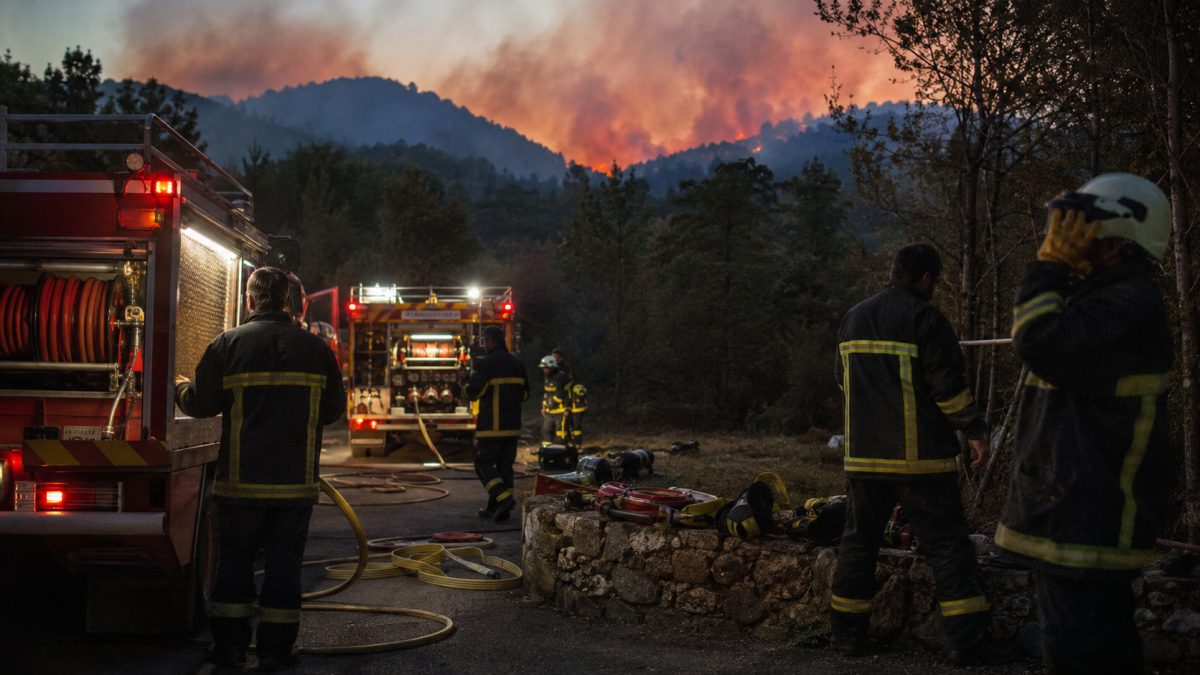
Volunteer firefighters facing megafires: is the model cracking?
Volunteer firefighters facing megafires are often presented as an obvious pillar of the French model: they make up nearly 80% of firefighters and help maintain emergency coverage across the country. But that impressive figure also says something else: France’s civil protection system depends heavily on people who are not employed as firefighters and who respond after work or during their holidays.
The issue of volunteer firefighters facing megafires is therefore not only about courage or the number of available fire engines. It is a question of sustainable human capacity. Several warning signs overlap: many volunteers do not stay for more than three years, firefighters in France are assigned some of the broadest missions in Europe, and operational pressure could rise further with population ageing and climate change.
80% volunteers: a strength that also looks like dependence
The French system relies on the complementarity of professional and volunteer firefighters. On paper, this organisation provides a considerable human reserve. In practice, it requires fire and rescue services to recruit large numbers of volunteers regularly simply to ensure continuity of emergency response.
This is where the 80% figure takes on a different meaning. It does not mean that four firefighters out of five are permanently available like employees in a conventional service. Volunteering exists alongside professional, family and personal lives. The more frequent, lengthy or difficult to reconcile with a job interventions become, the more central the question of actual availability becomes.
The fact that many volunteers do not remain engaged for more than three years reinforces this fragility. Even with a broadly stable national workforce, a system can be under strain if it must constantly replace those who leave quickly. Stability in the total headcount alone therefore does not measure the strength of the human resource.
Has France lost volunteers over ten years? The precise figure is missing
Over a decade, the total number of firefighters in France, professionals and volunteers combined, is described as broadly stable. However, there is no precise figure here showing how many volunteers were gained or lost over that period. Saying that volunteering collapsed by X% would therefore mean inventing a figure that is not present in the available data.
This absence does not prevent the structural problem from being seen. A stable total population can conceal very high turnover among volunteers. If a significant share of recruits leave before three years, the SDIS must maintain constant recruitment efforts to preserve the same apparent capacity.
Statistics must also be read carefully: professionals who also hold volunteer status are counted only as professionals in official statistics. The 2025 edition of the SDIS statistics, covering 2024 data, was collected from 99 fire and rescue services. This framework is useful for monitoring the system, but it does not turn overall stability into proof that volunteering alone is stable.
The real breaking point: missions are increasing faster than the available workforce
French firefighters do not only fight fires. Their missions are among the broadest in Europe; only Denmark and Finland ask as much of them. Several trends may further increase interventions: shortages of private ambulance crews, wildfires, floods and storms, particularly under the effects of population ageing and climate change.
The problem can therefore be summed up simply: even if staffing remains stable, the workload can still increase. It is a bit like keeping the same number of drivers while the number of trips, their duration and their difficulty all rise. The system does not necessarily crack because it has fewer people; it can crack because it asks more of a workforce that is not growing.
The Gironde fires of summer 2026 made this tension visible on a large scale. More than 220,000 people were evacuated during the summer fires, and the Lège-Cap-Ferret fire alone led to the evacuation of 36,000 people, including 8,000 permanent residents. These figures first show the scale of operations to protect the population, but they also give an idea of the logistical and human resources mobilised around a major event.
Spain and Portugal: beware the easy comparison
The idea that Spain or Portugal have already solved the problem simply by switching to a salaried model is appealing, but it cannot be seriously asserted without comparable data on staffing, employment status, territorial organisation and how these systems have changed over time.
In other words, a useful comparison is not to pit a “French volunteer model” against an “Iberian professional model” without homogeneous figures. To know whether another country offers a credible way out, one would at least need to compare the share of professionals, the exact role of volunteering, staffing continuity, the cost of the system and the way reinforcements are organised during major fires. Without that basis, it is better to acknowledge the limit than to create false certainty.
What if volunteering erodes by 2030?
There is no quantified projection here showing how many volunteers would still be present in 2030. However, a reasonable scenario can be built from the constraints that are already observable.
Scenario 1: staffing remains stable, but renewal becomes more difficult
The SDIS continue to recruit enough people to offset departures, but at the cost of constant effort. The system holds, while becoming more sensitive to local recruitment difficulties and to volunteer availability during periods of high activity.
Scenario 2: volunteering declines while missions increase
Pressure then shifts mechanically onto professionals and the volunteers who remain. Some areas would have greater difficulty maintaining the same continuity of emergency response without increasing salaried staffing, reorganising duty rosters or reviewing the allocation of missions. It would also be a financial problem: a parliamentary report on the cost of the SDIS has already highlighted a funding model running out of steam as operational pressure rises.
Scenario 3: the model must be redesigned
If volunteering stopped providing the critical mass that gives it its strength today, France could not simply replace four volunteers with four professionals overnight. The current weight of volunteering is too great for complete substitution to be neutral in organisational and financial terms.
The most credible risk is therefore not a sudden collapse one morning in 2030, but gradual deterioration: harder recruitment, tighter availability, a heavier burden on those who remain and rising costs to preserve the same level of coverage.
The figure to watch is not only the number of firefighters
The debate on megafires would benefit from tracking more than the area burned or the number of evacuations. To assess the strength of the model, it is necessary to look at the average length of volunteer service, their actual availability, the SDIS’s ability to renew staffing and changes in mission workload.
This is also why a simple average response time would not be enough to settle the issue: no reliable figure of this kind is available here, and in any case it would vary by area and mission. The central question runs deeper. France still has a model capable of mobilising huge numbers of people, but that model depends on voluntary commitment that must constantly be renewed. Faced with more demanding crises, the real warning begins when stable headcounts conceal human availability that is becoming more fragile.