 English
  French
  German
  Spanish
  Hindi
Hindi  Italian
  Japanese
  Korean
  Norwegian
  Chinese
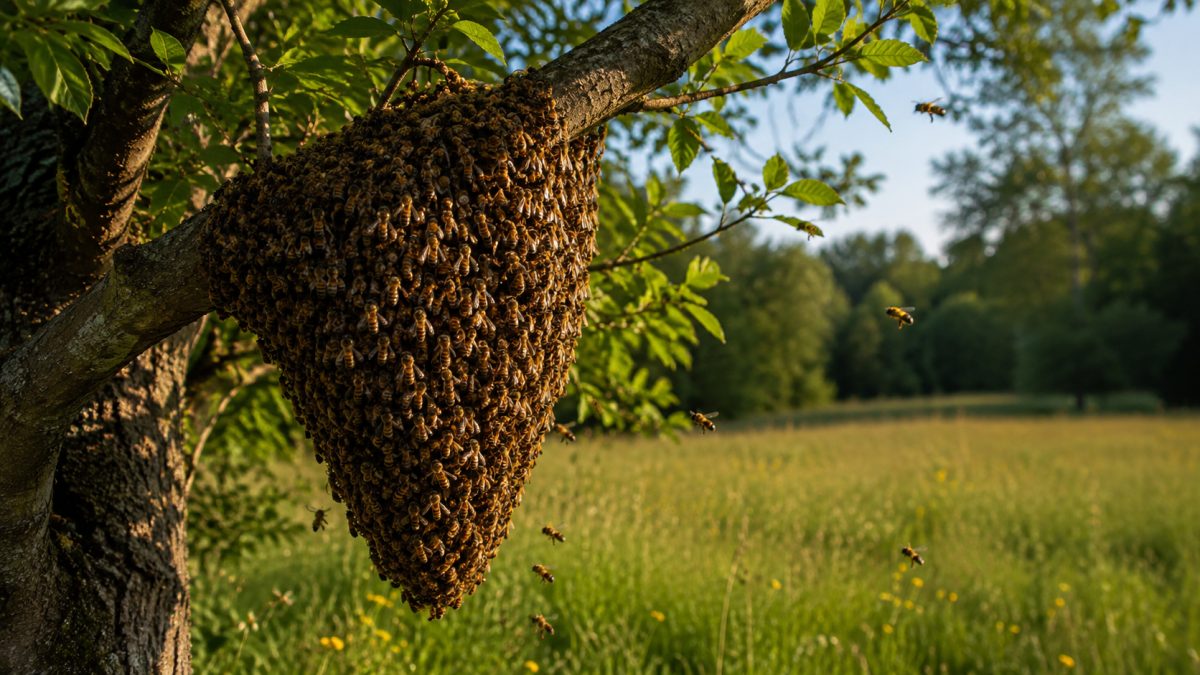
When bees vote better than we decide
One readily imagines that deciding together requires a great deal of intelligence. A large number of brains, long discussions, sophisticated institutions. Bees offer an almost opposite picture. When a colony has to choose a new nest, the vast majority of its members do not compare the options themselves. A few scouts search, assess, return, and communicate. The decision emerges from this partial circulation of information.
This detail changes the question. Collective performance may depend less, first and foremost, on the amount of intelligence available than on how a group organizes access to information, the ability to participate, and competition among several options. This is where ethology becomes unsettling for our own decision-making mechanisms.
A colony does not gather 20,000 experts
During swarming, the old queen leaves the colony with about 40 to 70% of the workers. A typical swarm then contains between 10,000 and 20,000 individuals. It leaves carrying honey, but this autonomy is short-lived: about three days. A shelter must therefore be found quickly.
Yet not everyone starts searching. Only 3 to 5% of the swarm becomes scouts. These are the most experienced foragers. They explore the surroundings in search of a cavity large enough — at least 15 liters, ideally around 40 — with a small entrance near the bottom, protection from the weather, and no ant infestation.
When a scout finds a promising site, she returns to the swarm and performs a waggle dance. She does not deliver a verdict. She brings a proposal to the group.
Thomas D. Seeley, a biologist at Cornell University, has spent more than four decades studying these colonies as units of collective decision-making. His book Honeybee Democracy, published in 2010, describes a decentralized, competitive, and self-correcting process.
The most interesting comparison is not between a bee and a citizen, but between a colony and an institution.
An effective institution does not need everyone to know everything. It needs the right information to be able to rise up, several options to be able to exist, and a poor choice to be able to lose support.
The first problem with a vote is not opinion, but access
A collective mechanism can be theoretically open and practically almost unusable. The example of people held in detention in France shows this clearly. Their right to vote was maintained in principle, but exercising it was long complicated. The law of December 31, 1975 allowed voting by proxy. The 1994 reform of the Penal Code ended the automatic deprivation of voting rights. In 2019, postal voting was tested in all French prisons.
Participation figures give an idea of the concrete effect of access conditions: 2% in 2017, 8% in 2019, 10% in 2021, then about 22% in 2022. In the most recent municipal election mentioned, only 4% of potentially eligible incarcerated voters participated. A law passed during the summer of 2025 then restricted this access again.
The parallel with the swarm is not moral; it is mechanical. A rule may proclaim that all members count, but if the participation channel works poorly, the actual decision is produced by a fraction of the group. Among bees, that fraction is organized as a specialized function. Among humans, low participation can instead signal a flaw in the system.
In other words, before asking whether a collective decision is wise, we must ask who was actually able to contribute to it and under what conditions.
A crowd is not a giant brain
Football offers another signal. Sociologist Philippe Terral points out that its popularity is not due only to what happens on the field. What attracts people is therefore not just the sporting action itself, but also the collective phenomenon surrounding it.
An audience shares rhythms, emotions, and expectations. It produces a sense of collectivity without automatically producing a high-quality decision. This is an essential distinction. Being numerous in the same place, watching the same thing, or reacting together is not enough to create collective intelligence.
Bees are interesting precisely because they do not merely aggregate reactions. Their system separates roles: explore, signal, compare, recruit. It turns a biological crowd into a procedure.
This may be one of the blind spots of our own participatory institutions: we are very good at measuring audiences, mobilization, popularity, or noise. We are less good at distinguishing an active crowd from a process genuinely capable of correcting its mistakes.
Intelligence is expensive; good rules can cost less
Neuroscientist Nikolay Kukushkin puts forward a useful thesis for understanding this paradox: intelligence may not be a natural goal toward which all species tend, but rather an expensive evolutionary luxury. He notes that one gram of brain tissue requires about ten times more nutrients than an average gram of the rest of the body.
According to him, classic explanations such as bipedalism or a meat-based diet can help explain how a large brain became possible, but not why it was worth having.
Applied to collective decision-making, this idea opens up a powerful line of thought: a group may not need to make everyone extraordinarily intelligent. It can also build a mechanism that distributes cognitive tasks properly.
In a swarm, only a small minority explores. The others do not need to know every possible site or calculate their qualities. The system reduces the individual cost of decision-making by organizing distributed intelligence.
This is a less flattering lesson than the idea of the “wisdom of crowds.” A crowd is not wise by nature. It can become effective if its rules prevent certain information from dominating too quickly, allow several proposals to coexist, and give the group a way to revise its choice.
What we can really borrow from bees
The system studied by Seeley explicitly inspired algorithms used in computing and telecommunications. The available material does not, however, allow us to name specific institutions or algorithms, or to rigorously detail the verification mechanisms sometimes associated with this research. It would therefore be misleading to invent a more precise technical lineage.
But the general idea is already powerful. Copying bees does not mean imitating their dances. It means asking better questions about the architecture of a decision:
- Who actually explores the options?
- How do proposals become visible?
- Can a competing option still emerge?
- Does the system correct an error, or does it simply amplify the first dominant signal?
- Does theoretical participation correspond to participation that is actually practical?
The connection between a colony, a detained population, a football crowd, and the biological cost of intelligence is obviously not given in advance. That is precisely what makes it fruitful. Each in its own way, the four cases show that a collective cannot be reduced either to the number of its members or to their individual intelligence.
The quality of a decision depends on the invisible infrastructure that turns individuals into a procedure. Bees did not invent our institutions. They simply remind us of a rule we easily forget: when a group makes a poor decision, the problem is not always in the minds of its members. It may lie in the way the group allows them — or does not allow them — to search, signal, challenge, and participate.