 English
  French
  German
  Spanish
  Hindi
Hindi  Italian
  Japanese
  Korean
  Norwegian
  Chinese
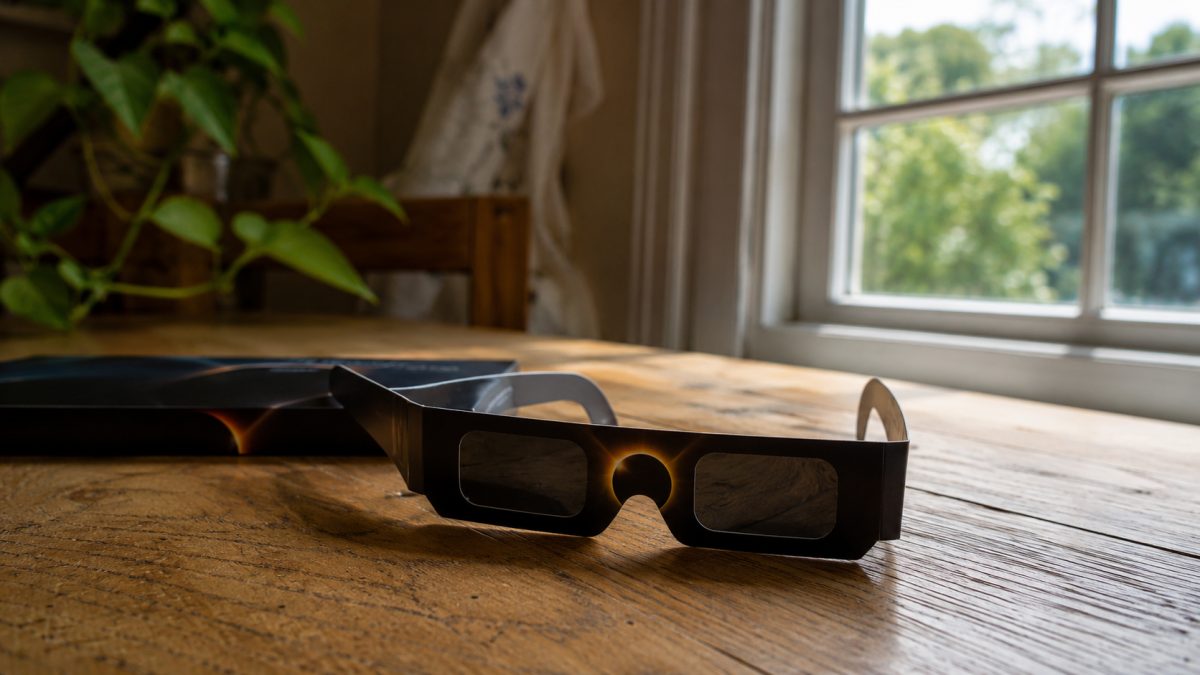
Eclipse glasses: avoid counterfeits before August 12
Four days before the August 12, 2026 eclipse, buying eclipse glasses should not come down to choosing the cheapest pair or the one whose packaging looks the most convincing. In France, the Sun will be obscured by 90 to 99.9% depending on the region, while the eclipse will be total in Spain. So the real question is simple: how can you tell a genuinely suitable pair from a product with misleading markings?
For eclipse glasses, price alone does not provide the answer. In early July 2026, Que Choisir bought ten models from pharmacies, supermarkets, magazines, opticians and the Internet: all ten filtered solar radiation correctly, even though several had shortcomings in their markings, instructions or certificates. In other words, compliance cannot be judged from the receipt or the prestige of the retailer.
The first filter: look for the right standard, not just the CE logo
For direct observation of the Sun, the reference to look for is EN ISO 12312-2:2015, or its amended version EN ISO 12312-2:2015+A1:2020. The EN ISO 12312-1:2022 standard concerns ordinary sunglasses: it is not suitable for viewing an eclipse. A simple CE marking is therefore not enough to conclude that a pair provides protection for solar observation.
Even before testing the filter, you can carry out a very practical check of the frame and documentation. The expected information is precise enough to rule out some questionable products:
- the NF EN ISO 12312-2:2015 standard reference must appear;
- the certification must be printed directly on the frame, not only on a sticker or the packaging;
- the CE marking must be present;
- the manufacturer’s name and contact details must be indicated;
- a product or batch reference must make it possible to identify the pair;
- if the manufacturer is located outside the European Union, the importer and its contact details must also be indicated.
Some specialist sellers also recommend checking for a four-digit number corresponding to a notified body. Examples cited include 2834 for CCQS Certification Services in Ireland, 0123 for TÜV Süd and 0197 for TÜV Rheinland. This is not a decorative detail: the point of this check is to obtain a more precise trace of the body involved in the inspection.
A concrete case of misleading markings: Biniki on Amazon
The risk is not purely theoretical. In April 2024, five days before the U.S. eclipse, Amazon removed the Biniki brand because the stated marking was incomplete: “ISO 12312” instead of “ISO 12312-2”. The difference looks tiny, but it completely changes how the product should be interpreted. This is exactly the kind of detail a hurried buyer may fail to notice.
A specialist retail website also claims that more than 200,000 fake pairs were urgently removed by Amazon during the 2017 U.S. eclipse. The same site puts the proportion of counterfeits at 15 to 30% among certain online sales linked to several past eclipses. These figures should be treated with caution: they are not accompanied here by independent institutional confirmation. Above all, they show why it is better to check your own pair than to rely solely on the marketplace name.
The most useful at-home protocol before August 12
1. Start with traceability
The first step requires no light source: read the frame, the instructions and the manufacturer’s information. A pair with no clear reference to ISO 12312-2, no identifiable manufacturer or an incomplete standard should immediately raise doubts. Glasses used for the 2019 eclipse should not be reused.
2. Perform the LED test before any solar observation
A protocol published by a specialist seller suggests using a powerful 100 W LED. Through genuine eclipse glasses, ambient light should be extremely dimmed. If the LED, the room, a hand or a phone screen remain clearly visible through the filter, this protocol considers the test a failure.
However, the transmission figures published by retail websites are not perfectly consistent with one another. One states that 99.9997% of visible light is blocked, meaning 0.0003% transmitted; another mentions a maximum threshold of 0.003%; a third gives no more than 0.00032%. This variation is a good reason not to treat a number printed on a product page as absolute proof. At home, you can spot a filter that is obviously too light, but you cannot reproduce a laboratory measurement.
3. Do not use the Sun as the first checking tool
Another commercial protocol suggests looking at the Sun for no more than two seconds in the early afternoon: a sharp orange disk against a black background would be the expected sign, while a blurred disk or glare would indicate a dangerous filter. I would not use this test as the first check of a suspicious pair: testing directly with your eyes a product whose reliability you are trying to determine is poor checking logic. It is better to verify traceability and behavior with an artificial light source first.
€2 or €15 glasses: can we really talk about a difference in quality?
Based on the available evidence, no, not in any demonstrated way. No quantified comparison directly links a price of €2 or €15 to better solar filtration. The Que Choisir test even supports an important distinction: the ten models bought through very different channels were effective at filtering radiation, while some were less rigorous in their markings or documentation.
Two concepts must therefore be separated: filter quality and product traceability quality. A more expensive pair may be sold with different presentation, packaging or distribution, but the data cited here do not show that its filter provides greater protection. Conversely, a cheap pair cannot be declared safe simply because it bears a CE logo.
The most useful comparison is therefore not “supermarket versus Internet” or “€2 versus €15”. It consists of checking five boxes for each pair: complete standard, marking on the frame, identifiable manufacturer, batch reference, strong-attenuation test. A pair that meets these criteria provides verifiable evidence; a pair that relies only on reassuring packaging or a high price mainly provides an impression.
Why it is better to check now rather than the day before
The French Astronomy Association estimates national demand for 2026 at 20 to 25 million pairs. Its eclipse project officer, Alain Cirou, estimates that identifiable worldwide production is far below this demand. Without concluding that shortages are certain everywhere, this potential pressure is enough to make last-minute purchases less comfortable.
The laboratory result published by Que Choisir is fairly reassuring: none of the ten models tested posed a risk to eye health based on the measured filtration. But this result does not make all eclipse glasses in circulation reliable products. Above all, it shows that two extremes should be avoided: assuming that the Internet necessarily sells fakes, or thinking that an expensive product bought through a reputable channel no longer needs to be checked.
For August 12, the best strategy is therefore very practical: read, check, compare, then test. And if essential information is missing or the filter lets you see the room normally, there is no reason to gamble with your eyesight.