
 English
  French
  German
  Spanish
  Hindi
Hindi  Italian
  Japanese
  Korean
  Norwegian
  Chinese
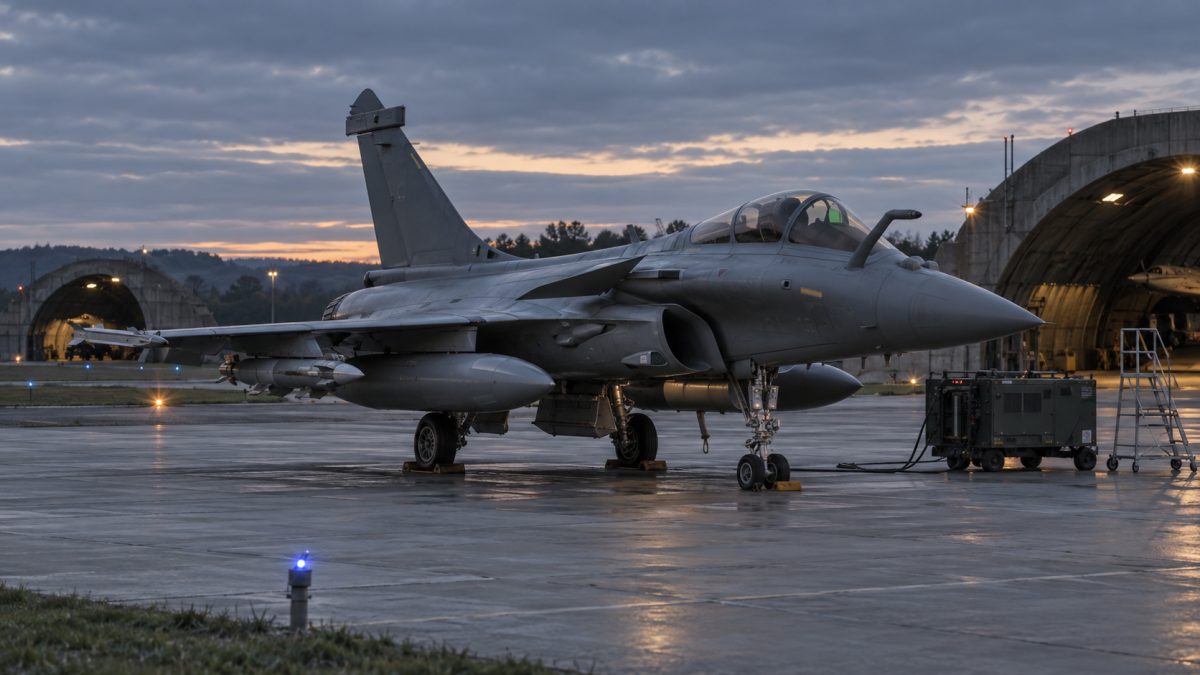
Dassault Rafale and Poland: costs and Europe’s air-power race
The Dassault Rafale sits at the heart of a European paradox. On export markets, the French fighter keeps piling up orders, with a backlog of 220 aircraft at the end of 2025, 175 of them destined for foreign customers. Yet as Poland accelerates its military modernization in response to the Russian threat, Warsaw is building its future first around the American F-35A. The issue is therefore not simply which aircraft performs best: the amounts actually contracted, industrial lead times and the alliances shaping procurement also matter.
To understand what a Dassault Rafale really costs in this race, the trap is precisely to look for a single “list price.” Export contracts often bundle aircraft, weapons, training and support. The comparison with Poland is especially revealing: its 32 F-35As were ordered as early as January 2020, but the first three aircraft did not arrive at Łask air base until May 2026. At the same time, Warsaw is considering another 32 F-35s and is still studying around forty twin-engine fighters.
The real price of a Rafale depends first on what is bought with it
The Rafale’s largest export contract is with the United Arab Emirates: 80 Rafale F4s for about €14 billion. A simple division gives €175 million per aircraft. But that figure is not the price of the airframe alone: the contract also includes weapons, training and logistical support. It is therefore better understood as an average cost per aircraft within a complete package.
Indonesia shows why this distinction is essential. Jakarta ordered 42 Rafales for an announced total of between $8 billion and $11 billion, depending on the scope counted. Divided mechanically by the number of aircraft, that works out to roughly $190 million to $262 million per aircraft equivalent. Yet the estimate for the aircraft itself is around $115 million. Deliveries of the first batch of three aircraft began in early 2026.
India pushes the gap between aircraft price and overall program value even further: an additional order for 114 Rafales, announced in February 2026, represents about €30 billion, or nearly €263 million per aircraft if the total is divided bluntly. The same logic applies to Ukrainian negotiations opened by a letter of intent in November 2025: about €20 billion is being discussed for roughly one hundred aircraft, or €200 million per aircraft equivalent.
The right way to read the figures: a “Rafale at 175, 200 or 263 million” does not mean the aircraft alone changes price by those proportions. These ratios measure contracts with different contents. Directly comparing those totals with an isolated unit price for an F-35 or Eurofighter would therefore be misleading.
In Poland’s case, the data available here provide the F-35 fleet size and timetable, but not a contract value that would allow a like-for-like calculation. It would therefore be artificial to manufacture a precise Rafale/F-35/Eurofighter price duel. Industrial commitments and delivery schedules, however, already make it possible to compare strategies.
Poland is not just buying aircraft: it is rebuilding a fleet
Poland has to replace aircraft inherited from the Soviet era, notably its MiG-29s and Su-22s. In January 2020 it signed for 32 F-35As under the Harpia program. The first three aircraft reached Łask in May 2026; 14 are expected by the end of 2026 and another 12 in 2027. Warsaw is now considering 32 more F-35As, which would bring the potential fleet to 64 aircraft.
But that is only one part of the plan. Poland has also studied a requirement for about 35 fourth-generation fighters in order to reach ten squadrons after the retirement of the MiG-29 and Su-22. Aircraft mentioned include the F-15EX, the Eurofighter Typhoon and the KF-21 Boramae. Warsaw is also interested in the Tempest program. No final decision on this second component has been confirmed.
This overlap matters: it shows that after 2022, European air rearmament does not necessarily lead to a single aircraft type. Poland may seek to combine the fifth-generation fighter it has already selected with another aircraft to fill out its squadrons. Boeing has even proposed pairing its MQ-28 Ghost Bat collaborative drone with its F-15EX offer. And the U.S. “F-15 Eagle Crest” framework contract, awarded to Boeing for $131.23 billion, lists Poland among potential foreign customers without constituting a firm Polish order.
Why the F-35 dominates Europe more than the Rafale
The contrast is clear: only Greece, Croatia and Serbia have ordered the Rafale in Europe, while thirteen European nations have chosen the F-35. Part of the explanation is institutional. Germany, Belgium, the Netherlands, Italy and Turkey host U.S. B61 nuclear bombs, and the F-35A is the only aircraft certified to carry them. Germany explicitly linked its purchase to maintaining its participation in NATO nuclear sharing; Belgium, the Netherlands and Italy follow the same logic. In 2025, the United Kingdom announced an initial purchase of 12 F-35As to join that mission.
This mechanism does not apply to Poland in exactly the same way, but it changes the map of the European market. Some purchases are not decided on price and performance alone: they also depend on shared missions, systems already selected and NATO commitments. The Rafale is therefore competing with a political and operational architecture, not just another aircraft.
Delivery times are becoming almost as strategic as price
Dassault delivered 26 Rafales in 2025, up from 21 in 2024. At the end of 2025, its backlog stood at 220 aircraft. At a constant 2025 production rate, that volume represents more than eight years of deliveries. This calculation is not a forecast — production can change — but it gives an order of magnitude for industrial pressure. Around 500 companies take part in the Rafale supply chain, including Safran, Thales and MBDA.
France has already used another method to deliver more quickly to some European customers: transferring second-hand Rafales to Greece and Croatia. That solution temporarily reduced its own operational fleet. It illustrates a point often absent from comparisons: during a period of simultaneous rearmament, an aircraft available sooner may have greater strategic value than one that is theoretically cheaper but delivered much later.
Poland provides another example. More than six years separate the signing of the F-35 contract in January 2020 from the arrival of the first aircraft at a Polish base in May 2026. That has not stopped Warsaw from potentially seeking to double its order: its planning horizon extends to the creation of new squadrons by around 2039.
Who could still buy the Rafale in Europe?
The most concrete prospect today is Ukraine. A letter of intent signed with France in November 2025 opened negotiations around roughly one hundred Rafales, for a potential value of €20 billion. It is not a firm contract and should be presented as such. But no other European lead mentioned here is as advanced.
Poland, by contrast, should not be presented as a future Rafale customer on the basis of the available evidence. Warsaw is examining several aircraft to complement its F-35s, but no direct negotiations with Dassault have been confirmed. That is precisely what makes the Polish case interesting: it shows that the Rafale’s worldwide success — 533 firm orders since the start of the program according to Dassault Aviation, including 323 export orders by the end of 2025 — does not automatically translate into a breakthrough in Central Europe.
The new map of European air power is therefore taking shape less around a “best fighter” than around three constraints: the real content of contracts, the ability to deliver and the alliance architecture. The Rafale can win gigantic export contracts and still remain a minority choice in Europe; Poland can expand its fleet massively with American aircraft while keeping several options open; and the Eurofighter, F-15EX, KF-21 or Tempest can still fill complementary roles. Since 2022, buying a combat aircraft has increasingly meant choosing an industrial and geopolitical path for several decades.