 English
  French
  German
  Spanish
  Hindi
Hindi  Italian
  Japanese
  Korean
  Norwegian
  Chinese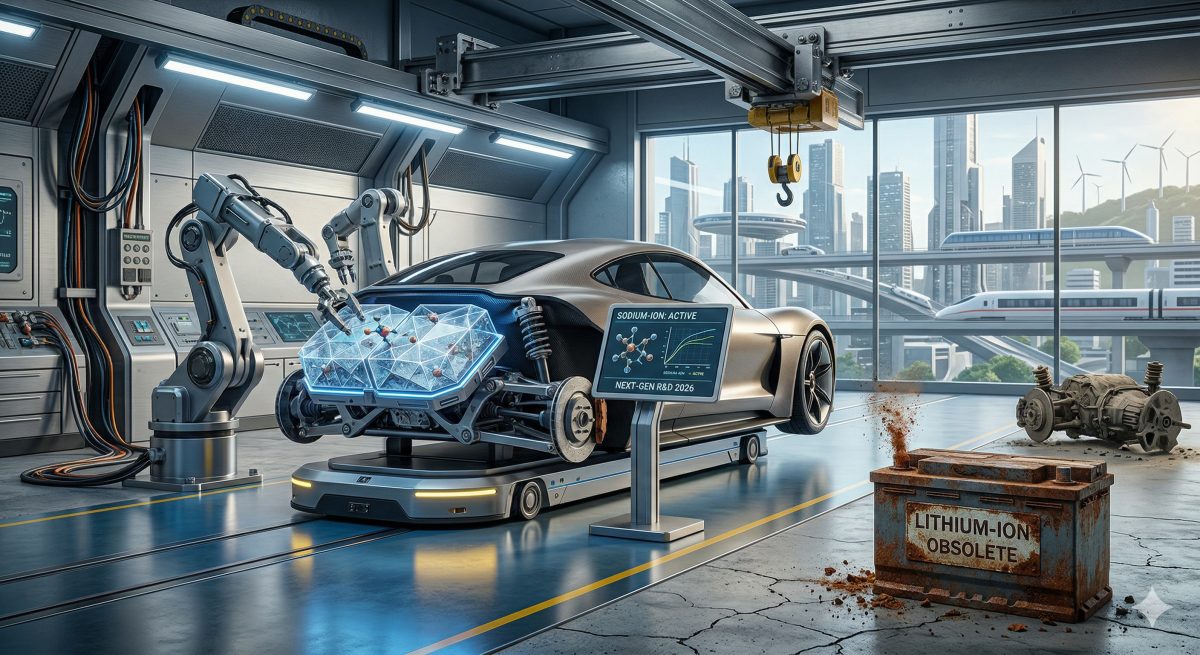
Sodium-ion batteries: the revolution challenging lithium in 2026
What if the future of batteries no longer relied on lithium, but on an ingredient as ordinary as table salt? In 2026, sodium-ion batteries are finally leaving the laboratories to invade factories, electric vehicles and storage networks. MIT ranked them among its 10 breakthrough technologies of 2026, and for good reason: they promise to redraw the cards of a market dominated for two decades by lithium.
Why sodium changes the game
Sodium is the sixth most abundant element on Earth. It is found in sea salt, in soda deserts, everywhere. Unlike lithium, whose reserves are concentrated in a handful of countries (Chile, Australia, China), sodium suffers from no geopolitical tension over its supply. This abundance translates directly into costs: projections for 2026 estimate a price of 37 euros per kWh for sodium-ion cells, nearly 40% less than conventional lithium-ion.
Beyond price, sodium-ion batteries offer remarkable technical advantages. They operate over a wider temperature range, from -40 °C to +80 °C, making them ideal for extreme climates. They are also safer: the risk of thermal runaway — that dreaded phenomenon that can cause fires in lithium batteries — is considerably reduced with sodium chemistry.
CATL opens the dance with the first production vehicle
The strongest signal of 2026 came from China. In February, battery giant CATL and automaker Changan Automobile unveiled the Changan Nevo A06, the world's first production vehicle equipped with sodium-ion batteries. With an energy density reaching 175 Wh/kg and an announced range of 500 kilometers, this sedan proves that sodium technology is now mature for the mass market.
CATL doesn't stop there: the Chinese group announced a large-scale deployment of its entire sodium-ion range throughout 2026. The goal is clear — offering electric vehicles significantly cheaper than those equipped with lithium batteries, while maintaining comparable performance for everyday use.
Tiamat: the rising French champion
France is not left out of this revolution. The startup Tiamat, born from CNRS research, stands as a European sodium-ion pioneer. Supported by a strategic investment from Stellantis, the company has launched the construction of a large-scale sodium-ion cell production plant on French soil.
For France, the stakes go beyond mere technological innovation. Unlike lithium, whose supply chain remains largely dependent on Asia, sodium potentially allows mastery of the entire production chain, from raw material extraction to finished product. This is an argument of industrial sovereignty that resonates particularly in the current context of tensions in the Middle East and concerns about global supply chains.
Stationary storage: the other playing field
While electric vehicles capture media attention, it may be in stationary storage that sodium-ion batteries will have the greatest short-term impact. Solar and wind farms need massive storage systems to smooth their intermittent production. For these applications, energy density (battery weight) matters less than cost per cycle and lifespan.
On these criteria, sodium-ion excels. Several grid-scale storage projects equipped with sodium-ion batteries are already operational in China, and Europe is preparing its own installations. Global investment in this sector exceeded 20 billion dollars in 2026, a sign of growing industry confidence.
Limitations to know
Sodium-ion batteries are not a miracle cure. Their energy density remains lower than that of the best lithium-ion batteries (175 Wh/kg vs. more than 250 Wh/kg for premium NMC). This means that for the same range, a sodium battery will be larger and heavier. For premium vehicles or electric aviation, lithium therefore retains its advantage.
Furthermore, the technology is still young in terms of industrial production. Manufacturing yields need to improve, and the recycling chain remains to be built. But these challenges are comparable to those faced by lithium-ion ten years ago — and we know how quickly that industry progressed.
2026, a historic turning point
What is at stake in 2026 is potentially the end of lithium's monopoly on electrochemical storage. Not that lithium will disappear — it will remain indispensable for high-performance applications — but it will now have a serious competitor for everyday uses: entry-level vehicles, residential storage, cordless tools, electric two-wheelers.
Sodium-ion embodies a simple but powerful promise: democratizing energy storage. With accessible raw materials, potentially local production and plummeting costs, this technology could well become the discreet but essential pillar of the energy transition. And France, thanks to players like Tiamat, holds all the cards to be a leader in it.