
 English
  French
  German
  Spanish
  Hindi
Hindi  Italian
  Japanese
  Korean
  Norwegian
  Chinese
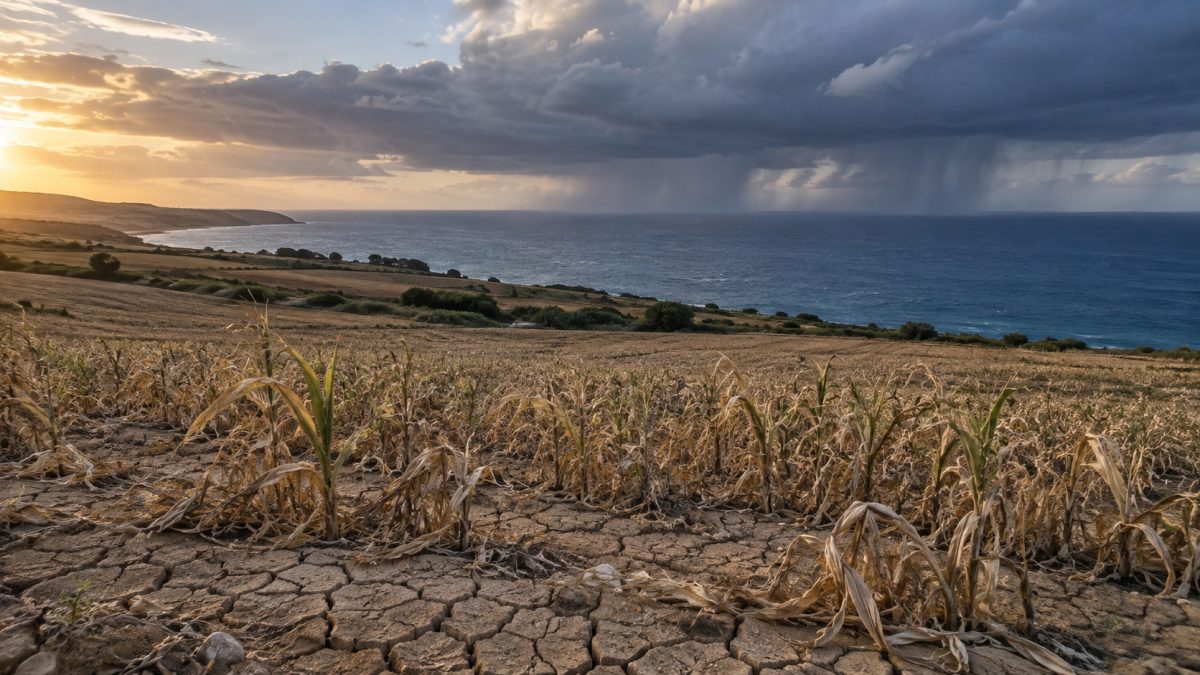
The oceans' invisible safety net against global drought
We tend to imagine drought as a local problem: a river running low, soil cracking, crops suffering. But on a planetary scale, the real question is more worrying: why do the world's major regions not all tip into drought at the same time? Part of the answer lies with an actor we rarely view from this angle: the ocean.
A study published in 2026 in Communications Earth & Environment, led by IIT Gandhinagar with the Helmholtz Centre for Environmental Research, analyzed global droughts over the 1901-2020 period. Its most striking result is not simply that oceans influence rainfall — that has long been known — but that they appear to help prevent regional droughts from becoming synchronized worldwide.
A dry world, but rarely dry everywhere at once
To understand this phenomenon, the researchers did not simply add up the affected areas. They represented the onset of droughts as a global network. When two distant regions entered drought within a short time window, they were considered synchronized. This approach makes it possible to track not only where drought appears, but also how several regions can fall into crisis almost together.
Recurring hotspots stand out: Australia, South America, southern Africa and parts of North America. Yet these hotspots do not all activate simultaneously. According to the study, the share of land affected at the same time by synchronized drought lies between 1.8% and 6.5%, far below an older estimate that reached as high as one sixth of the world's land.
The main mechanism behind this offset is the El Niño-Southern Oscillation, or ENSO. When Pacific temperatures shift into an El Niño phase, rainfall patterns are reorganized on a large scale. Australia can then become a major drought hotspot, while other regions respond differently. When La Niña takes over, the geography of risk changes again, with droughts often becoming more dispersed.
In other words, the ocean does not eliminate droughts. It redistributes them across time and space. This movement creates a mosaic of regional responses that limits the formation of a single dry crisis affecting many continents at the same time. That detail changes everything: a global system can absorb regional shocks as long as they do not happen everywhere together.
The real safety net is desynchronization
This is where the study becomes more interesting than a simple story about oceanography. Global food security does not depend only on one region avoiding drought. It also depends on other regions not all suffering at the same time.
The researchers examined historical yields for wheat, rice, maize and soybeans. In major farming regions, a moderate drought sharply raises the risk of crop loss: it often exceeds 25% and can surpass 40 to 50% for maize and soybeans in some areas. A local crisis is already serious. But several simultaneous agricultural crises would reduce the opportunities for compensation between producing regions just as much.
That is the invisible mechanism: we are not protected because nothing happens, but because bad things do not always happen in the same place at the same time. As long as one area suffers while another holds up, some margin remains. The researchers even suggest that the main drought hotspots could serve as early-warning regions to help stabilize food markets.
This idea of compensation is easy to miss because it looks like normality. When a system works, we see products available, flows continuing and prices remaining affordable. We do not see the imbalances offsetting one another in the background.
Is warming breaking this mechanism?
The rigorous answer is: this study does not yet allow us to say so. It shows that warming is already changing the drivers of drought severity, but it does not demonstrate that the oceanic desynchronization mechanism is weakening.
Over the most recent decades analyzed, about two thirds of the long-term changes in drought severity are linked to variations in precipitation. The remaining third is associated with the increase in evaporative demand caused by warming. In plain terms, even if rainfall remains central, a warmer atmosphere can worsen drying by demanding more water from soils and vegetation.
The important question therefore becomes less: “Will the oceans stop redistributing droughts?” and more: “Will this redistribution mechanism still be enough if each episode becomes more severe?” That is a question, not an established result. A safety net can remain in place while becoming less protective if the shocks it has to cushion grow larger.
For the world's food supply, vulnerability lies precisely in this combination. As long as droughts remain offset in time, less affected regions can compensate for part of the losses elsewhere. But if episodes become more severe across several major agricultural basins, the margin for compensation can shrink, even without the emergence of a perfectly simultaneous planetary drought.
Our safeguards often depend on what we do not see
This climate mechanism invites us to look at other systems differently. We should not claim that the economy or health systems work exactly like ENSO: no data in this study would support a direct scientific comparison. But as an analogy, the idea is powerful.
An economy often withstands shocks because not every company, sector and territory experiences the same shock at the same time. A health system holds up better if all facilities are not saturated simultaneously and some can take over. In both cases, protection does not come from the absence of failure: it comes from having capacity elsewhere, available at the right time.
We can call it reserve capacity, redundancy, diversification or simply margin. The word matters less than the principle: resilience often comes from crises not being synchronized. We tend to judge a system by its average performance, even though its robustness may depend more on how its weaknesses are distributed.
- An isolated shock can be severe but absorbable.
- Two shocks separated in time may leave room for recovery.
- Simultaneous shocks remove precisely the resources that were serving as backup.
This is what the oceans reveal in their own way. They do not guarantee a mild climate. They partly organize a world in which water crises do not completely overlap. And that simple offset is a form of global protection.
The danger is not only failure, but the loss of margin
We often look for catastrophic thresholds: the moment when a system “breaks.” The IIT Gandhinagar study points to a subtler concern. Before total failure, the safety margin may already be eroding. If warming increases drought severity through evaporation, the question is not only whether ENSO will continue to shift risks around. We also need to know how many simultaneous crises, even partial ones, our food systems can withstand.
The paradox is that compensation mechanisms are almost invisible as long as they work. We notice the missing harvest, not the one that made up for it. We notice the shortage, not the years when another region prevented it from happening. We easily confuse stability with the absence of fragility.
The oceans remind us of something broader: our collective security often depends less on absolute protection than on a series of backups. As long as those backups do not fail together, the system holds. The day several margins disappear at once, what seemed robust can suddenly look much more fragile.