 English
  French
  German
  Spanish
  Hindi
Hindi  Italian
  Japanese
  Korean
  Norwegian
  Chinese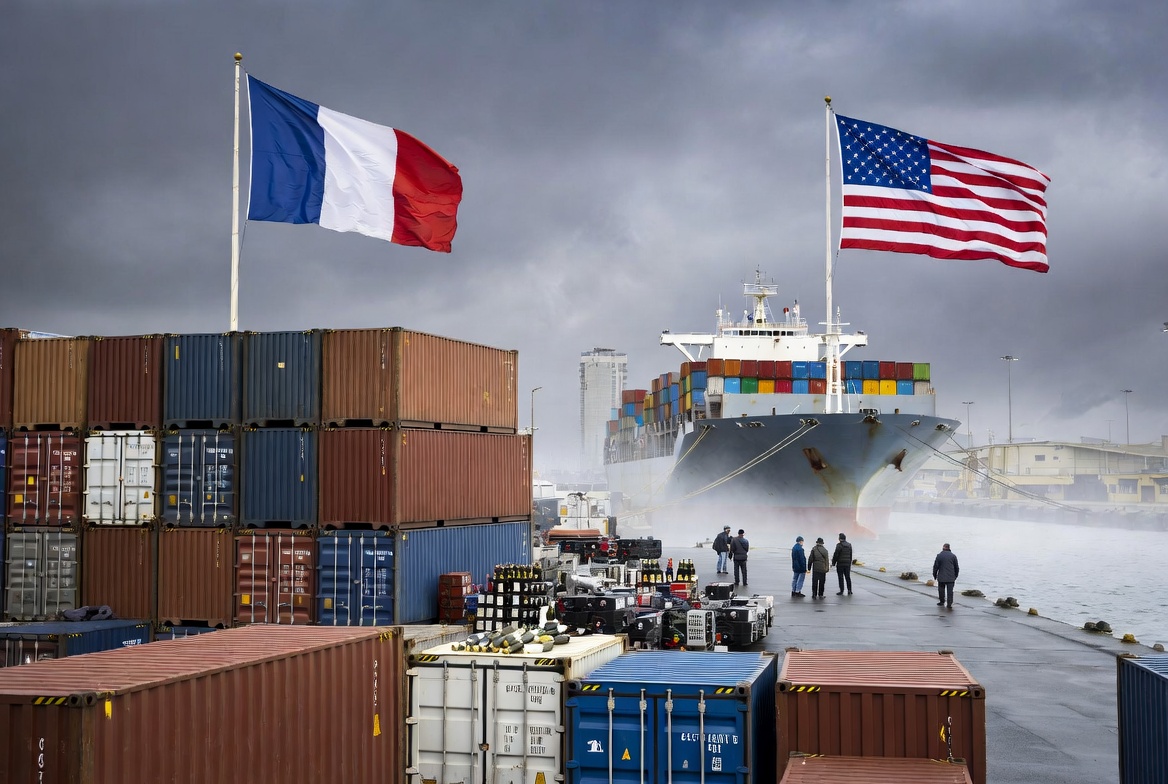
Trade War 2026: The Impact of Trump Tariffs on France
Since Donald Trump's installation for his second term in the White House, the trade war has returned in full force to the international scene. In 2026, American customs duties have established themselves as one of the hottest economic issues, directly threatening French exporters and their commercial balance with the United States. But what does this concretely mean for businesses, workers and consumers in France?
The tariff threat: from Greenland to all of Europe
It all begins with a territorial claim. In January 2026, Donald Trump announces he wants to make Greenland an American territory. To put pressure on Denmark and its European allies, he brandishes a formidable weapon: customs duties. He threatens to impose a surcharge of 10% on European exports to the United States, with a progressive increase to 25% for certain sectors if no agreement is found before June 1st.
This offensive is part of a broader strategy. The Trump administration considers tariffs as a tool of foreign policy as much as commercial policy. By targeting Europe, it seeks to obtain concessions on several fronts: defense, technology, and of course its geopolitical ambitions in the Arctic.
The potential impact is massive. According to the Tax Foundation, Trump's 2026 tariffs represent the largest increase in American taxes as a percentage of GDP since 1993, equivalent to an additional tax of $1,500 per American household. For Europe, tariffs at 25% would reduce European GDP growth by approximately 0.2 percentage points — which seems low, but conceals considerable sectoral disparities.
The French sectors on the front line
France exports each year nearly 50 billion euros of goods to the United States. Several industries are particularly exposed to the new surcharges:
- Aeronautics: with 9.7 billion euros in annual exports, Airbus and its French subcontractors are directly threatened. An increase in import costs in the United States could weaken French competitiveness against Boeing.
- Luxury goods: 6.5 billion euros of high-end products — leather goods, fashion, jewelry — cross the Atlantic each year. LVMH, Hermès, Kering: France's major luxury groups are watching the situation very closely.
- Wines and spirits: 4.1 billion euros of Bordeaux, Champagne, Burgundy and Cognac are exported each year to the United States, the world's leading market for these products. French wine producers still remember the 25% surcharges imposed during Trump's first term in 2019-2020, which caused significant losses.
- Chemistry and pharmaceuticals: with 2.6 billion euros in exports, this sector is also vulnerable, especially since medicines represent the EU's leading export to the United States.
- Naval industry and electrical equipment: 1.8 and 1.5 billion euros respectively.
That said, France remains less dependent on the United States than some of its neighbors. Its exports to America represent only 1.6% of its GDP, compared to 3.8% for Germany, whose automotive industry is far more vulnerable.
And for French consumers?
Paradoxically, in the short term, French consumers could observe an unexpected effect: a drop in certain prices. Why? Because Asian goods — electronics, textiles, toys — that can no longer enter the United States will be redirected to other markets, including Europe. This abundance of supply could drive prices down on many everyday consumer goods.
But this optimistic picture has limits. In the medium term, the slowdown in world trade caused by the trade war will weigh on growth, employment and incomes in Europe. French companies that export to the United States may reduce their workforce or investments. And the rise in geopolitical tensions casts a general uncertainty over financial markets, which can affect household savings.
Europe's response: the "trade bazooka"
Faced with this offensive, the European Union has not remained with arms crossed. France pushed its partners to activate the Anti-Coercion Instrument (ACI), nicknamed the "trade bazooka." This tool, adopted in 2023, allows the EU to retaliate in a targeted manner against economic pressures deemed coercive:
- Restrict American suppliers' access to the European market
- Exclude American companies from European public markets
- Impose restrictions on certain strategic exports and imports
The objective is clear: to show Washington that Europe is ready to defend its interests without triggering an uncontrolled escalation. Negotiations are intense, and several European capitals are pressing to find a diplomatic agreement before the 25% tariffs come into force.
A power struggle that will define the transatlantic future
The 2026 trade war is not a simple tariff episode. It reflects a profound restructuring of relations between the United States and Europe. Donald Trump is questioning decades of transatlantic free trade and imposing a logic of power relations where multilateral rules once dominated.
For France, the challenge is twofold: defending its exporters in the short term, and rethinking its industrial strategy in the long term. Diversifying markets (Asia, Africa, emerging markets), strengthening the European internal market and investing in future-oriented sectors less dependent on relations with Washington seem to be the priority tracks.
One thing is certain: the happy globalization of the 1990s-2000s is definitively over. In this new world commercial order, France and Europe will have to learn to fight for their place.