
 French
 German
 English
 Spanish
 Hindi
 Italian
 Japanese
 Korean
 Norwegian
 Chinese
How China Is Depriving Africa of Its Donkeys and Income
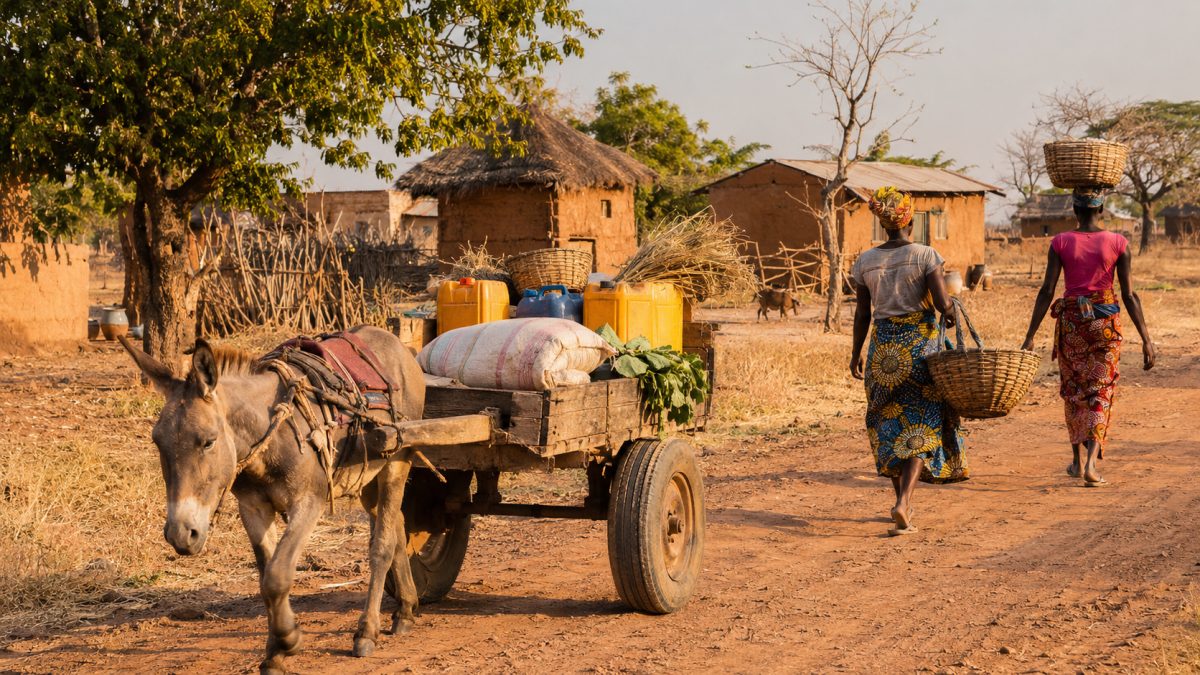
Chinese demand for ejiao, a gelatin made from donkey hides, fuels a global trade that threatens the livelihoods of rural African communities. According to the Institute for Security Studies, around 5.9 million donkeys are slaughtered worldwide each year to meet this demand. In February 2024, the African Union decided to ban the slaughter of donkeys for their skins to protect a vital economic resource.
This trade tells a much bigger story than that of an animal under threat. It shows how a raw material almost invisible in wealthy countries' economic statistics can become essential to an international market, disrupting entire communities. When a donkey disappears from an African village, more than an animal is lost. A means of transport, a source of farm labor and part of a family's income may all disappear at once.
Why does China need millions of donkey hides?
The answer lies in a product called ejiao. This gelatin extracted from donkey skin has been part of traditional Chinese medicine since the Tang dynasty. It has traditionally been used for fatigue, dizziness, dry coughs and certain types of irregular bleeding. These historical uses, however, do not constitute scientific proof of therapeutic effectiveness, which remains debated.
The product's market expanded dramatically as Chinese living standards rose and media exposure increased. According to the South African Institute of International Affairs, its appearance in the Chinese television series Empresses in the Palace, broadcast in 2011, helped raise its profile.
The economic impact has been striking. According to figures reported by The Conversation, China's ejiao market grew from $3.2 billion in 2013 to $7.8 billion in 2020. In 2023, its price could reach US$783 per kilogram.
It is no longer merely a traditional preparation made for a small customer base. It is a high-value market driven by massive demand for an animal-derived raw material whose supply cannot grow as quickly as sales.
When domestic supplies run short
China once had a large donkey population, but it has fallen sharply. According to figures reported by Brooke West Africa, the population declined from 11 million to around 2 million animals.
Around 2010, domestic supplies could no longer meet the industry's needs. Companies therefore began seeking hides elsewhere, particularly in Africa.
This geographic shift lies at the heart of the problem: a shortage in one domestic market became economic pressure on working animals on another continent.
Why has Africa become the main source for this industry?
Africa has the world's largest donkey population. According to The Conversation, of roughly 53 million donkeys worldwide in 2020, nearly two-thirds lived on the continent.
But this apparent abundance conceals a fundamental difference in how the animals are used. For the ejiao industry, a donkey is primarily a hide that can be turned into gelatin. For a rural African household, the same animal is productive equipment throughout its lifetime.
It carries water, crops and goods. It supports farming and reduces the human effort needed for daily journeys.
This contrast creates a genuine economic contradiction. The international market pays for the animal's disappearance, while the local economy depends on its continued presence.
According to the Institute for Security Studies, 158 million Africans consider donkeys an important economic asset. Such dependence means that selling a hide can have consequences far beyond the transaction's value.
How does losing a donkey make a family poorer?
To understand the mechanism, imagine a small business suddenly losing its delivery vehicle. Goods become harder to move, some activities cost more and transport takes longer.
In rural Africa, the consequences can be even more immediate. According to a study by the organization Brooke, losing a donkey can cause a 30% to 40% drop in annual household income.
The loss is not just financial. When animal-powered transport disappears, household tasks must be redistributed. The Institute for Security Studies notes that women and children are particularly affected by the increase in physical labor.
Girls in particular may be called upon more often to do household chores at the expense of their schooling. The absence of a transport animal can thus trigger a chain of effects: greater fatigue, less available time, lower income and reduced access to education.
Globalization is often discussed in terms of factories and jobs moving elsewhere. Here, it indirectly shifts the burden of labor. A product sold in a distant market can mean extra hours of carrying goods by hand for a woman or girl.
The replacement-cost trap
Rising international demand also pushes up animal prices. In Burkina Faso, according to information collected by Banfora.org from Brooke West Africa, the price of a donkey rose from 30,000 to 120,000 CFA francs.
The price therefore quadrupled. For a poor household whose animal has been stolen, replacing it becomes much harder.
This increase illustrates a particularly destructive economic mechanism: the resource becomes more expensive precisely when those who depend on it can least afford to keep or replace it.
How does such a little-known supply chain operate?
The hide trade does not consist solely of direct transactions between African livestock owners and Chinese buyers. It also involves middlemen, cross-border movements and illegal networks.
In West Africa, the routes described by Banfora.org run through Niger, Nigeria and Mali, pass through Burkina Faso, then reach Ghana or Togo before export to China.
These routes make it difficult to monitor animals and establish their origins. Demand also encourages theft once animals become profitable enough for traffickers.
The exact scale of the trade remains difficult to establish. Some estimates suggest China imports around three million hides annually, while the Institute for Security Studies estimates that 5.9 million donkeys are slaughtered worldwide each year for ejiao. These figures do not necessarily cover the same scope and should not be confused.
This lack of statistical visibility is itself part of the problem. A supply chain can cross several countries without the economic losses borne by local communities being clearly reflected in the final product's value.
Why is the African ban still not enough?
In February 2024, at the African Union's 37th summit in Addis Ababa, African states adopted a ban on slaughtering donkeys for their skins. According to the South African Institute of International Affairs, the decision aims to protect a continental population estimated at 33 million animals.
The campaign continued at a pan-African conference on donkeys held in Abidjan in June 2025. More than fifteen countries backed a moratorium as part of a continental strategy covering 2026–2035, according to information reported by LFP Cheval.
But adopting a political decision does not guarantee consistent enforcement. Differences in national regulations and porous borders allow trafficking to continue.
Burkina Faso offers an instructive precedent: a decree already regulated donkey slaughter and exploitation in 2016, but the practice resumed in 2019, according to Banfora.org.
An effective response would therefore require coordinated inspections, traceability of animals and hides, and cooperation among transit and exporting countries. It could also involve online marketplaces distributing products containing ejiao.
Organizations have called on Alibaba, Amazon and eBay to remove these products from their listings, while a Donkey Sanctuary petition has gathered more than one million signatures, according to LFP Cheval.
What this trade reveals about how we define wealth
The story of donkey hides exposes a fundamental weakness in some global supply chains: they can put a price on a raw material, but struggle to value all the services it provided before extraction.
A hide has an immediately identifiable market value. By contrast, the years of transport, farm work and time saved by a living animal do not appear directly in the price paid by the final buyer.
This is precisely what makes the industry so revealing. An industry can generate considerable value at one end of the planet while destroying productive capacity at the other, without accounting for that destruction in the product's price.
The issue therefore extends beyond donkey trading. It concerns all resources whose local usefulness exceeds their immediate resale value. When international trade ignores this invisible function, the communities least able to absorb the shock often bear the consequences.
Protecting African donkeys is not just about preserving a domestic animal: it also means defending a rural economic infrastructure that the global market fails to value properly.
Frequently asked questions
Why does China import so many donkey hides?
The hides are used to produce ejiao, a gelatin used in traditional Chinese medicine. Strong demand and China's shrinking donkey population have driven producers to seek supplies abroad, particularly in Africa.
How does this trade affect African families?
Losing a donkey deprives some families of an essential means of transport and agricultural labor. According to a Brooke study, it can reduce annual household income by 30% to 40% while increasing the physical workload of women and children.
Is the donkey hide trade banned in Africa?
In February 2024, the African Union adopted a continent-wide ban on slaughtering donkeys for their skins. Enforcement remains uneven, however, particularly because of differing regulations and difficulties policing borders.
How could the industry be better regulated?
More effective regulation would require closer coordination between states, monitoring of cross-border transport and hide traceability. Action targeting the distribution of ejiao products could also reduce outlets for illegal trade, provided it is accompanied by measures protecting rural communities' incomes.
Sources
- China imports millions of donkey hides from Africa every year: new book traces the drivers and impact (theconversation.com)
- Why the African Union Stopped the Donkey Hide Trade with China (saiia.org.za)
- China's donkey hide imports from Africa: drivers and impact (newsminimalist.com)
- Donkey hide trafficking: Africa stands against a destructive global trade ... (lfpcheval.fr)
- The AU's ban on the horrific donkey skin trade (issafrica.org)
- Donkey trafficking: “If this trade continues, there will not be a single donkey left in West Africa ...” (banfora.org)