 German
  French
  English
  Spanish
  Chinese
  Japanese
  Korean
  Hindi
Hindi  Norwegian
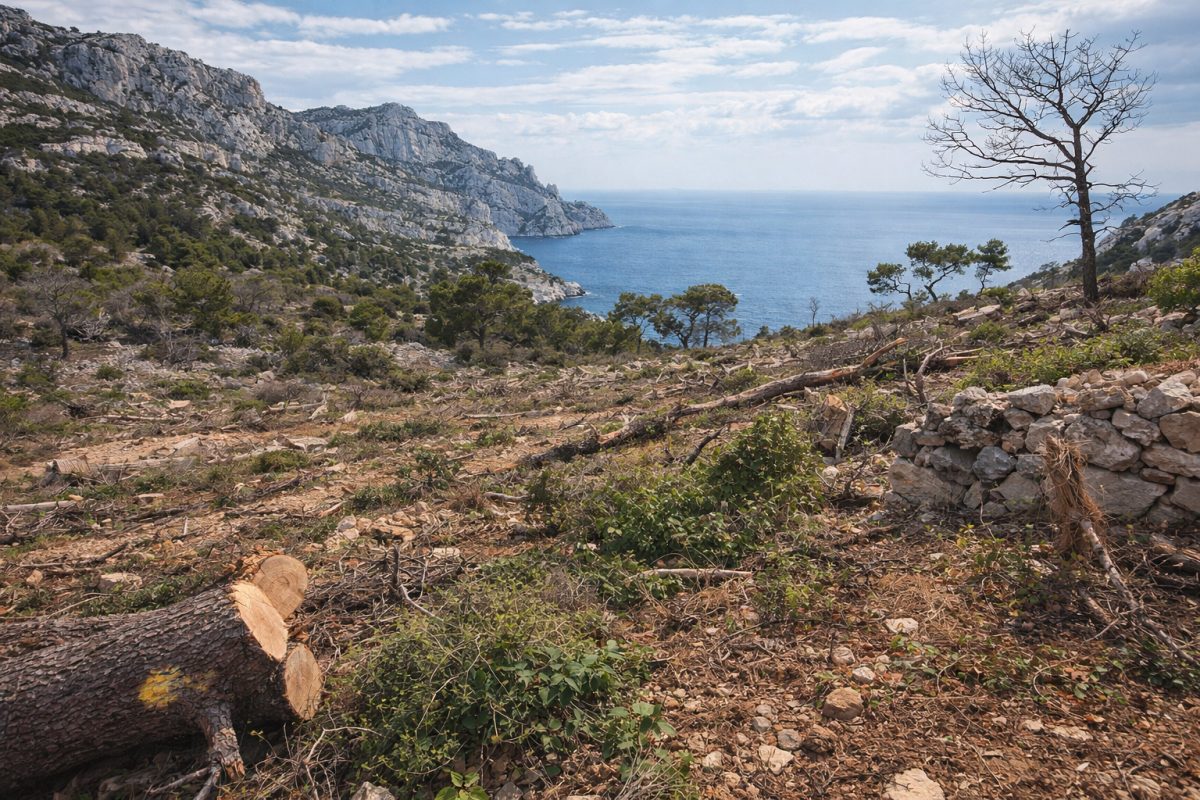
Walking in the Calanques: a feeling, a sadness
Personal testimony / personal feelings
Note: this text expresses a subjective personal impression of an observed situation. It is not intended to be controversial.
To unwind after a difficult week, yesterday morning (Sunday), I went to the Parc des Calanques in Marseille. After the usual short climb, what a (nasty) surprise — and shock — it was to see the sign indicating that this is a state forest gone, along with the sign marking the entrance to the Parc des Calanques: vanished.
The shock on the path
Instead, about a hundred pine trees lay scattered on the ground, along with shrubs and garrigue plants (such as cistus) uprooted. What a disaster to see this landscape of mosses and lichens, thyme and rosemary torn up, strawberry trees shredded, laurustinus cut down!
What an awful scene of devastation…
And this is only the beginning, since more than 300 trees (and counting) are still to be sacrificed, in the name of land clearing that, in my view, does not respect the root system.
Consequences that worry
Often, young trees that have been felled and uprooted will no longer hold the soil in place. Mudslides during persistent rain will become more frequent and will certainly have dramatic long-term consequences.
And what can be said of all those trees and shrubs that served as the "pantry" for great tits (predators of processionary caterpillars), or the shelter for bats (devourers of mosquitoes)? These marked trees and shrubs are set to be cut down very soon.
A contrast that is hard to understand
Furthermore, it was noted that picking, camping and riding motorcycles are prohibited, out of respect for the place and its tranquillity. Yet when you see the current result — electric saws, equipment and trucks — a good part of this landscape seems disfigured.
A disheartening walk that, instead of relaxing me, made me angry! A shocking situation where the pine trees, the low stone walls and the plant cover no longer seem to be respected.
It will come as no surprise that the rare natural coolness of this city is no longer present in this small corner of nature torpedoed and plundered, and that it will become, over time and with climate change, a sort of year-round tinderbox — even more so in the summer period.
What a regrettable and distressing waste, given that the "living" trees (not diseased ones) did not deserve this destructive carnage. Poor garrigue, poor shredded forest…



Walking in the Calanques: a feeling, a sadness
Personal testimony / personal feelings
Note: this text expresses a subjective personal impression of an observed situation. It is not intended to be controversial.
To unwind after a difficult week, yesterday morning (Sunday), I went to the Parc des Calanques in Marseille. After the usual short climb, what a (nasty) surprise — and shock — it was to see the sign indicating that this is a state forest gone, along with the sign marking the entrance to the Parc des Calanques: vanished.
The shock on the path
Instead, about a hundred pine trees lay scattered on the ground, along with shrubs and garrigue plants (such as cistus) uprooted. What a disaster to see this landscape of mosses and lichens, thyme and rosemary torn up, strawberry trees shredded, laurustinus cut down!
What an awful scene of devastation…
And this is only the beginning, since more than 300 trees (and counting) are still to be sacrificed, in the name of land clearing that, in my view, does not respect the root system.
Consequences that worry
Often, young trees that have been felled and uprooted will no longer hold the soil in place. Mudslides during persistent rain will become more frequent and will certainly have dramatic long-term consequences.
And what can be said of all those trees and shrubs that served as the "pantry" for great tits (predators of processionary caterpillars), or the shelter for bats (devourers of mosquitoes)? These marked trees and shrubs are set to be cut down very soon.
A contrast that is hard to understand
Furthermore, it was noted that picking, camping and riding motorcycles are prohibited, out of respect for the place and its tranquillity. Yet when you see the current result — electric saws, equipment and trucks — a good part of this landscape seems disfigured.
A disheartening walk that, instead of relaxing me, made me angry! A shocking situation where the pine trees, the low stone walls and the plant cover no longer seem to be respected.
It will come as no surprise that the rare natural coolness of this city is no longer present in this small corner of nature torpedoed and plundered, and that it will become, over time and with climate change, a sort of year-round tinderbox — even more so in the summer period.
What a regrettable and distressing waste, given that the "living" trees (not diseased ones) did not deserve this destructive carnage. Poor garrigue, poor shredded forest…
Walking in the Calanques: a feeling, a sadness
Personal testimony / personal feelings
Note: this text expresses a subjective personal impression of an observed situation. It is not intended to be controversial.
To unwind after a difficult week, yesterday morning (Sunday), I went to the Parc des Calanques in Marseille. After the usual short climb, what a (nasty) surprise — and shock — it was to see the sign indicating that this is a state forest gone, along with the sign marking the entrance to the Parc des Calanques: vanished.
The shock on the path
Instead, about a hundred pine trees lay scattered on the ground, along with shrubs and garrigue plants (such as cistus) uprooted. What a disaster to see this landscape of mosses and lichens, thyme and rosemary torn up, strawberry trees shredded, laurustinus cut down!
What an awful scene of devastation…
And this is only the beginning, since more than 300 trees (and counting) are still to be sacrificed, in the name of land clearing that, in my view, does not respect the root system.
Consequences that worry
Often, young trees that have been felled and uprooted will no longer hold the soil in place. Mudslides during persistent rain will become more frequent and will certainly have dramatic long-term consequences.
And what can be said of all those trees and shrubs that served as the "pantry" for great tits (predators of processionary caterpillars), or the shelter for bats (devourers of mosquitoes)? These marked trees and shrubs are set to be cut down very soon.
A contrast that is hard to understand
Furthermore, it was noted that picking, camping and riding motorcycles are prohibited, out of respect for the place and its tranquillity. Yet when you see the current result — electric saws, equipment and trucks — a good part of this landscape seems disfigured.
A disheartening walk that, instead of relaxing me, made me angry! A shocking situation where the pine trees, the low stone walls and the plant cover no longer seem to be respected.
It will come as no surprise that the rare natural coolness of this city is no longer present in this small corner of nature torpedoed and plundered, and that it will become, over time and with climate change, a sort of year-round tinderbox — even more so in the summer period.
What a regrettable and distressing waste, given that the "living" trees (not diseased ones) did not deserve this destructive carnage. Poor garrigue, poor shredded forest…