
 English
  French
  German
  Spanish
  Hindi
Hindi  Italian
  Japanese
  Korean
  Norwegian
  Chinese
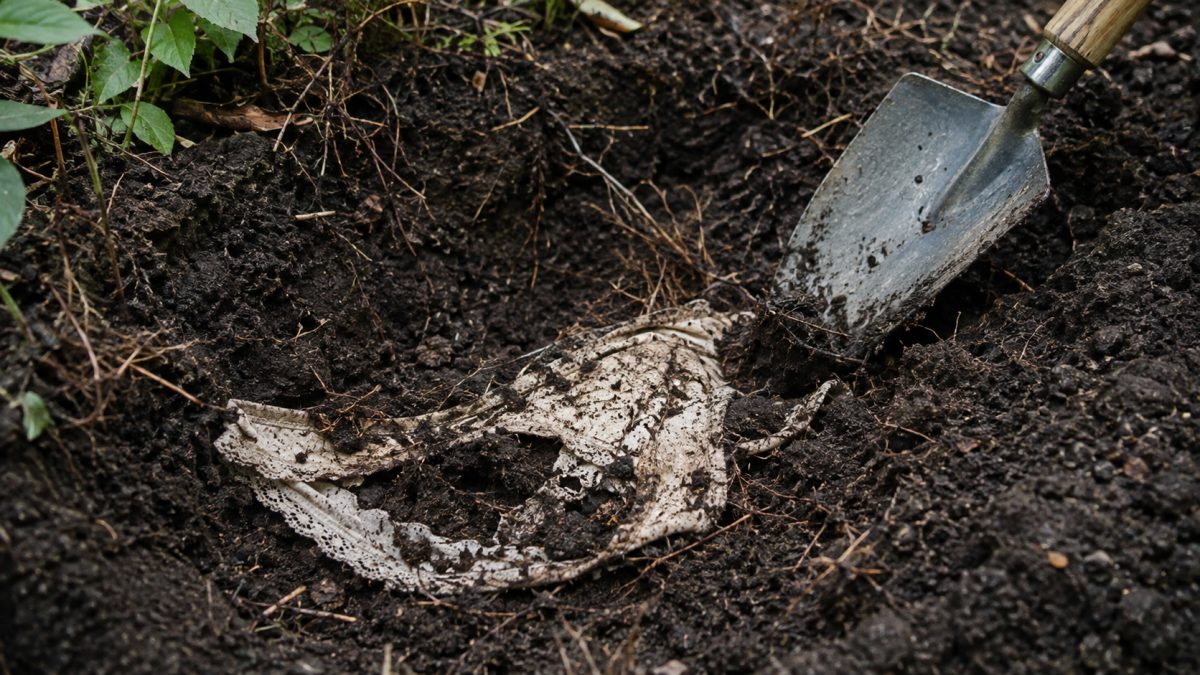
Does burying cotton underwear really reveal soil health?
There is something almost too perfect about this experiment: you bury a pair of white underwear, come back a few weeks later, and the condition of the fabric seems to tell the story of the hidden life beneath our feet. The more cotton has disappeared, the more “alive” the soil appears. It is a powerful, easy-to-understand image, and that is precisely why it can become misleading.
The test works well for showing one real thing: a soil’s ability, under given conditions, to break down cellulose. But this measurement alone does not sum up soil health. Heavily eaten-away underwear proves neither high overall fertility, nor the absence of pollution, nor good drought resistance. Above all, it shows that at the time and place of the test, organisms and favorable conditions allowed rapid decomposition.
What the microbes are really eating
Cotton is made mainly of cellulose, a complex carbohydrate that forms the structure of plant cell walls. Once buried, this cellulose becomes a source of carbon and energy. Soil bacteria and fungi produce enzymes capable of cutting long cellulose chains into smaller molecules, which are then metabolized or returned to the carbon cycle. Earthworms also contribute by physically fragmenting the material.
In other words, the underwear does not disappear because “the soil is good” in some general sense. It disappears because a community of organisms can process that material in the specific environment where it was buried.
That distinction matters, because decomposition speed depends on several factors. Fabric that remains almost intact may reflect low microbial abundance, but it can also result from a lack of moisture, unfavorable temperatures, limited organic matter availability, or other environmental conditions. A single result therefore cannot identify one unique cause.
An experiment turned into citizen science
The idea has been adopted in several countries. In Switzerland, the University of Zurich and Agroscope launched the citizen-science project Proof by Underpants in 2021. More than 1,000 volunteers took part, burying over 2,000 pieces of underwear at around 1,000 sites. Tea bags were also buried alongside them, and participants later sent the recovered objects to the laboratory together with a soil sample.
The value of this study lies in its scale. It made it possible to compare gardens, lawns, cropland and meadows. Land use emerged as the dominant factor in decomposition rate, more predictive than most of the measured physicochemical properties. Nutrient levels also played a significant role.
Figures published by Nautilus provide a vivid illustration: after two months, the average share of decomposed cotton reached 58% in private gardens and 40% in lawns. These precise values are not repeated in the other presentations of the same study, however, so they are better treated as an order of magnitude reported by that source rather than as a standalone benchmark to overinterpret.
The strongest result lies elsewhere: the way soil is used and managed clearly changes the biological activity that this test can reveal.
Why “eaten underwear = healthy soil” is an oversimplification
The problem starts when an indicator is turned into a verdict. Heavy decomposition shows substantial biological activity around a cellulose-rich material. It does not automatically tell us whether all useful soil functions are in good condition.
Fertility, for example, cannot be reduced to how quickly microbes consume cotton. The Swiss study itself shows that nutrients matter, but the test does not directly measure overall fertility. Pollution is even further removed from what it observes: none of the cited experiments presents the underwear as a contaminant test. The same caution applies to drought resistance: moisture directly affects decomposition, but that is not enough to measure a soil’s overall ability to withstand a dry spell.
These limitations are a logical consequence of what the protocol actually measures, not a condemnation of the experiment. In fact, the opposite is true: the test becomes more useful once we stop asking it to answer every question.
The trap of a single pair
The Australian trial conducted in Busselton illustrates the problem well. Seven pairs of underwear were distributed across five soil treatments, with three plots per treatment. Results varied greatly, including between plots receiving the same treatment.
Peter Clifton, program manager at South West NRM, drew a very practical conclusion: many more repetitions would have been needed to obtain more convincing results, at least three pairs per plot, or 45 in total for that setup. The message is almost more interesting than the photo of shredded underwear: a spectacular measurement still needs replication.
A pair buried in one corner of a garden can therefore tell you something about that particular corner. It does not necessarily describe the entire property. Two plots receiving the same treatment can also produce different results, as the Busselton trial showed.
How to turn the gimmick into a useful diagnostic
The test becomes much more valuable when treated as an initial indicator rather than a conclusion. Three useful additions emerge directly from the available experiments:
- Repeat the test in several places. Multiple burials show whether the result is consistent or highly variable. The Australian experiment shows why this replication is essential.
- Add another standardized material. In the Swiss study, tea bags were buried in parallel, and their decomposition was strongly correlated with that of the cotton. This provides a second point of comparison.
- Pair a soil sample with physicochemical measurements. The Swiss protocol did more than photograph underwear: the samples were also used to characterize the soils, including their properties and nutrient levels.
It also helps to record the burial duration precisely and avoid comparing different protocols as though they were equivalent. In Switzerland, the described duration was 30 or 60 days; in Australia, some trials lasted eight to eleven weeks; in the US Buzz on the Range program, the recommendation exceeds 90 days, with burial at about three inches. These differences make direct comparisons difficult.
An excellent thermometer, not a complete health check
The buried-underwear test succeeds because of its visual impact. A laboratory analysis needs numbers; a missing piece of cotton communicates instantly. It is a remarkable awareness tool because it makes visible underground activity that would normally remain completely out of sight.
But the metaphor needs to stay accurate. A thermometer can signal that something is happening in an organism; it does not replace a complete diagnosis. The underwear plays a similar role for soil. It shows biological decomposition activity in a given context. It can reveal differences between land uses, draw attention to a low-activity area, or encourage further measurement.
What it should not be asked to provide is a certificate of “good soil.” The real lesson of this experiment is therefore not that microbes love our underwear. It is that a simple indicator becomes scientific only when we know exactly what it measures, what makes it vary, and what it cannot prove.