
 English
  French
  German
  Spanish
  Hindi
Hindi  Italian
  Japanese
  Korean
  Norwegian
  Chinese
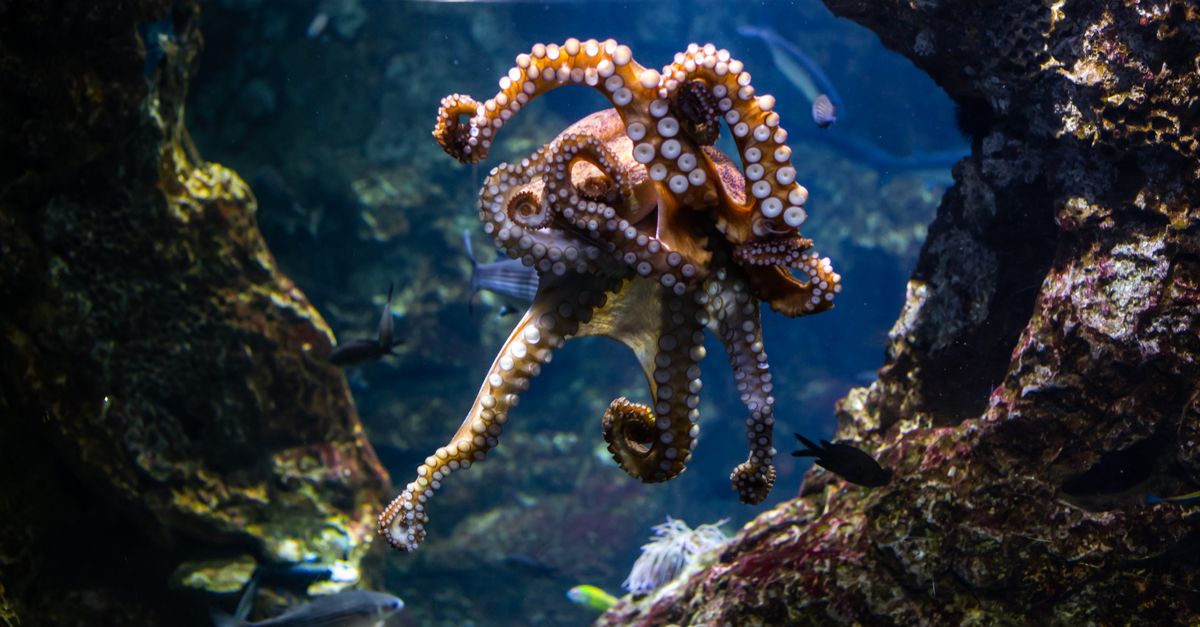
Octopuses Change Color While Sleeping. Do They Dream?
It is one in the morning in a laboratory at the Okinawa Institute of Science and Technology (OIST). An octopus is asleep in its tank. Suddenly, something strange happens: its skin, a dull gray only seconds earlier, begins to flash. Dark patches spread across its sides, golden reflections ripple along its arms, and a camouflage pattern appears before vanishing within seconds. Then everything becomes calm again. The octopus is still asleep.
What happens in the head—or rather, in the arms—of this animal while it sleeps? Does it dream? A few decades ago, the question would have seemed absurd. It has become one of the most fascinating questions in modern neurology.
A study that changes how we see sleep
In June 2023, a team of researchers from OIST and the University of Washington published in the journal Nature the results of a study on sleep in the species Octopus laqueus. What they discovered challenges established assumptions: octopuses pass through two clearly distinct phases of sleep, much like the ones mammals—including us—experience every night.
The first phase is quiet. The octopus remains still, its skin takes on a uniform shade, and its neural activity slows. This is also what is observed in humans during non-REM sleep, the so-called “slow” phase.
Then, about once an hour, everything changes. For one to two minutes, the octopus's arms twitch slightly, its eyes move beneath half-closed lids, its breathing quickens, and its skin begins producing fleeting colored patterns. At the same time, electrophysiological recordings of the brain reveal neural activity very close to the waking state—particularly in the superior frontal and vertical lobes, regions associated with learning and memory.
This phase matches, feature for feature, what we call REM sleep in mammals (for Rapid Eye Movement, also known as paradoxical sleep). This is the phase during which humans dream.
Five hundred million years apart—and yet
What makes this discovery philosophically dizzying is the evolutionary distance separating octopuses from humans. Our last common ancestors lived roughly 500 to 550 million years ago. They were probably small marine worms with no true brain, no complex memory, and nothing remotely resembling what we call an inner life.
Since that split, the two lineages have evolved entirely independently. Vertebrates built a centralized, hierarchical brain with a cortex. Cephalopods took a radically different path: the octopus has around 500 million neurons, but two-thirds of them are not in its central brain. They are distributed through its arms. Each arm is, in a sense, a semi-autonomous entity capable of making certain motor decisions without consulting the command center.
And yet both lineages arrived at the same result: two-phase sleep, including a period of intense activity resembling wakefulness. This phenomenon of convergent evolution—when two very distant species independently develop the same solution to a problem—suggests that this kind of sleep is not an accident. It may serve an essential function, perhaps in memory consolidation or in processing the day's experiences.
Do they really dream?
The question remains open—and scientists are cautious. Saying that an octopus “dreams” implies assuming that it has some form of subjective experience, an inner life. This is where neuroscience reaches its current limits.
What can be stated is that during the active phase of sleep, octopuses display all the behavioral and neural correlates associated with dreaming in mammals: brain activity resembling wakefulness, involuntary muscle movements, and rapid changes in skin patterns. These colored skin changes are especially intriguing: they seem to reproduce entire sequences of camouflage or warning coloration, as though the animal were mentally replaying a hunt, an escape, or an interaction.
Sylvia Lima de Souza Medeiros, a Brazilian researcher who in 2019 filmed an octopus undergoing these colorful nocturnal episodes, observed: “We think she may have been reliving experiences from the day.” In 2023, the OIST data provided a neurological basis for that intuition.
What octopuses teach us about ourselves
There is something profoundly unsettling—in the best sense—about discovering that REM sleep is not exclusive to mammals. We already knew that birds and reptiles display simplified forms of this type of sleep. But octopuses, with their radically different neural architecture, add powerful evidence: active sleep is not an accident of vertebrate evolution. It may be a necessity for any form of complex cognition.
In other words, if you want to learn, remember, and adapt, perhaps you need to dream. And if octopuses dream, then dreaming is far older and far more universal than we once thought.
This is one of those discoveries that changes more than the way we see an animal. It changes how we think about what it means to have a brain, a memory, and perhaps an inner experience. Somewhere in the Okinawan night, an octopus with nine brains flashes softly in a tank. What is happening in its arms and frontal lobes remains mysterious. But the idea that it is going through something remotely similar to what we experience every night is no longer quite science fiction.