
 English
  French
  German
  Spanish
  Hindi
Hindi  Italian
  Japanese
  Korean
  Norwegian
  Chinese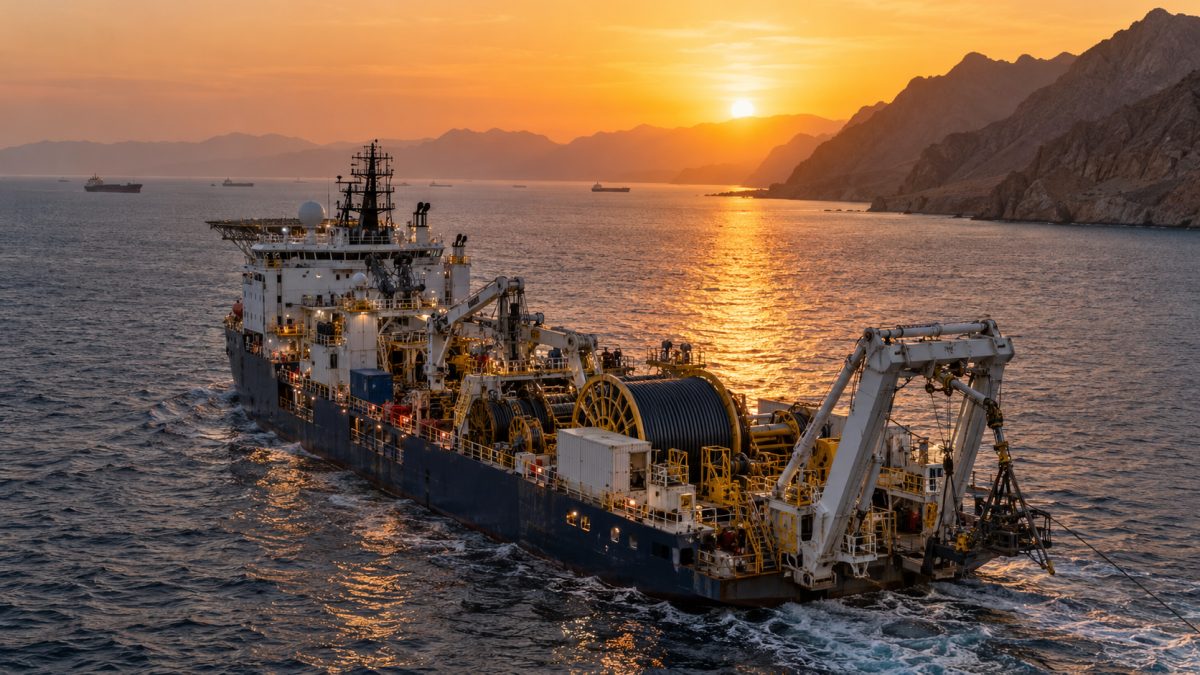
Submarine cables, the new oil of geopolitics
Submarine cables have become a military issue because the Internet depends on geographic passages that are as narrow and politically exposed as the old energy routes. In 2026, more than 90% of data capacity between Europe and Asia passes through Red Sea cables, according to Rest of World, while the Bab al-Mandab Strait is less than 32 kilometres wide.
What is at stake here therefore goes far beyond a network outage. For decades, we have spoken of the Internet as an almost immaterial space: the “cloud”, online services, instant exchanges. But beneath this airy vocabulary lies a much older reality: physical routes, territories, straits, rights of passage, and actors capable of protecting, blocking or bypassing them.
How can a war in Yemen slow down the Internet thousands of kilometres away?
The problem lies less in the total number of cables than in their concentration. Fibres and operators can be multiplied; if several routes cross the same narrow passage, their diversity is partly illusory. The Red Sea is now providing a real-world demonstration.
In 2024, three cables there were damaged, probably by the anchor of a cargo ship disabled after a Houthi missile attack. Then, on 6 September 2025, several cables — SMW4, IMEWE and FALCON GCX — were cut near Jeddah. The exact causes have not been established, and the Houthis deny any involvement. The technical consequences, however, are documented: Microsoft Azure reported increased latency and traffic rerouting, while disruptions affected India, Pakistan, the United Arab Emirates and Saudi Arabia, among others.
This is how a local conflict becomes a global problem: traffic does not necessarily disappear, but it has to take a longer or more expensive route. A measurement published by GeoCables in April 2026 illustrates the extreme end of this logic: between Tbilisi and Aden, Yemen, the observed route went through Frankfurt and then Starlink, with a minimum latency of 790 milliseconds.
And when a cable breaks in a contested area, the repair itself becomes political. Teams may need permits and security guarantees before working at sea, which can delay repairs for months.
Why are cables now following the logic of pipelines?
The parallel with oil is not merely a metaphor. Strategic infrastructure creates power precisely because it connects two places that need each other. Pipelines gave importance to the territory they crossed, the producing country, the port and the strait. Fibre optics recreates this geography with another commodity: the flow of information.
Perhaps the most revealing sign is not a cut, but what companies do to avoid one. Google bought a pair of fibres installed alongside Turkish state pipelines, agreeing to pay two to three times the usual rate. A pair of fibres on a new link crossing Turkey normally costs about €6 million, according to Rest of World. In other words, route security is becoming valuable enough to justify a geopolitical premium.
Iraq also wants to become a route. A contract with Qatari operator Ooredoo plans to carry data to Europe through an underground link from the port of Al-Faw. Google and Meta have already begun using live an Iraqi terrestrial route previously kept in reserve. Microsoft, meanwhile, plans more than $400 million in investment in submarine and terrestrial links in the Middle East by 2030.
This is where the parallel with the 20th century becomes interesting: when a strategic route becomes dangerous, it is not merely repaired. Another route is financed. Then the territories capable of hosting that route gain value. Finally, public and private powers seek to decide who may participate.
When does controlling the route amount to controlling part of the Internet?
This battle is not limited to the Middle East. Meta developed Bifrost with Keppel and Telin between Singapore and the US West Coast via Indonesia to bypass the South China Sea. Google and Meta also developed Echo between Eureka, California, and Singapore, with a successful landing in summer 2026. These choices were also shaped by repeated refusals by the US FCC to authorize direct cable links with Hong Kong.
Geopolitics therefore does not threaten cables only after they are laid: it shapes their routes before they even exist. The United States also uses trade rules as leverage. Since February 2025, the Agreements on Reciprocal Trade have included a clause allowing ICT suppliers deemed dangerous for submarine cables, satellites, and 5G or 6G networks to be excluded.
At the same time, infrastructure ownership is becoming concentrated. According to Global Voices, more than 600 submarine cables are active or planned worldwide, spanning more than 1.5 million kilometres, and Google, Amazon, Meta and Microsoft own more than 75% of the world's cables. The boundary between industrial policy, national security and commercial strategy then becomes particularly thin.
My observation is simple: we may be doing with data what the previous century did with energy. First, infrastructure is built to meet economic demand. Then, we discover that certain routes are vital. Finally, controlling them becomes an instrument of power. The cable is not the new oil because data is oil; it is because dependence on physical infrastructure produces the same instincts of securing, bypassing and exerting influence.
Can the Internet really be made less vulnerable?
There is no single solution. Adding cables in the same strait is not enough if all remain exposed to the same conflict. The emerging response combines terrestrial routes, new submarine paths and, in some cases, satellites capable of taking over.
But geographic redundancy comes at a cost and sometimes shifts risk rather than eliminating it. A route through another country becomes dependent on that country. A cable avoiding a contested sea may encounter more restrictive regulation elsewhere. A satellite can maintain a link, but the Tbilisi-Aden example shows that a detour can sharply increase latency.
True resilience therefore means preventing the same event from disabling several solutions at once. It is less spectacular than a military fleet, but probably just as strategic: diversify passages, technologies and jurisdictions. The Internet looks global, yet its robustness depends on very local decisions made on coasts, in ports and along terrestrial corridors.
Frequently asked questions
How can a conflict in Yemen slow down the Internet in Europe?
Because a large share of exchanges between Europe and Asia passes through the Red Sea and the Bab al-Mandab Strait. According to Rest of World, more than 90% of Europe-Asia capacity transits there in 2026, so a cut can force traffic onto longer routes and increase latency.
Why have submarine cables become strategic targets?
They concentrate an essential function in physical passages that are sometimes extremely narrow. Media linked to Iran's Revolutionary Guards, for example, published a map in 2026 of cables around the Strait of Hormuz, presenting them as vulnerable, showing that their strategic value is now explicitly part of the balance of power.
Did the Houthis cut the Red Sea cables?
This has not been established. The Houthis deny involvement in the September 2025 cuts and the exact causes remain unconfirmed; several hypotheses have circulated without decisive evidence.
What can be done if the Internet depends on conflict zones?
The answer is to genuinely diversify routes: cables through other seas, terrestrial corridors and backup satellite solutions. Investments by Google, Meta and Microsoft show that this diversification is already underway, but each new route in turn creates new geographic and political dependencies.