 English
  French
  German
  Spanish
  Hindi
Hindi  Italian
  Japanese
  Korean
  Norwegian
  Chinese
Singapore: self-sufficiency does not always mean security
There is an intuitive way to think about a country’s security: produce what you need yourself. Less dependence, therefore less vulnerability. The idea is politically powerful because it seems almost self-evident. Yet Singapore tells a more unsettling story. This city-state, severely constrained by its territory, has managed to make its water supply far more resilient without making total self-sufficiency its guiding principle. At the same time, it has discovered how costly the pursuit of food autonomy can become when geography works against it.
The real lesson is therefore not “we must import” or “we must produce at home.” It is more demanding: the security of a resource depends less on where it comes from than on the ability to prevent a single failure from bringing everything to a halt. This is precisely the kind of question France will increasingly have to ask itself about water, energy and food.
Singapore’s water: securing supply without locking itself in
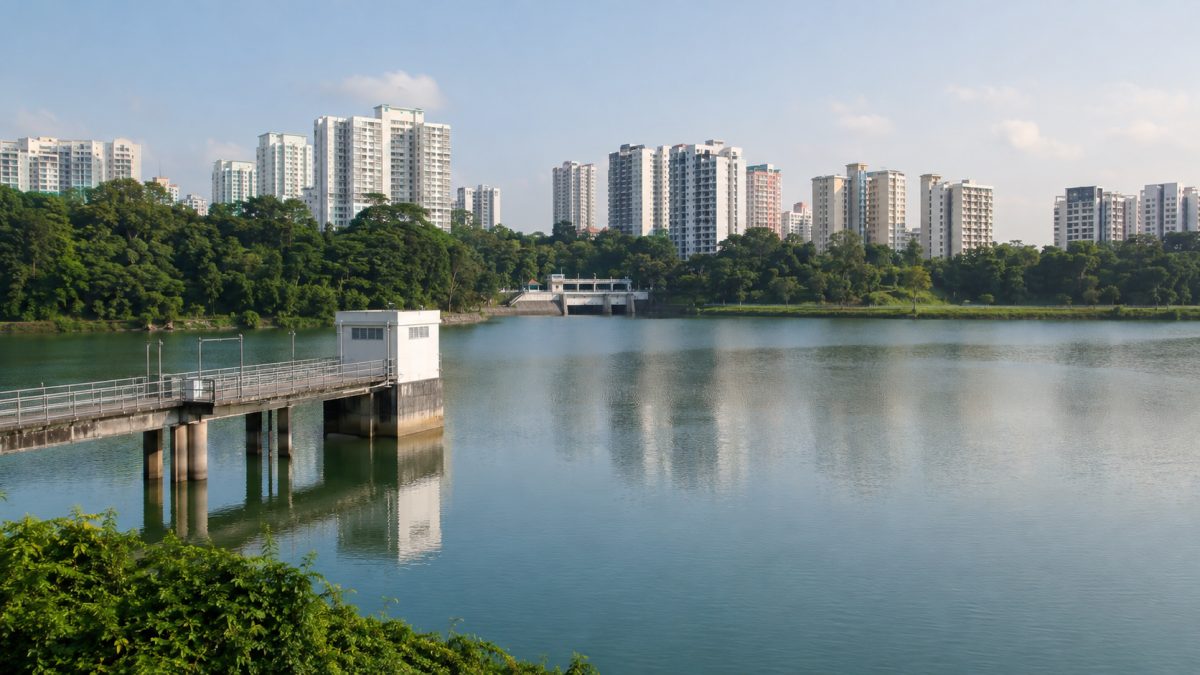
Singapore starts from an almost caricatural situation. The country has neither major rivers, nor glaciers, nor abundant natural reserves. Even rainwater storage is limited by the size of its territory. Rather than trying to eliminate all external dependence, the country built its system around four complementary sources, the “Four National Taps”: local catchment water, imported water, recycled NEWater and desalination.
Local catchment is pushed very far: around two-thirds of the territory serves as a water catchment area, with some 8,000 kilometres of canals and drains carrying rainwater to 17 reservoirs. But Singapore also continues to import raw water from Johor, Malaysia, under an agreement signed in 1962 and valid until 2061. The agreement allows up to 250 million gallons per day.
Alongside this accepted dependence are two sources designed to better withstand weather variability. NEWater, launched in 2002, relies in particular on microfiltration, reverse osmosis and disinfection. The process has undergone more than 150,000 scientific tests. The country also has five reverse-osmosis desalination plants, including the Jurong Island plant opened in April 2022.
This system is interesting because it does not seek doctrinal purity. It combines a local resource, a cross-border import and two industrial technologies. Each source has its own constraints, but their combination reduces the risk that a single problem becomes existential.
Security is not necessarily the absence of dependence. It can be the absence of a single dependency.
Food shows the other side of the problem
The contrast is striking. Singapore imports more than 90% of its food from 187 countries and regions. Yet in the 1980s, the country had achieved self-sufficiency in eggs, poultry and pork. But land scarcity gradually reduced the number of farms. Today, around 1% of the territory is devoted to agriculture.
Faced with this vulnerability, the government launched the “30 by 30” goal in 2019: to produce 30% of nutritional needs locally by 2030. The ambition was appealing. It responded to an understandable fear: that an external shock could cut off supplies. The war between Russia and Ukraine has also shown how interconnected food chains are. Singapore did not import its eggs directly from either country, but rising poultry-feed costs still pushed up their price.
The problem is that a security policy can itself create costs and vulnerabilities. Several local farms, including agri-tech companies such as I.F.F.I and VertiVegies, have closed. After a review, Singapore dropped the “30 by 30” target in favour of more differentiated goals for 2035: 20% local production for “fibre” and 30% for “protein.”
The 2024 figures show why the issue is difficult. Local production accounted for 8% of the fibre category and 26% of the protein category. In detail, only 3% of vegetables consumed were grown locally, compared with 34.4% of eggs and 6.1% of seafood. In other words, even within an autonomy target, not all types of production are equal.
The trap of “producing everything at home”
Brunei offers another warning. Despite years of investment aimed at developing rice self-sufficiency, the locally produced share rose only from 4.8% in 2017 to 8% in 2024. Economist Peter A. Coclanis stresses a point often missing from public debate: strategies that give absolute priority to security can overlook opportunity cost, meaning what is given up when capital, land or labour is mobilised to produce locally something that could be obtained more efficiently in another way.
This is where the word “self-sufficiency” becomes misleading. It blends two different goals: being able to survive a disruption and permanently producing the entirety of one’s consumption. The first can justify stockpiles, backup capacity, a minimum level of domestic production or multiple suppliers. The second can lead to scarce resources being devoted to an activity that is structurally costly.
The real question for France: what dependence are we willing to accept?
The French case cannot simply be copied from Singapore. The territories, resources and economies are too different. But the framework for thinking can be transferred. For each critical resource, we should stop mechanically opposing independence and dependence, and instead ask three questions: how many sources do we have, which of them can fail at the same time, and what price are we willing to pay for backup capacity?
For water, this means distinguishing the natural resource itself from the resilience of the system that captures, treats, recycles and distributes it. For energy, it means separating the desire to produce more domestically from the need to retain several supply routes. For food, it requires distinguishing strategic production from areas where trade remains more efficient.
This framework imposes no single answer. Above all, it avoids a dangerous reflex: believing that a resource is secure simply because it is domestic. Domestic production concentrated in a single region, dependent on the same input or the same technology, may be less resilient than supply spread across several origins.
Conversely, economic efficiency must not be used as a pretext for blind dependence. A cheap supply chain with no fallback can become extremely costly the day it breaks. The Singaporean lesson is therefore less liberal than it may appear: diversification requires infrastructure, heavy investment and sometimes capacity that is not the cheapest in day-to-day operation.
The most useful sovereignty may not be autarky
Singapore has not eliminated its vulnerabilities. It has spread them out. Its water system combines territory, international cooperation, recycling and desalination. Its food system, meanwhile, shows the opposite limit: wanting to reduce dependence is not enough to make large-scale local production economically viable.
For France, the relevant choice will probably not be between “make everything here” and “buy everything elsewhere.” It will be to decide, resource by resource, what share must absolutely be capable of being secured locally, what share can be diversified abroad, and what replacement capacity must exist before a crisis.
That is less spectacular than a slogan about self-sufficiency. But it may be a stronger definition of sovereignty: not living without others, but remaining able to choose when one of them is missing.