

Would the nutritional value of our food change over time?
Is our food becoming less nutritious over time?
In the Veritasium video below, Derek Muller tells us that he investigated the topic.
I personally found this information interesting, so I will try to summarize it all as best I can.
According to a report published in 2004 (Changes in USDA Food Composition Data for 43 Garden Crops, 1950 to 1999), between 1950 and 1999 in the USA, the intake of protein would have decreased by 6%, vitamin C by 15%, as well as other minerals and vitamins.
However, these figures remain approximate, because it is difficult to certify that they reflect the overall reality, since only 43 crops were tested and these tests date back several decades. That said, we can still infer that the nutritional value of food is decreasing.
Other more recent studies confirm the phenomenon:
Where does this decline come from?
At first glance, one recurring argument concerns the depletion of soil after multiple harvests that “wear out” the soil.
However, farmers use all kinds of fertilizers to compensate and make sure plants do not lack anything. Moreover, if the soil really no longer had enough potential, food could no longer grow.
Another possibility would be the manual selection of species and plant variations.
One could suppose that farmers and agricultural researchers focus on plants that look as good as possible or resist certain pests better. This could have the side effect of indirectly selecting those with poor nutritional value.
To make sure this hypothesis was not valid, researchers checked plants that are not cultivated, such as goldenrod, which is an important source of protein for bees but has never been cultivated for humans. So the plants should have remained untouched.
The Smithsonian Institute has preserved hundreds of goldenrod samples since 1942, so it was possible to compare the nutritional value of goldenrod from more than 50 years ago with those collected today. They concluded that its nutritional value had fallen sharply, estimated at 30% over 100 years.
So even a plant ignored by humans has lost nutritional value over time.
The current scientific conclusion
Knowing that carbon dioxide is a primary source of food for plants and that in recent years the CO2 level has increased very significantly, it could be an important factor in the phenomenon.
A study revealed, unsurprisingly, that by injecting CO2 into plants, they grew much more than without this injection.
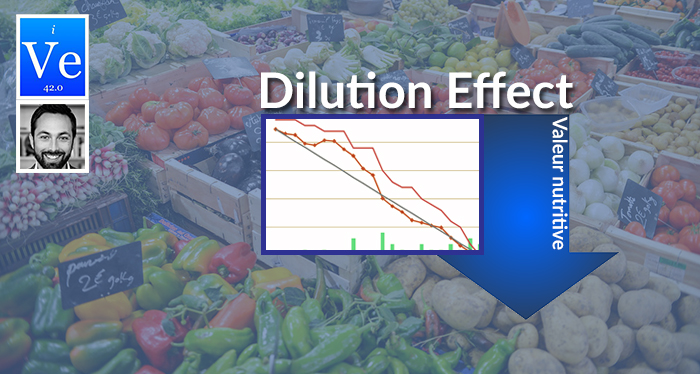
That said, a plant that grows taller and faster does not necessarily mean it will be more nutritious. They also observed that the nutritional value of the same food grown more slowly would be higher than with more CO2. This phenomenon is called “the dilution effect”; in short, the more surface area there is, the fewer nutrients there are.
According to Derek Muller, the current scientific conclusion would be that the CO2 level is increasing, which lowers the nutritional value of food through the dilution effect.
So the more CO2 we have in the atmosphere, the more food we will need to eat to meet our protein needs, which could also result in obesity problems.
Would the nutritional value of our food change over time?
Is our food becoming less nutritious over time?
In the Veritasium video below, Derek Muller tells us that he investigated the topic.
I personally found this information interesting, so I will try to summarize it all as best I can.
According to a report published in 2004 (Changes in USDA Food Composition Data for 43 Garden Crops, 1950 to 1999), between 1950 and 1999 in the USA, the intake of protein would have decreased by 6%, vitamin C by 15%, as well as other minerals and vitamins.
However, these figures remain approximate, because it is difficult to certify that they reflect the overall reality, since only 43 crops were tested and these tests date back several decades. That said, we can still infer that the nutritional value of food is decreasing.
Other more recent studies confirm the phenomenon:
Where does this decline come from?
At first glance, one recurring argument concerns the depletion of soil after multiple harvests that “wear out” the soil.
However, farmers use all kinds of fertilizers to compensate and make sure plants do not lack anything. Moreover, if the soil really no longer had enough potential, food could no longer grow.
Another possibility would be the manual selection of species and plant variations.
One could suppose that farmers and agricultural researchers focus on plants that look as good as possible or resist certain pests better. This could have the side effect of indirectly selecting those with poor nutritional value.
To make sure this hypothesis was not valid, researchers checked plants that are not cultivated, such as goldenrod, which is an important source of protein for bees but has never been cultivated for humans. So the plants should have remained untouched.
The Smithsonian Institute has preserved hundreds of goldenrod samples since 1942, so it was possible to compare the nutritional value of goldenrod from more than 50 years ago with those collected today. They concluded that its nutritional value had fallen sharply, estimated at 30% over 100 years.
So even a plant ignored by humans has lost nutritional value over time.
The current scientific conclusion
Knowing that carbon dioxide is a primary source of food for plants and that in recent years the CO2 level has increased very significantly, it could be an important factor in the phenomenon.
A study revealed, unsurprisingly, that by injecting CO2 into plants, they grew much more than without this injection.
That said, a plant that grows taller and faster does not necessarily mean it will be more nutritious. They also observed that the nutritional value of the same food grown more slowly would be higher than with more CO2. This phenomenon is called “the dilution effect”; in short, the more surface area there is, the fewer nutrients there are.
According to Derek Muller, the current scientific conclusion would be that the CO2 level is increasing, which lowers the nutritional value of food through the dilution effect.
So the more CO2 we have in the atmosphere, the more food we will need to eat to meet our protein needs, which could also result in obesity problems.
Would the nutritional value of our food change over time?
Is our food becoming less nutritious over time?
In the Veritasium video below, Derek Muller tells us that he investigated the topic.
I personally found this information interesting, so I will try to summarize it all as best I can.
According to a report published in 2004 (Changes in USDA Food Composition Data for 43 Garden Crops, 1950 to 1999), between 1950 and 1999 in the USA, the intake of protein would have decreased by 6%, vitamin C by 15%, as well as other minerals and vitamins.
However, these figures remain approximate, because it is difficult to certify that they reflect the overall reality, since only 43 crops were tested and these tests date back several decades. That said, we can still infer that the nutritional value of food is decreasing.
Other more recent studies confirm the phenomenon:
Where does this decline come from?
At first glance, one recurring argument concerns the depletion of soil after multiple harvests that “wear out” the soil.
However, farmers use all kinds of fertilizers to compensate and make sure plants do not lack anything. Moreover, if the soil really no longer had enough potential, food could no longer grow.
Another possibility would be the manual selection of species and plant variations.
One could suppose that farmers and agricultural researchers focus on plants that look as good as possible or resist certain pests better. This could have the side effect of indirectly selecting those with poor nutritional value.
To make sure this hypothesis was not valid, researchers checked plants that are not cultivated, such as goldenrod, which is an important source of protein for bees but has never been cultivated for humans. So the plants should have remained untouched.
The Smithsonian Institute has preserved hundreds of goldenrod samples since 1942, so it was possible to compare the nutritional value of goldenrod from more than 50 years ago with those collected today. They concluded that its nutritional value had fallen sharply, estimated at 30% over 100 years.
So even a plant ignored by humans has lost nutritional value over time.
The current scientific conclusion
Knowing that carbon dioxide is a primary source of food for plants and that in recent years the CO2 level has increased very significantly, it could be an important factor in the phenomenon.
A study revealed, unsurprisingly, that by injecting CO2 into plants, they grew much more than without this injection.
That said, a plant that grows taller and faster does not necessarily mean it will be more nutritious. They also observed that the nutritional value of the same food grown more slowly would be higher than with more CO2. This phenomenon is called “the dilution effect”; in short, the more surface area there is, the fewer nutrients there are.
According to Derek Muller, the current scientific conclusion would be that the CO2 level is increasing, which lowers the nutritional value of food through the dilution effect.
So the more CO2 we have in the atmosphere, the more food we will need to eat to meet our protein needs, which could also result in obesity problems.
English
French
Spanish
Chinese
Japanese
Korean
Hindi
German
Norwegian